
Ukrainian Drones Strike Rosneft Refineries as Fuel Crisis Deepens
Ukrainian drone strikes hit two Rosneft refineries in Krasnodar and Samara on Saturday, igniting fires and injuring five as Kyiv's campaign against Russia's energy infrastructure deepens the country's fuel crisis.
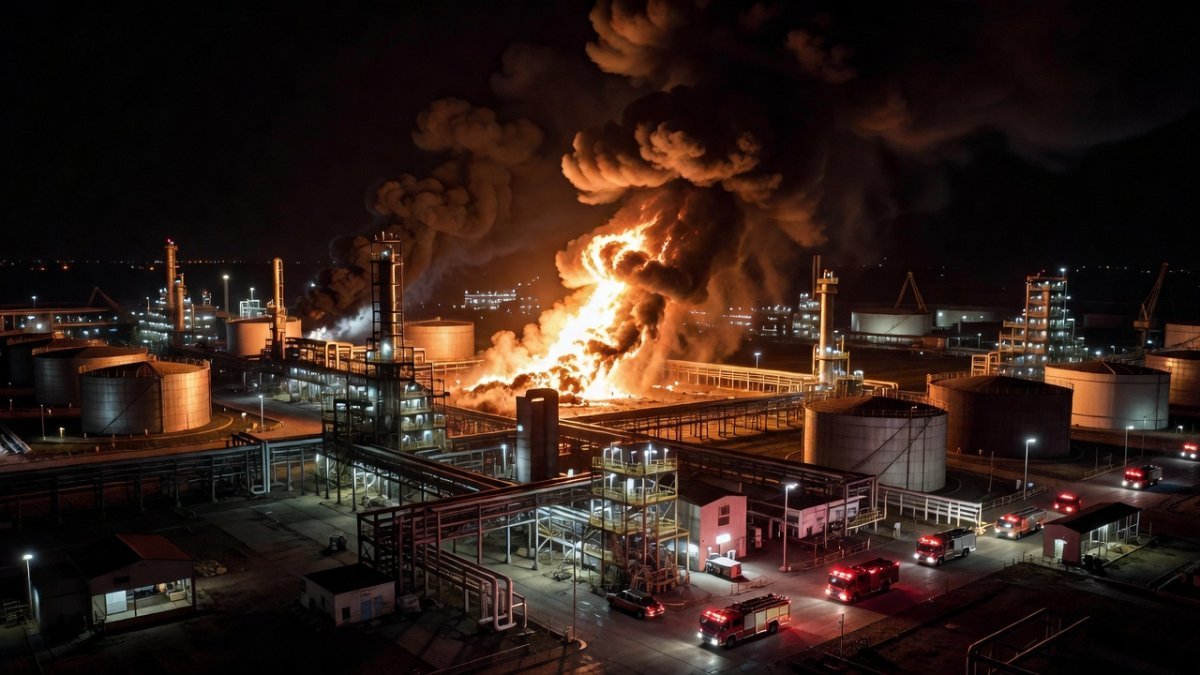
Ukrainian forces carried out coordinated drone strikes on two major Russian oil refineries early Saturday morning, hitting facilities in the Krasnodar and Samara regions as part of an ongoing campaign against Moscow's energy infrastructure. The attacks come amid a deepening nationwide fuel shortage that has already prompted emergency measures from the Russian government. Local officials and independent monitors confirmed fires and damage at both sites.
Ukrainian Drones Strike Rosneft Refineries in Krasnodar and Samara as Fuel Crisis Intensifies
Moscow, Russia - Aug. 8, 2026 — Ukrainian attack drones struck the Ilsky Oil Refinery in Krasnodar region and the Syzran Oil Refinery in Samara region overnight on Saturday, according to statements from both sides and independent verification. The operations targeted facilities that supply petroleum products to Russian military and civilian sectors. Russia's Defense Ministry reported intercepting hundreds of drones across multiple regions during the same period.
Ilsky Refinery Hit in Krasnodar Region
Local authorities in Krasnodar stated that debris from a Ukrainian drone caused a fire at the Ilsky Oil Refinery, which was later extinguished. Five people sustained injuries at the plant and received medical treatment. The facility operates six processing units with a total annual capacity of approximately 6.6 million tons of oil and handles hydrocarbon feedstock for petroleum products.
The Ilsky refinery serves as a key supplier of fuel for Russian armed forces operations, according to Ukraine's General Staff. Residents in the area reported the incident early Saturday, with emergency services responding to contain the blaze.
Damage assessments indicate the strike disrupted processing capacity at a site that receives and ships refined outputs essential for regional distribution networks. The incident aligns with patterns of targeting infrastructure nodes that sustain both military logistics and civilian supply chains in southern Russia.
Syzran Facility Damaged in Samara Region
Residents in Samara reported at least ten explosions between 3:50 a.m. and 4:30 a.m. local time, followed by a thick column of black smoke from the Syzran Oil Refinery. Independent OSINT analysis by Astra confirmed the fire at the site. The refinery belongs to the Rosneft group and processes between 8.5 and 8.9 million tons of oil annually, producing more than 20 types of petroleum products including motor fuels and road bitumen.
Samara region Governor Vyacheslav Fedorishchev acknowledged a drone attack on one of the region's industrial enterprises but provided no further details on the facility or damage extent. The Syzran plant ranks among the key oil refining operations in the Samara region.
The facility's output supports multiple sectors, making its temporary impairment a factor in broader supply constraints reported across central Russia. Independent verification of the blaze underscores the precision of the strike on a Rosneft asset with significant throughput.
Ukrainian General Staff Details Coordinated Operation
Ukraine's General Staff confirmed strikes on the Ilsky refinery, the Syzran refinery, and the Sivash jack-up drilling rig in the Black Sea. Operators from the Main Intelligence Directorate's Department of Active Operations and Department of Unmanned Systems carried out the deep-strike mission. Ukrainian President Volodymyr Zelensky has described such actions as long-range sanctions on Russian energy capabilities.
Al Jazeera reported that Ukraine's 40-day strike campaign has now targeted 14 refineries, several oil depots and loading terminals, 14 aircraft, and four airfields. Both refineries struck on Saturday function as critical suppliers of fuel and petroleum products for Russian military needs, according to the General Staff statement.
The inclusion of the Sivash rig extends the operation beyond land-based targets, illustrating an integrated approach to degrading Russian energy extraction and refining capacity. This coordinated effort reflects sustained focus on assets tied directly to armed forces sustainment.
Russian Air Defenses Intercept Hundreds of Drones
Russia's Defense Ministry stated that air defenses destroyed 397 fixed-wing Ukrainian drones overnight across more than a dozen regions. The affected areas included Belgorod, Bryansk, Voronezh, Kursk, Lipetsk, Oryol, Penza, Rostov, Ryazan, Samara, Saratov, Tambov, and Tula, as well as occupied Crimea and the Sea of Azov. Reuters could not independently verify reports from either side.
The ministry's figures reflect the scale of Ukrainian drone activity reported in recent weeks. Russian officials have not released detailed assessments of damage at the targeted refineries beyond initial local statements.
Interceptions across such a wide geographic spread highlight the dispersed nature of the assault and the strain on defensive resources. The absence of granular damage reports leaves open questions about the full operational impact on affected sites.
Broader Fuel Shortage Affects Russian Regions
Since August 2025, repeated Ukrainian strikes on Russian oil refineries have reduced refined products output and triggered a nationwide fuel crisis. The situation escalated in mid-2026, with Russian-controlled Crimea declaring a state of emergency in June and reports of long queues and rationing at gas stations across affected areas. The strikes have disrupted supply chains that normally support both civilian and military demand.
Ordinary Russians in multiple regions have faced higher costs and limited availability at pumps. The crisis has strained logistics in southern and central areas where refined fuel distribution depends on facilities like those in Krasnodar and Samara.
Reduced output from key refineries has compounded shortages that began more than a year ago, affecting transportation and industrial activity far from the conflict zone. The pattern of disruptions points to cumulative effects on Russia's domestic energy balance.
Government Authorizes Lower-Grade Fuel Production
On August 6, Prime Minister Mikhail Mishustin signed a decree authorizing the temporary production, import, and sale of low-grade gasoline meeting Euro-2, Euro-3, and Euro-4 standards through July 1, 2027. Officials framed the measure as an anti-crisis response to the fuel shortage. Russia had banned Euro-2 fuel in 2013 and completed its transition to cleaner Euro-5 standards in 2016, with Euro-2 permitting up to 50 times more sulfur content than current requirements.
The government also extended a ban on gasoline and diesel exports through the end of January 2027. Average gasoline prices in Russia have risen 17.7 percent since the start of the year, standing at 77.69 rubles per liter as of August 3.
Reintroduction of lower-standard fuels represents a reversal of long-standing environmental policies aimed at reducing emissions. The price increase and export restrictions together signal acute pressure on domestic availability and government efforts to stabilize markets.
Additional Strike Reported Far From Front Lines
On Friday, August 7, a Ukrainian drone struck a Wildberries warehouse in Yekaterinburg, more than 2,000 kilometers from the Ukrainian border. The incident sparked a fire, led to the evacuation of about 800 employees, and prompted brief flight restrictions at Koltsovo Airport. The attack demonstrated the reach of Ukrainian unmanned systems into Russia's interior.
EU and NATO officials have monitored the pattern of strikes on Russian energy assets without direct comment on the latest incidents. Ukrainian authorities continue to link the operations to efforts to degrade Moscow's logistical support for its military campaign.
The warehouse incident illustrates how strikes extend beyond energy targets to commercial infrastructure, amplifying economic ripple effects in distant regions. Such reach challenges assumptions about the geographic limits of Ukrainian operational capabilities.
Analysis and Implications
Analysts suggest the coordinated strikes on major refineries could indicate Ukraine's intent to sustain pressure on Russia's energy sector even as Moscow adjusts production standards to mitigate shortages. This approach may aim to compound existing supply constraints that have already forced policy reversals on fuel quality and export controls.
The geographic spread of drone activity, including incidents far from the border, could point to an evolving strategy that tests Russian air defenses across multiple fronts. Observers note that repeated targeting of Rosneft facilities and related infrastructure might gradually erode the logistical backbone supporting military operations.
These developments could signal a shift toward deeper economic strain within Russia, where fuel price rises and emergency measures reflect broader vulnerabilities. The pattern underscores how sustained deep-strike operations might influence both battlefield sustainment and domestic stability over the longer term.
By Irina Volkov, Staff Writer
This article was produced with AI-assisted research and editorial support. Reporting is based on sources cited in the article.
What's Your Reaction?
 Like
0
Like
0
 Dislike
0
Dislike
0
 Love
0
Love
0
 Funny
0
Funny
0
 Wow
0
Wow
0
 Sad
0
Sad
0
 Angry
0
Angry
0

Russia/Eastern Europe Correspondent at Global1.News. Covering Russian politics, energy, security, and the shifting dynamics of the post-Soviet space. Provides clear-eyed analysis on one of the world's most opaque regions.















Comments (0)