
Trump Sends Witkoff and Kushner to Moscow and Kyiv in High-Stakes Push to End Ukraine War
The United States is making its most direct intervention yet in the stalled Ukraine peace process, dispatching President Donald Trump’s two most trusted envoys to meet with the leaders of both Russia and Ukraine this weekend in a bid to break a diplomatic deadlock that has persisted for months.
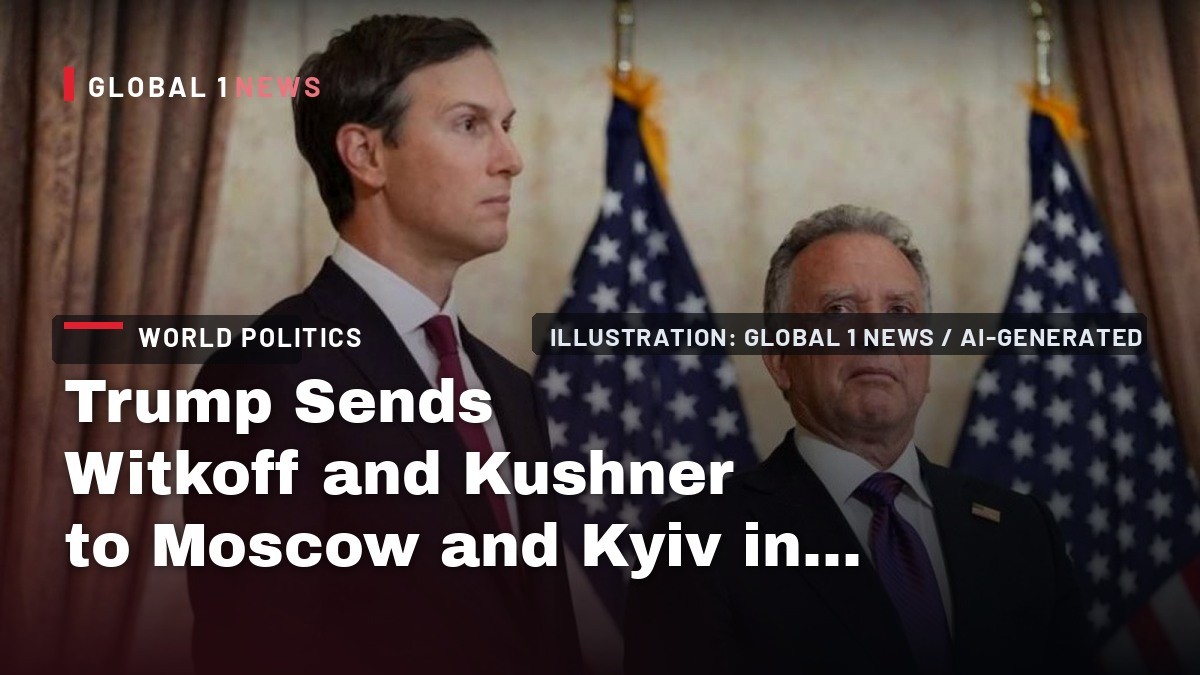
The United States is making its most direct intervention yet in the stalled Ukraine peace process, dispatching President Donald Trump’s two most trusted envoys to meet with the leaders of both Russia and Ukraine this weekend in a bid to break a diplomatic deadlock that has persisted for months. Steve Witkoff and Jared Kushner are scheduled to hold talks with Russian President Vladimir Putin in Moscow on Saturday before traveling to Kyiv for discussions with Ukrainian President Volodymyr Zelensky on Sunday, according to Axios and confirmed by Trump himself.
Trump’s top envoys jet to Moscow and Kyiv as Washington seeks a breakthrough in the five-year war, with Beijing watching closely as a potential kingmaker.
Beijing — The carefully choreographed shuttle diplomacy marks the first visit by either Witkoff or Kushner to Ukraine since Trump returned to the White House, and it comes at a moment when the geopolitical landscape has shifted dramatically. US-mediated peace efforts were effectively frozen in February 2026 following the outbreak of the US-Israeli war with Iran, and the two envoys have since held only separate, unproductive discussions with Russian and Ukrainian negotiators. Now, with the conflict entering its fifth year and Russia controlling roughly 20 percent of Ukrainian territory, Washington is turning to direct presidential-level engagement — and, increasingly, to Beijing — to find a path toward ending Europe’s largest armed conflict since 1945.
A Weekend of High-Stakes Diplomacy
According to Axios, which cited US officials, Witkoff — Trump’s special envoy — and Kushner, the president’s son-in-law and senior adviser, departed for Moscow on Friday, September 4. Their itinerary is precise: a meeting with Putin in the Russian capital on Saturday, September 5, followed by a journey to Kyiv for talks with Zelensky on Sunday, September 6. Trump confirmed the trip in the Oval Office on Friday, stating that he had dispatched the pair to determine whether genuine progress could be made toward a settlement between the two warring presidents.
The timing is notable. The visit comes just days after CIA Director John Ratcliffe traveled to Moscow to discuss restarting diplomatic efforts, including the possibility of a Trump-Putin-Zelensky summit. It also follows a period of intense behind-the-scenes maneuvering in which Witkoff and Kushner have maintained separate channels with Russian and Ukrainian negotiators, though with little tangible result. The fact that both envoys are now traveling together, in sequence, to both capitals signals a coordinated American attempt to bridge the vast gap between Moscow’s and Kyiv’s positions.
Zelensky’s Cautious Welcome and Call for Restraint
Zelensky confirmed the planned meetings in a post on X, stating that Ukrainian authorities were preparing for the American delegation. His message was measured but pointed. The Ukrainian president called for reciprocal restraint — specifically, no air strikes from either side for the duration needed to hold the talks and manage logistics. He framed Kyiv’s objective as making the visit and discussions “as constructive and substantive as possible” while identifying “real options” for moving the war toward an end.
Notably, Zelensky suggested that September could bring significant changes, a hint of cautious optimism that stands in contrast to the grim realities on the ground. Around the time the envoys’ arrival was being arranged, reports emerged of a drone attack near Kyiv’s Zhulyany airport, though information that the envoys were to arrive by plane remained officially unconfirmed. The incident, if verified, would underscore the fragility of any diplomatic window in a war marked by near-daily aerial bombardments.
Putin’s Pragmatic Signal from Vladivostok
Putin, for his part, has already signaled a degree of openness. Speaking at the Eastern Economic Forum in Vladivostok, Russia’s premier economic gathering in the Far East, the Russian leader acknowledged the possibility of a settlement. He noted that several countries, including the United States and China, were ready to support a peace deal. Yet he attached a critical caveat: the matter ultimately had to be resolved by Russia and Ukraine, the two countries directly involved.
That formulation is classic Putin — accepting of external mediation in principle while reserving ultimate control over outcomes. It also serves a dual purpose: it keeps Washington and Beijing engaged as potential guarantors while denying them any formal role in dictating terms. For Moscow, the war remains a bilateral issue with Ukraine, even as its economy grows increasingly dependent on Chinese support and its diplomatic isolation deepens.
The Intelligence View: A Long Road to Ceasefire
Not everyone shares the optimism emanating from Washington and Moscow. Kyrylo Budanov, Zelensky’s chief of staff and former military intelligence chief, offered a sobering assessment in an interview with The New York Times. Budanov said that while US-mediated talks could resume in September, conditions for a ceasefire were unlikely to emerge before spring 2027. He stressed that Ukraine must keep diplomatic channels open even while fighting continues, offering a stark rationale: “the war cannot be eternal.”
Budanov’s timeline — nearly a year away for any realistic ceasefire — suggests that this weekend’s meetings are likely to be exploratory rather than decisive. His comments reflect a broader Ukrainian wariness that Washington’s enthusiasm for a deal may outpace Kyiv’s security requirements. For Ukraine, any settlement must address territorial integrity, security guarantees, and the future of Russian-occupied lands. For Russia, the calculus revolves around retaining its gains and preventing Ukraine’s integration into Western security structures. These positions remain fundamentally irreconcilable in the short term.
Beijing’s Central Role: Leverage, Neutrality, and the APEC Factor
While Witkoff and Kushner focus on Moscow and Kyiv, the most consequential player in this diplomatic drama may be watching from Beijing. At the two-day Trump-Xi summit held in the Chinese capital on May 14-15, 2026, Trump personally urged Xi Jinping to help end the Ukraine war, pressing Beijing to use its leverage over Moscow to bring Putin back to the negotiating table with Zelensky, according to the South China Morning Post, which cited multiple people familiar with the talks.
That appeal was not accidental. Ukrainian officials have estimated that China supplies a large share of the drones, chips, and dual-use goods sustaining Russia’s war effort — a claim Beijing rejects — giving Washington a powerful incentive to seek Chinese assistance. Beijing has publicly maintained close ties with Moscow while positioning itself as a neutral party willing to facilitate peace. After the May summit, Chinese Foreign Minister Wang Yi stated that both superpowers were investing significant efforts in political settlements of the Ukraine and Middle East crises and would maintain communication.
The diplomatic calendar reinforces Beijing’s centrality. At the 26th Shanghai Cooperation Organization (SCO) Council of Heads of State meeting in Bishkek, Kyrgyzstan, on September 1, 2026, Xi Jinping said China stands ready to strengthen communication and coordination with all parties on Ukraine, the Middle East, Afghanistan, and other hotspot issues, promoting political settlement. More tantalizingly, a trilateral Xi-Trump-Putin encounter has been floated around the upcoming Shenzhen APEC summit, which would place Beijing at the very heart of any endgame diplomacy.
The Strategic Calculus: Why Washington Needs Beijing
The American turn toward Beijing reflects a hard-nosed strategic assessment. Washington recognizes that it has limited direct leverage over Moscow; sanctions have bitten but not broken Russia’s war machine, and Putin has shown remarkable resilience in absorbing economic pain. China, by contrast, holds significant cards: it is Russia’s largest economic partner, a buyer of its energy, and a supplier of critical technologies. If Beijing were to condition its support on Moscow’s willingness to negotiate seriously, the impact could be transformative.
Yet Beijing’s calculus is more nuanced than Washington might hope. China benefits from a weakened Russia that is dependent on Chinese goodwill, but it does not want a Russian defeat that could trigger instability or a Western-backed regime change on its border. A prolonged, frozen conflict serves Chinese interests by tying down American attention and resources. Beijing’s stated position as a neutral peace facilitator allows it to reap diplomatic dividends without making costly commitments. The question is whether Xi will choose to convert his leverage over Putin into concrete pressure — and what price he might demand in return.
Second-Order Effects: Europe, the Global South, and the Multipolar Order
The implications of this diplomatic push extend far beyond the battlefields of eastern Ukraine. For Europe, a US-brokered deal that excludes European leaders from the table would be a profound humiliation, reinforcing the continent’s marginalization in security matters that directly affect its borders. European capitals have watched with unease as Washington and Beijing have emerged as the principal interlocutors in a war on Europe’s eastern flank.
For the Global South, the outcome of these negotiations will test the credibility of the multipolar order that China and Russia have championed. If Beijing can deliver Moscow to the table, it would validate the narrative that a China-led alternative to US hegemony can produce stability. If the talks collapse, it would expose the limits of that vision. The Shenzhen APEC summit, scheduled for later this year, looms as the potential stage for a grand bargain — or a spectacular failure.
What to Watch in the Coming Days
As Witkoff and Kushner land in Moscow and Kyiv, several indicators will signal whether this initiative has genuine momentum. First, the tone of the readouts: will both Putin and Zelensky emerge with statements suggesting flexibility, or will they hold firm to maximalist positions? Second, the drone attacks: if Ukraine honors Zelensky’s call for reciprocal restraint and Russia reciprocates, it would mark a tangible de-escalation. Third, any announcement of a Trump-Putin-Zelensky summit would represent a dramatic escalation of engagement.
The presence of Ratcliffe’s earlier trip and the floating of a trilateral Xi-Trump-Putin encounter suggest that multiple tracks are being pursued simultaneously. Washington appears to be building a scaffolding of summits and envoys designed to create momentum toward a settlement. Whether that scaffolding can bear the weight of five years of bloodshed, mutual distrust, and irreconcilable aims remains the central question. Budanov’s warning that a ceasefire is unlikely before spring 2027 serves as a necessary corrective to any premature triumphalism.
For now, the world watches as two American envoys — one a real estate mogul turned diplomat, the other the president’s son-in-law — attempt what seasoned negotiators have failed to achieve. Their success or failure will reverberate far beyond the trenches of Ukraine, shaping the balance of power in Europe, the credibility of American diplomacy, and the role of China in a rapidly fragmenting global order. September, as Zelensky noted, could indeed bring significant changes. Whether those changes lead toward peace or further entrenchment of the conflict is a question that only the coming weeks will answer.
By Prof. Marcus Chen, Staff Writer
This article was produced with AI-assisted research and editorial support. Sources: BBC News, Axios, Reuters, Kyiv Post, South China Morning Post.
What's Your Reaction?
 Like
0
Like
0
 Dislike
0
Dislike
0
 Love
0
Love
0
 Funny
0
Funny
0
 Wow
0
Wow
0
 Sad
0
Sad
0
 Angry
0
Angry
0

World Politics Analyst at Global1.News. Based in Beijing, covering US-China relations, global trade, and geopolitical strategy. Brings deep analytical perspective to the power dynamics shaping international affairs.














Comments (0)