
Trump's 15% Polysilicon Tariff Escalates US-China Tech War
President Trump has signed an executive order imposing a 15% tariff on polysilicon imports, escalating the US-China tech war. Beijing has responded with drone export controls and other countermeasures as both powers vie for control of critical supply chains.
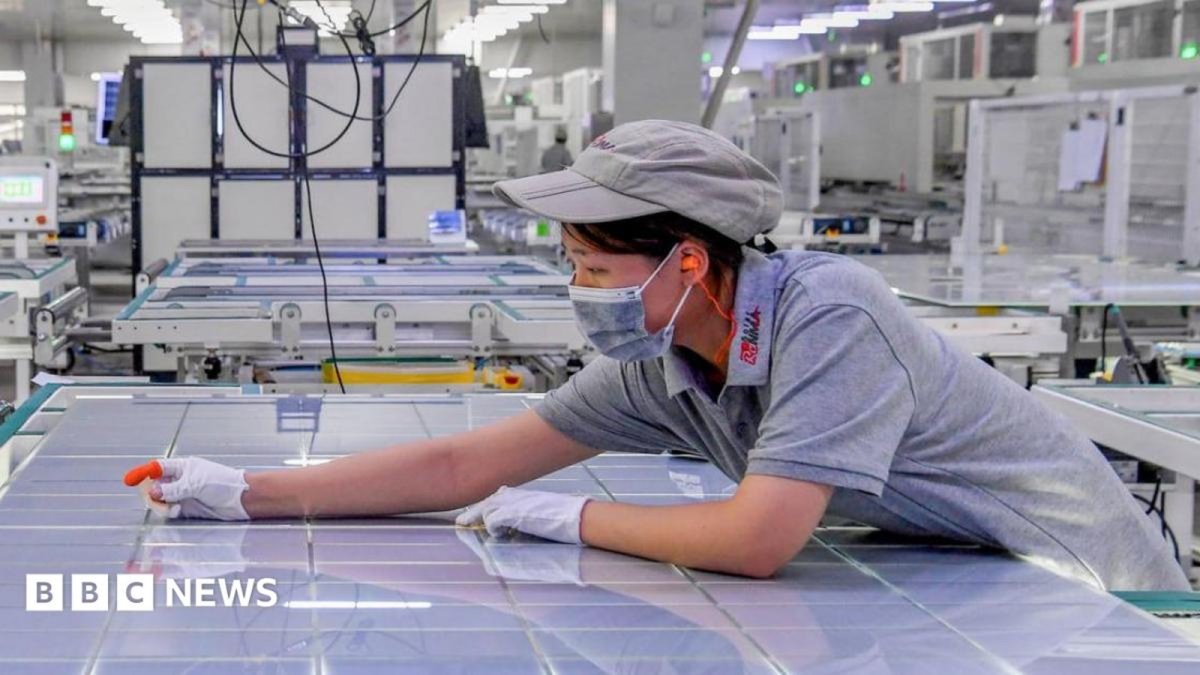
The latest salvo in the Washington-Beijing technological confrontation is aimed at the unglamorous but indispensable material that underpins both the artificial intelligence revolution and the global green energy transition. On Thursday, August 6, 2026, President Donald Trump signed an executive order imposing a 15% tariff on imported products made from polysilicon, the ultra-pure form of silicon essential for semiconductors and solar panels. The move, which follows a national security investigation into overseas production of the material, is a direct challenge to China's near-monopoly on supply and represents a calculated attempt by Washington to rewire the most critical nodes of the global tech supply chain.
What the Order Does
The executive order formally accepts recommendations put forward by Secretary of Commerce Howard Lutnick. The core mechanism is a 15% ad valorem tariff on imported polysilicon and related products, but the order goes further by establishing minimum import prices designed to prevent foreign producers from undercutting American manufacturers on cost. The price floors are set at $21 per kilogram for raw polysilicon, $100 per kilogram for polysilicon ingots and wafers, $0.22 per watt for solar cells, and $0.38 per watt for solar modules or panels. These are engineered to ensure that even after accounting for production efficiencies abroad, domestic US producers can compete on price.
The new tariff is not scheduled to take effect until December 4, 2026, a deliberate phasing-in period that allows for market adjustment and potential diplomatic maneuvering. The order also directs the Commerce Department to design an incentive programme for companies that commit to building factories for polysilicon or its derivative products within the United States. The proclamation's text frames this as a matter of industrial survival: "The plan of action in this proclamation will, among other things, help ensure the commercial viability of United States production of polysilicon and its derivatives that is necessary to meet United States economic and national security requirements."
The National Security Rationale
The justification for the order rests on a stark statistical decline that Washington argues has left the country dangerously exposed. According to the White House, the United States controlled 50% of global polysilicon production in 2005. By 2024, that share had collapsed to less than 2%. The intervening two decades saw the bulk of manufacturing capacity migrate to China, which now holds a near-monopoly on the material's production. President Trump framed this as a failure of American policy, stating that for decades the US has allowed "foreign firms to weaken United States producers in the polysilicon sector."
The national security investigation that preceded the order concluded that this dependency constitutes an unacceptable vulnerability. Polysilicon is not merely a commercial commodity; it is a critical input for military equipment, advanced electronics, and the datacentres that power modern AI systems. The logic follows a pattern established in earlier US actions against Chinese technology: when a single adversary controls the production of a material essential to both economic competitiveness and defence capabilities, the market alone cannot be trusted to secure supply. The order is therefore designed to force a re-shoring of production capacity, regardless of the short-term cost to American consumers and manufacturers who currently benefit from cheaper imported inputs.
China's Response
Beijing's reaction was swift and unequivocal. The Chinese embassy in Washington issued a statement condemning the move as a "serious disruption" to bilateral trade, accusing the United States of "abusing state power to go after Chinese businesses." China's foreign affairs ministry spokesperson Lin Jian echoed the point. "The US is overstretching the concept of national security, and abusing state power to go after Chinese businesses," Lin Jian said. "Protectionism will not make the US more competitive." He further warned that the move "seriously disrupts normal trade and economic exchanges between Chinese and US businesses, and is not in the interest of US businesses and consumers or anyone else for that matter."
The rhetorical response has been matched by concrete action. On August 5, 2026, one day before the US order, China's Ministry of Commerce announced a tightening of export controls on drones and related components and technologies destined for the United States, imposing a more rigorous case-by-case approval process. This is a direct retaliatory measure aimed at a sector where Chinese firms hold significant advantages. Beijing has also launched a national security review into imported printers and copiers, suspended cooperation with US certification agencies for mandatory Chinese product certifications, and banned six American entities from operating in the Chinese market. These countermeasures signal that Beijing is prepared to escalate in kind, targeting US commercial interests across multiple sectors rather than confining the dispute to polysilicon alone.
Why Polysilicon Matters
The strategic importance of polysilicon cannot be overstated. It is the foundational material for semiconductors, the chips that power everything from smartphones to the advanced AI processing units driving the current technological boom. Without a reliable supply of ultra-pure polysilicon, the construction of new datacentres, the expansion of AI computing infrastructure, and the deployment of solar power generation would all grind to a halt. The material sits at the intersection of two of the most consequential technological trends of the decade: the AI race and the global energy transition.
The primary beneficiaries of this order are the two main US-based producers: Hemlock Semiconductor and Wacker Chemie. Hemlock, which operates a major plant in Michigan, is a joint venture between US tech giant Corning and Japan's Shin-Etsu Handotai. Munich-based Wacker Chemie runs a factory in Tennessee. Both companies have welcomed the administration's intervention. A Corning spokesperson said the tariff encouraged "continued investment in US capacity and supports long-term US competitiveness." Wacker expressed appreciation for the administration's engagement "given the ramifications for semiconductor supply chain resilience, advanced computing infrastructure, and broader US defence and security interests." These statements underscore that the order is about creating the economic conditions for domestic expansion.
The Broader Tech War
This polysilicon tariff is the latest in a series of escalating US restrictions on Chinese technology imports. Washington has previously moved to limit the entry of Chinese drones, humanoid robots, and other advanced tech products. The pattern is consistent: identify a critical technology where China has achieved market dominance, launch a national security review, and impose tariffs or outright bans to force supply chain diversification. The polysilicon action extends the front line of the tech war from finished products to the raw materials and intermediate goods that feed the manufacturing ecosystem.
The broader context is a tit-for-tat tariff war between the world's two largest economies that has been on hold since May 2025. That pause now appears increasingly fragile. Each new restriction from Washington invites a calibrated response from Beijing, and the cycle shows no sign of abating. The drone export controls announced by China's Ministry of Commerce are a pointed reminder that Beijing has its own leverage, particularly in sectors where Chinese manufacturers have achieved near-total dominance. The suspension of cooperation with US certification agencies adds a further layer of friction, potentially delaying American companies' ability to sell products in the Chinese market.
The Economic Context
The timing of this escalation is notable given the divergent economic trajectories of the two powers. Beijing revealed that China's exports surged by 23.9% in dollar terms year-on-year in July, driven by strong shipments of AI-related products. This data point suggests that, despite ongoing trade tensions, Chinese manufacturers are thriving in the very sectors that Washington is attempting to constrain. Sheana Yue, senior Asia economist at consultancy Oxford Economics, offered a nuanced assessment. China's "strong electronics and machinery exports," combined with industrial input imports, suggested that "AI and electrification will drive global manufacturing." She added that "China's competitiveness in AI hardware, electric vehicles, batteries, and other high-value manufacturing will probably allow it to continue gaining global export market share despite softer demand."
This economic resilience complicates the US strategy. If Chinese producers can continue to gain global market share despite tariffs and restrictions, the impact of the polysilicon order may be more limited than Washington hopes. The US solar industry has long accused Chinese rivals of dumping cheaper panels on the market, a practice allegedly enabled by excessive government subsidies and by relocating manufacturing to third countries to circumvent US tariffs. The new minimum import prices are designed to close these loopholes, but their effectiveness will depend on enforcement and on the willingness of other countries to cooperate with US trade authorities.
Strategic Implications
The polysilicon tariff represents a significant escalation in the US-China competition for technological supremacy. For Washington, the goal is clear: to rebuild domestic manufacturing capacity in a sector deemed critical to national security, even at the cost of higher prices and potential supply disruptions in the short term. The incentive programme for domestic investment is a long-term bet that American industry can, with government support, regain competitiveness in a field where it has been largely absent for two decades.
For Beijing, the response will likely be multifaceted. Beyond the immediate countermeasures, China may seek to deepen its relationships with other markets in the Global South, positioning itself as a reliable supplier of critical materials to countries that do not share Washington's security concerns. The AI race, which is central to this conflict, will continue to drive demand for polysilicon regardless of tariff barriers. The question is whether the global supply chain will bifurcate into separate US-aligned and China-aligned spheres, or whether market forces will ultimately prevail over state intervention.
The second-order effects extend beyond the two protagonists. Countries with nascent polysilicon or semiconductor industries may find themselves courted by both sides as they seek to diversify supply chains. The tariff could accelerate investment in manufacturing capacity in allied nations, reshaping the global geography of high-tech production. For the Global South, the dispute presents both risks and opportunities: the risk of being caught in the crossfire of a superpower conflict, and the opportunity to position themselves as neutral suppliers of critical materials.
This article was produced with AI-assisted research and editorial support. Sources: BBC News, The Guardian, White House, MOFCOM statements. By Prof. Marcus Chen, Staff WriterWhat's Your Reaction?
 Like
0
Like
0
 Dislike
0
Dislike
0
 Love
0
Love
0
 Funny
0
Funny
0
 Wow
0
Wow
0
 Sad
0
Sad
0
 Angry
0
Angry
0

World Politics Analyst at Global1.News. Based in Beijing, covering US-China relations, global trade, and geopolitical strategy. Brings deep analytical perspective to the power dynamics shaping international affairs.















Comments (0)