
UK threatens to ban Eritreans over migrant return policy
The threat, announced in mid‑October 2026, follows a pattern of UK officials using visa restrictions to compel cooperation on returns, a tactic that has already been deployed against Angola, Namibia and the Democratic Republic of Congo.
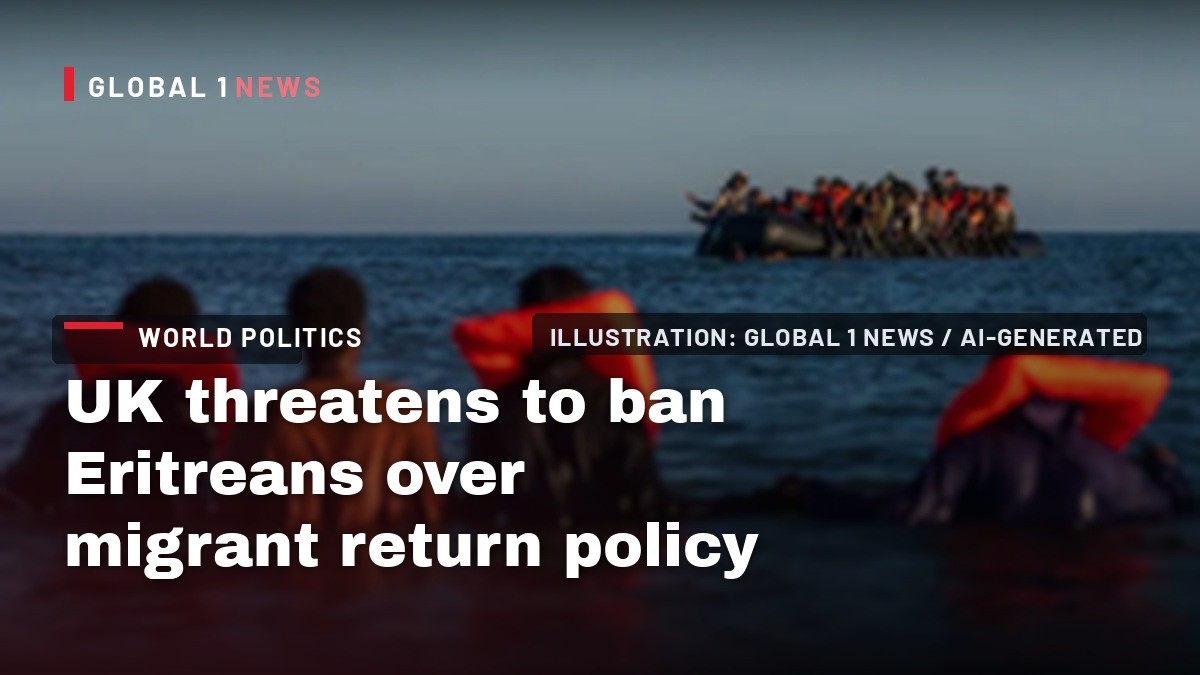
In a stark escalation of diplomatic pressure, Britain’s Home Secretary Shabana Mahmood has warned that Eritrean nationals could face a blanket ban from entering the United Kingdom unless the Horn of Africa state agrees to take back a larger share of migrants and foreign‑national offenders. The threat, announced in mid‑October 2026, follows a pattern of UK officials using visa restrictions to compel cooperation on returns, a tactic that has already been deployed against Angola, Namibia and the Democratic Republic of Congo.
What the ban would entail
The proposed measures would bar all Eritreans from entering the UK, a step that would affect not only ordinary travellers but also diplomatic staff. From Thursday, Eritrean diplomats in London would be restricted from travelling more than 60 kilometres outside the capital without explicit permission, mirroring limits placed on British officials in Asmara. In addition, fast‑track visas for Eritrean VIPs would be halted, and any existing exemption granted to an Eritrean official in August 2026 could be withdrawn.
British officials have framed the move as a response to Eritrea’s “refusal” to accept the return of migrants and criminal offenders. Mahmood said the country “has had every chance to accept the return of criminals and those with no right to be in the UK. Unlike other countries, it has refused.” The Home Office, however, disputes Eritrean claims that the UK has misrepresented the voluntary nature of returns, insisting that its position has been “misrepresented” by the embassy in London.
Why Eritrea is in the cross‑hairs
Eritreans have been the most common nationality among small‑boat arrivals in the 12 months to June 2026, accounting for 18 % of those crossings, according to the House of Commons Library. Over the same period, more than 5,800 Eritreans arrived via small boats, while a further 1,300 were granted visas, most to join family already settled in Britain. Yet, only seven Eritreans were returned to their home country in that timeframe, with a further 244 sent to other destinations.
Human Rights Watch has long highlighted the repressive nature of the Eritrean regime – forced labour, indefinite national service and severe limits on freedom of expression. Many young Eritreans risk dangerous journeys to escape a one‑party state where conscription can last for decades, elections have never been held since independence in 1993, and independent media are absent. The restrictive religious environment, limited to four recognised faiths, adds another layer of pressure for those seeking to flee.
The broader UK return strategy
Mahmood’s warning sits within a wider UK policy to increase returns and deportations. From July 2025 to June 2026, the Home Office recorded more than 40,600 returns, an 8 % rise on the previous year. Of those, fewer than 6,000 had been convicted of a criminal offence, indicating that many returns involve asylum seekers whose claims have been refused or who have lost lawful status. Overall, small‑boat arrivals since the start of 2026 have fallen by 40 % compared with the same period a year earlier, suggesting a slowdown in the flow but not a cessation.
The government has also experimented with bilateral “one‑in, one‑out” schemes, such as the trial with France that returned 1,087 people by June 2026. Earlier, the Home Office signalled willingness to suspend visas for any country that “fails to co‑operate with the return of its citizens,” a stance that has already been applied to Angola, Namibia and the DRC, though restrictions on the latter were lifted after cooperation improved.
Expert views on the efficacy of a ban
Dr Madeleine Sumption, director of the Migration Observatory at the University of Oxford, cautioned that targeting Eritrea would have limited impact on overall migration numbers. Eritrea accounts for roughly 8 % of UK asylum applications, with about 7,000 filings in the most recent year of data. Crucially, 84 % of Eritrean asylum seekers succeed at the initial decision stage, and many more are expected to succeed on appeal. Sumption noted that only a small fraction of Eritrean arrivals are actually removable, reducing the practical leverage of a visa ban.
She also warned of unintended consequences. “If you’re looking at overall numbers of people who are refused asylum and not returned to their country of origin, it would be places like Pakistan, also Bangladesh that are right at the top of the list,” Sumption told BBC Radio 4. “The collateral damage of a ban on visas for those countries when you have so many international students coming, for example, and a lot of people coming on work visas would be much greater than a country like Eritrea.” The implication is that a ban on Eritrea may be a symbolic gesture rather than a decisive tool for curbing migration.
Political and diplomatic fallout
Eritrea’s embassy in London dismissed the UK’s threat as a “perfunctory political gimmick,” pointing out that the UK has not issued a single visa to an Eritrean official since 2023 – a claim the Home Office denies. The embassy also accused Britain of refusing “meaningful and appropriate dialogue,” alleging that the UK failed to disclose the return of criminals still serving prison terms and that the government mischaracterised voluntary returns as anything but forced.
British officials, meanwhile, argue that the restrictions on Eritrean diplomats are reciprocal, mirroring limits placed on British staff in Asmara. The Home Office spokesperson described Eritrea’s commentary as a “misrepresentation of the UK’s position.” Nonetheless, the diplomatic spat underscores a widening rift, with both sides accusing the other of bad faith and of using migration as a bargaining chip in broader geopolitical negotiations.
What lies ahead for migrants and policy
As the UK tightens its return regime, the human dimension remains stark. Young Eritreans continue to risk perilous sea journeys to escape conscription and repression, while the UK grapples with a surge of small‑boat arrivals that, despite a recent dip, still number in the thousands each year. The Home Office’s data shows that, of the 40,605 returns from July 2025 to June 2026, only about 6 % of total emigration from the UK in 2025 involved those deported, suggesting that returns are a relatively small slice of overall mobility.
Whether the threatened ban will prompt Eritrea to accept more returns, or simply add another layer of tension to an already fraught relationship, remains uncertain. What is clear is that the UK’s strategy of leveraging visa restrictions as diplomatic pressure is gaining momentum, even as experts warn that such measures may have limited effect on the underlying drivers of migration – conflict, repression and the search for a better future. As the October 2026 deadline approaches, both governments will be watching closely to see if the threat translates into concrete cooperation or further entrenches a stalemate that leaves vulnerable migrants caught in the crossfire of international politics.
This article was produced with AI-assisted research and editorial support. Reporting is based on the source material cited below. Sources: BBC News Africa; bbc.co.uk; Global1.News (17 October 2026).
By Amara Diop, Staff Writer
What's Your Reaction?
 Like
0
Like
0
 Dislike
0
Dislike
0
 Love
0
Love
0
 Funny
0
Funny
0
 Wow
0
Wow
0
 Sad
0
Sad
0
 Angry
0
Angry
0

West Africa/Sahel Correspondent at Global1.News. Dakar-based journalist covering politics, security, climate, and development across Francophone and Anglophone West Africa. Tells the stories of a region undergoing profound transformation.











Comments (0)