
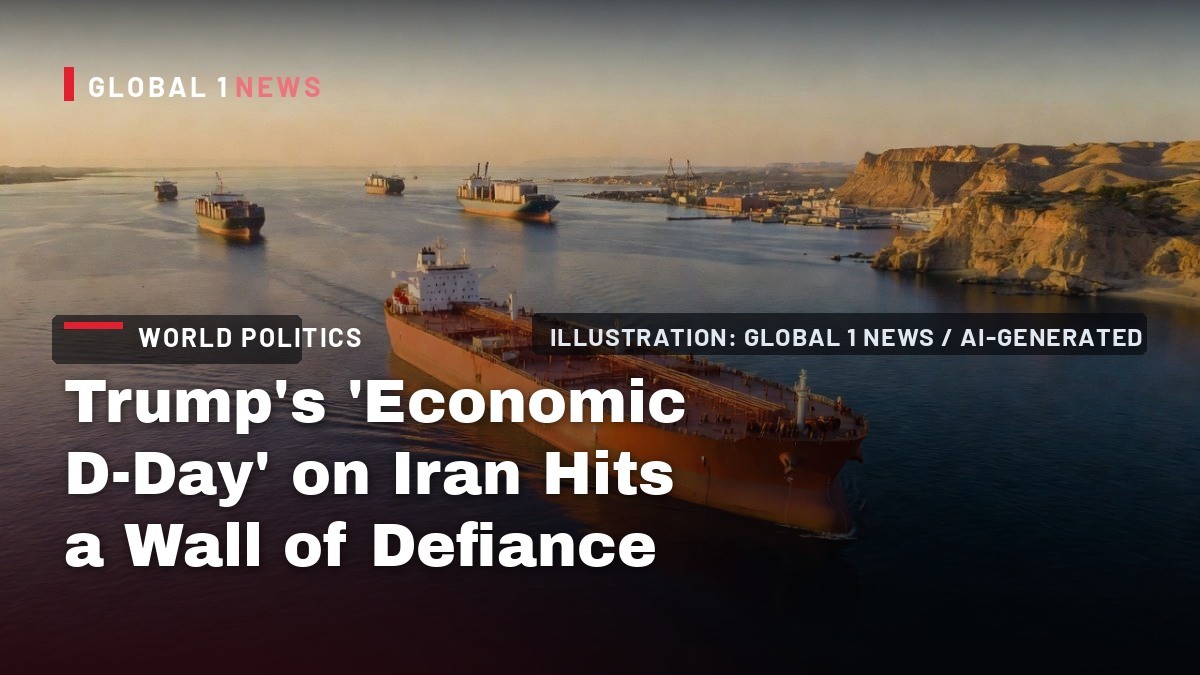
Trump's 'Economic D-Day' on Iran Hits a Wall of Defiance as Hormuz Standoff Grinds Into Month Seven
Trump's "economic D-Day" against Iran faces defiance six months into the 2026 war. Bessent's sanctions squeeze targets Tehran, but China's oil purchases, Hormuz diplomacy via Oman and Qatar, and waning US public support complicate the path to reopening the strait.
The Anatomy of the Economic Squeeze
The pivot to economic warfare marks a significant shift in strategy. Fortune reported on August 13 that the Trump administration was moving away from a military campaign that had failed to force capitulation, instead targeting an "entrenched" Iranian regime through financial means. The National followed on August 14, reporting that Washington had vowed to squeeze Iran's economy "to its limits."
Bessent's "economic D-Day" framing, reported by both Politico and CNN on August 24, signals the administration's intent to treat the financial campaign with the same gravity as a military invasion. However, CNN noted a critical nuance: the United States is "holding off on imposing the biggest penalties" despite the aggressive rhetoric. This suggests a calibrated approach, likely designed to preserve leverage in ongoing diplomatic backchannels while maintaining maximum pressure on Tehran's leadership.
Axios outlined on August 24 what it called "5 ways Iran's economy is wilting under Trump's pressure," detailing the compounding effects of sanctions, banking restrictions, and the naval blockade. The escalation comes more than six months into a war that has already exacted a heavy toll on Iran's civilian population and its ability to conduct normal commerce with the outside world.
Tehran's Leadership Digs In
Iranian officials have responded to the economic offensive with a mixture of defiance and diplomatic maneuvering. CNN reported on August 22 that a senior Iranian military leader vowed Tehran "will not submit" as the US prepared its economic squeeze. The message was unambiguous: military pressure failed, and economic pressure will fail too.
Iran's Foreign Minister Abbas Araghchi has been the public face of this defiance. On August 20, he dismissed Trump's economic punishment plan as a continuation of "failed policies," according to the New Indian Express. Three days later, Araghchi pivoted to a more conciliatory tone, stating that the United States has no path forward other than engaging with the Iranian people through respect, justice, and dignity, as reported by PressTV and Reuters.
By August 27, Araghchi had sharpened his rhetoric again, accusing the US and Israel of directly engineering the current turmoil across the Middle East. He warned that broken promises and continued economic warfare have pushed the region to the brink, according to Head Post. This oscillation between defiance and openness reflects a leadership that is under immense pressure but unwilling to show weakness.
The Oman and Qatar Diplomatic Track
Amid the economic warfare, a parallel diplomatic track has emerged, centered on Oman and Qatar. On August 26, Iran's Deputy Foreign Minister Kazem Gharibabadi announced that Iran and Oman had agreed on a temporary maritime route for ships through the Strait of Hormuz, as reported by Al Jazeera. The announcement came with a critical caveat: the waterway will not fully reopen until the United States fulfills its commitments.
CNBC reported on August 25 that Iran and Oman had discussed a jointly managed shipping route through the strait, a proposal that could provide a face-saving mechanism for both sides. The diplomatic groundwork for this arrangement was laid earlier in August, when Axios reported via Israel Hayom on August 5 that the US, Iran, and Oman were nearing a 60-day interim agreement to reopen the strait.
Qatar's prime minister added another layer to the diplomacy, holding talks in Tehran on August 27 focused on Hormuz and the broader war, according to Al Jazeera. The Qatari mediation comes amid international hopes that US-Iran dialogue will resume, though Tehran has signaled it will not negotiate from a position of weakness.
Iran's Conditions for Reopening Hormuz
The central question remains: what will it take for Iran to fully reopen the Strait of Hormuz? Tehran has been explicit about its conditions. An Iranian official named Rezaei, speaking through the state news agency IRNA, laid out the position clearly: "The US must first take practical steps to fulfil Iran's conditions, and then Iran will proceed to open the Strait of Hormuz."
Al Jazeera's live blog from August 27 reported that Tehran is preparing a list of conditions for any agreement. The same report noted that Trump is "not in a hurry" over talks, suggesting the administration believes time is on its side as Iran's economy deteriorates. Tehran, for its part, continues to defend dialogue with the US even as it demands concrete actions rather than promises.
The temporary Oman-mediated maritime route appears designed to test the waters — literally and figuratively. If both sides can manage a limited reopening without incident, it could build confidence for a broader agreement. If not, the standoff could escalate further, with Iran potentially intensifying its military posture in the strait.
The China Complication
The economic squeeze faces a significant structural challenge: China remains the biggest buyer of Iran's oil. Both US News and The Guardian reported on August 25 that Beijing's continued purchases undermine the effectiveness of US sanctions. Chinese refiners have proven adept at circumventing restrictions, often through shadow fleets and opaque financial channels.
This creates a fundamental tension in the US strategy. Sanctions that are too aggressive risk alienating China at a time when Washington is seeking Beijing's cooperation on other fronts. Sanctions that are too lenient allow Iran to continue earning revenue, prolonging the standoff. The Trump administration has yet to resolve this dilemma, and the Chinese factor looms large over any assessment of the economic campaign's likely success.
The IEA's August 2026 Oil Market Report adds another layer of complexity, forecasting that world oil demand will decline by 1.6 million barrels per day in 2026, citing the ongoing closure of the Strait of Hormuz and elevated fuel prices. A prolonged disruption could accelerate this demand destruction, but it also raises the stakes for finding a resolution.
Oil Markets and Global Economic Fallout
The oil market has been on a rollercoaster throughout August. Brent crude crossed $90 a barrel in mid-August, sitting near $91 on August 17-18, before falling back to about $76.76 by August 27. West Texas Intermediate was near $72.91, close to four-month lows as markets weighed the prospects for diplomacy against the risk of further escalation.
The price retreat suggests traders believe a negotiated settlement is possible, but the volatility underscores how fragile the situation remains. Politico's August 24 analysis framed the stakes bluntly: "Bessent's 'economic D-Day' may not end the war — or $4 gas." US gasoline prices hovering near $4 a gallon have become a political liability for the administration, which campaigned on lowering energy costs.
The economic damage extends beyond oil. Middle East Eye reported that the war is pushing Middle Eastern airlines toward a $4.3 billion loss in 2026, as regional airspace closures and elevated fuel costs wreak havoc on the industry. The broader regional economy is feeling the strain, with tourism, shipping, and investment all suffering from the prolonged conflict.
Waning Public Support and Political Stakes
The political calculus in Washington is shifting as the war drags on. Reuters reported this week that US public support for military action against Iran has fallen to 31 percent, while President Trump's approval rating stands at 33 percent, according to PressTV's August 27 report. These numbers suggest a war-weary public that is losing patience with the administration's approach.
The economic squeeze is thus a double-edged sword for the administration. It offers a path to victory without further military escalation, but it also risks prolonging a conflict that is already deeply unpopular. If gasoline prices remain elevated and the standoff continues into the fall, the political pressure on Trump could intensify significantly.
The Institute for the Study of War's Iran Update from August 27 documents continuing US and partner military operations across the region, indicating that the military campaign has not fully ceased even as the economic pressure intensifies. This dual-track approach — military operations alongside economic warfare — carries inherent risks of miscalculation.
What Comes Next: Talks or Further Escalation
As September approaches, the path forward remains uncertain. The Oman-mediated maritime route could provide a foundation for broader negotiations, but Iran's insistence on preconditions and the US reluctance to offer concessions create a difficult negotiating environment. The 60-day interim agreement discussed in early August has not materialized, and both sides continue to position for maximum leverage.
Analysts suggest Tehran could intensify the dispute militarily if the economic pressure becomes unbearable, according to The New York Times' August 24 report. This could mean renewed attacks on shipping, further restrictions on the strait, or provocations against US naval assets. The risk of escalation remains high, even as both sides express openness to dialogue.
What is clear is that the "economic D-Day" has not produced a quick victory. Iran's leadership remains intact, its economy is hurting but not collapsing, and its regional allies continue to support the regime. The coming weeks will test whether the economic squeeze can achieve what military force could not — or whether the standoff will grind on into a new phase of the conflict.
This article was produced with AI-assisted research and editorial support. Sources: CNN, Al Jazeera, Reuters, Politico, Axios, The New York Times, the International Energy Agency, and the Institute for the Study of War.
By Jessica Ali, Staff WriterWhat's Your Reaction?
 Like
0
Like
0
 Dislike
0
Dislike
0
 Love
0
Love
0
 Funny
0
Funny
0
 Wow
0
Wow
0
 Sad
0
Sad
0
 Angry
0
Angry
0

Editor-in-Chief at Global1.News. Atlanta-based journalist who cuts through the BS and tells it like it is. Lead anchor, host, and the voice you hear when the spin stops and the truth starts.










Comments (0)