
Trinidad and Tobago's 30 Joint Army-Police Posts Draw Procurement Probe and Political Fire
Port of Spain, Trinidad and Tobago — Prime Minister Kamla Persad-Bissessar announced on 3 August 2026 that 30 joint army-police posts will be set up across Trinidad and Tobago over the next four months as part of an expanded national security strategy under the ongoing State of Emergency.
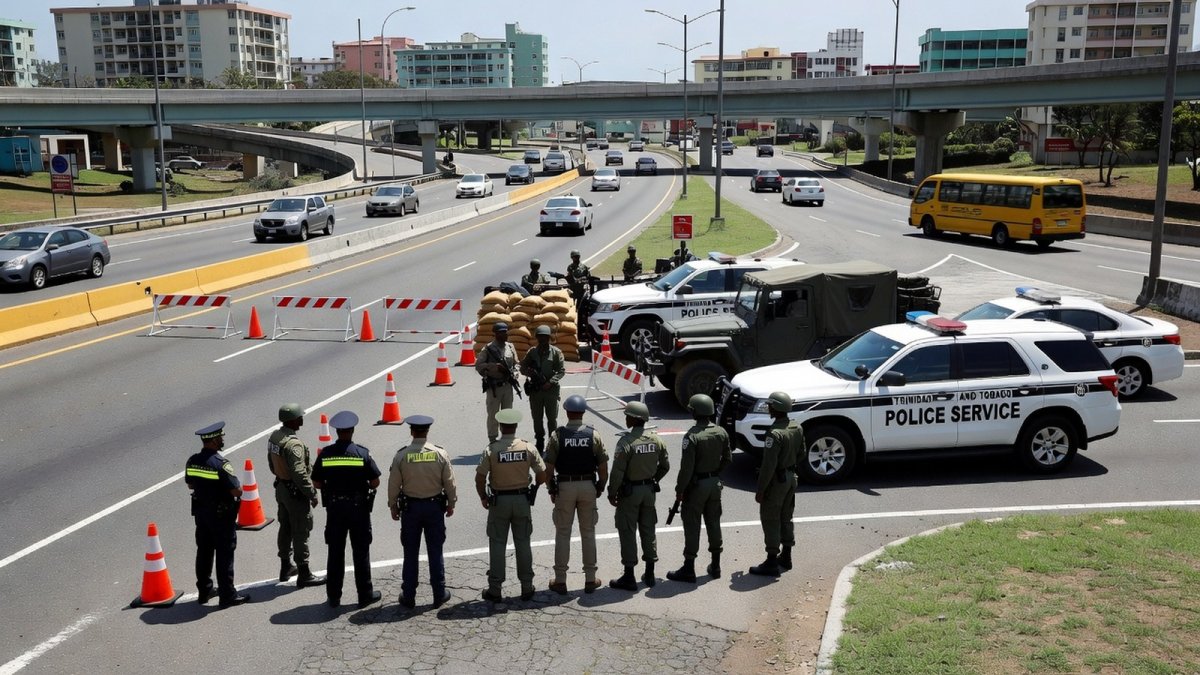
Port of Spain, Trinidad and Tobago — Prime Minister Kamla Persad-Bissessar announced on 3 August 2026 that 30 joint army-police posts will be set up across Trinidad and Tobago over the next four months as part of an expanded national security strategy under the ongoing State of Emergency.
The Prime Minister's Security Announcement
Prime Minister Kamla Persad-Bissessar announced on 3 August 2026 that 30 joint army-police posts will be set up across Trinidad and Tobago over the next four months. The move forms part of the Government's expanded national security strategy during the ongoing State of Emergency. Families in communities long affected by violent crime welcomed any sign of progress, especially after the Prime Minister noted a ten-day stretch without a single murder, even as she acknowledged one incident on the day of her statement. Steady gains against the murder rate matter deeply when households already struggle with rising prices for food, fuel and school supplies.
Construction activity has already begun at identified locations. Workers have shifted to the Grand Bazaar site, where foundation work is under way, and completed foundation sites have been reported at Tarouba. These positions include the Tarouba Flyover and Grand Bazaar Interchange, chosen for their strategic placement along major transport corridors.
The Trinidad and Tobago Defence Force has maintained a recurring presence in joint patrols throughout the emergency period. This approach draws on established operational patterns that combine military logistics with police investigative capacity to address elevated crime and murder rates across the country.
Opposition Raises Concerns Over Funding and Role
Opposition Leader Pennelope Beckles criticised the plan, accusing the Prime Minister of using the posts to revive an earlier security model. She questioned how the projects would be funded and what part the military would play in everyday policing. Prime Minister Persad-Bissessar responded by calling the Opposition hypocritical, pointing to previous PNM support for similar joint operations during earlier administrations. The exchange has intensified debate over whether the posts represent a continuation of existing policy or a substantive shift in operational command structures, reflecting the deep political divide that often surfaces when crime and public safety dominate national conversation in Trinidad and Tobago.
Concerns have also centred on the long-term sustainability of the programme once the State of Emergency concludes. Opposition statements have emphasised the need for transparent cost projections and clear criteria for evaluating whether the posts deliver measurable reductions in violent crime.
Formal Complaint Triggers Procurement Probe
On 7 August 2026 attorney Randall Mitchell, a former PNM government minister, filed a complaint with the Office of the Procurement Regulation on behalf of social activist Wendell Eversley. The complaint asks the OPR to examine how contractors were chosen, the source of funding and whether competitive tendering took place. Questions about transparency in large public projects strike a chord with citizens who feel every dollar spent on security must be accounted for while the cost-of-living squeeze continues.
The Office of the Procurement Regulation operates as an independent body established to oversee public procurement across Trinidad and Tobago. Its investigations can produce formal findings, reports to Parliament, and recommendations that may influence future contract awards and oversight mechanisms.
The complaint specifically seeks contract values and documentation showing whether single-source or restricted tendering was applied. Such information is required under existing procurement legislation to ensure accountability in projects funded through public resources during the emergency period.
The same pairing of attorney and activist previously lodged a complaint with the Office of the Procurement Regulation in April 2026 over more than TT$3 billion in housing contracts, a process that was later discontinued. That track record gives the latest complaint added weight among citizens who want clear answers on how emergency security spending is being handled, and it reinforces the role of the independent regulator in checking how public money flows.
Established under the Public Procurement and Disposal of Public Property Act, the Office of the Procurement Regulation is tasked with monitoring compliance across state agencies and statutory bodies. Its mandate includes reviewing whether contracts above prescribed thresholds follow open and competitive procedures, and its findings can be reported to Parliament, giving the regulator a central place in the debate over how the security programme is financed.
Early Construction Work Begins at Key Sites
Workers have already moved onto the site at Grand Bazaar, and foundations are reported complete at Tarouba. The locations include the Tarouba Flyover and Grand Bazaar Interchange. These early steps show the Government is moving ahead with physical infrastructure even as the procurement questions remain open. Residents near these busy junctions hope the posts will bring greater safety without disrupting daily commutes or market trade.
Joint Operations and the State of Emergency
The Trinidad and Tobago Defence Force has worked alongside police in patrols throughout the emergency period. Professor Hamid Ghany noted that such joint posts could eventually reduce the need for the State of Emergency itself. For many families, the balance between emergency powers and normal civil life remains delicate, especially when crime pressures affect tourism recovery and the wider economy that depends on Carnival celebrations and visitor confidence.
The Defence Force's integration into daily policing functions has prompted analysis of command chains and legal authorities governing military involvement in civilian law enforcement. These operational questions remain central to evaluations of the posts' effectiveness beyond the immediate emergency timeframe.
Regional Crime Pressures and CARICOM Context
Trinidad and Tobago is not alone in facing these challenges. Jamaica has also used states of emergency and joint security operations against gang violence. CARICOM leaders continue to discuss how emergency measures can be balanced with civil liberties across the region. Small island developing states share similar vulnerabilities to climate impacts, diaspora connections and the need for stable energy sectors, all of which intersect with public safety concerns. Neighbouring countries watch how Trinidad and Tobago manages procurement accountability while protecting citizens from violence.
Community Hopes for Accountability and Safety
People across the country want both effective crime reduction and clear answers on how public money is spent. The complaint to the Office of the Procurement Regulation highlights the demand for proper processes in selecting contractors and setting contract values. As construction advances at Tarouba and Grand Bazaar, communities will judge the posts not only by their ability to deter crime but also by whether the entire effort meets standards of fairness and openness. In a nation where every household feels the pinch of inflation, trust in government spending on security remains essential to lasting progress.
Trinidad and Tobago's diaspora communities in New York, Miami, Toronto and London maintain close connections to developments in national crime policy through family networks and regular remittances. Safety conditions at home directly influence decisions about travel, investment and long-term relocation among these groups.
Local residents continue to monitor implementation timelines at sites such as Tarouba and Grand Bazaar, seeking clarity on how the posts will integrate with existing neighbourhood policing arrangements. Data on crime trends following the ten-day milestone period will inform ongoing assessments of the strategy's impact.
For residents, the measure of success will be whether the posts make neighbourhoods feel safer while the country's wider economic anxieties persist. With the State of Emergency still in force and questions over the programme's long-term cost unresolved, the coming months will test both the Government's security strategy and its commitment to transparent spending.
By Sharon Sahatoo, Staff WriterThis article was produced with AI-assisted research and editorial support. Sources: Trinidad Guardian, Trinidad Express, TTT News, CNC3, Office of the Procurement Regulation reporting.
What's Your Reaction?
 Like
0
Like
0
 Dislike
0
Dislike
0
 Love
0
Love
0
 Funny
0
Funny
0
 Wow
0
Wow
0
 Sad
0
Sad
0
 Angry
0
Angry
0

Caribbean Correspondent at Global1.News. Based in Port of Spain, Trinidad, covering Caribbean politics, economy, energy, climate, and culture. Amplifying the voices and stories of the Caribbean region.












Comments (0)