
Total Solar Eclipse Today: Why the Rare Celestial Event Won't Be Visible in India
Total Solar Eclipse Today: Why India Misses the Rare Celestial Event, and What It Means for Indian Science New Delhi – August 12, 2026 — The most significant total solar eclipse in nearly three decades for Europe and the Arctic is unfolding today, but for Indian skywatchers, the celestial spectacle
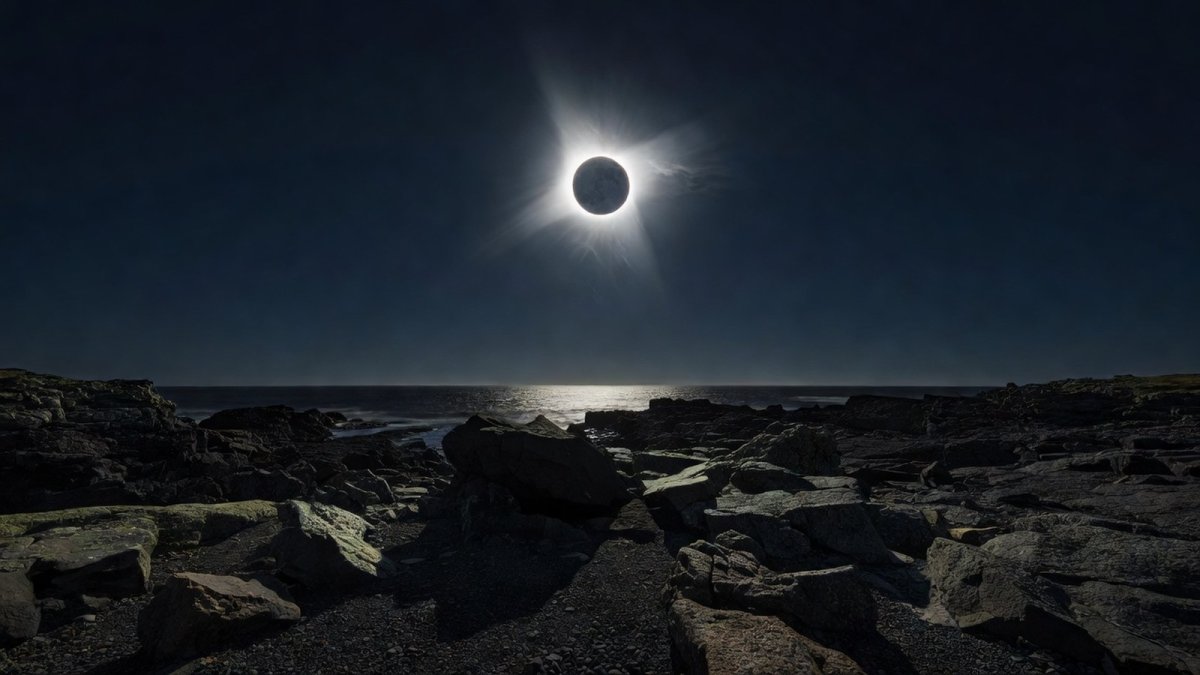
New Delhi – August 12, 2026 — The most significant total solar eclipse in nearly three decades for Europe and the Arctic is unfolding today, but for Indian skywatchers, the celestial spectacle will pass entirely unseen. The eclipse, which reaches its maximum at approximately 11:16 PM Indian Standard Time (IST), occurs after sunset across the entire subcontinent, leaving India in darkness while the Moon's shadow sweeps across the North Atlantic, Iceland, and Spain. This is the second solar eclipse of 2026, falling on the auspicious day of Hariyali Amavasya, yet its invisibility from Indian soil carries both scientific and cultural implications that merit close examination.
Total Solar Eclipse Today: Why the Rare Celestial Event Won't Be Visible in India
New Delhi – August 12, 2026 — The total solar eclipse of August 12, 2026, occurring at the Moon's descending node with a magnitude of 1.0386, represents a rare alignment of celestial mechanics that will be witnessed by millions across the Arctic, Iceland, and Spain. For India, however, the timing is unforgiving: the eclipse peaks at 11:16 PM IST, long after the Sun has set across every Indian longitude. The path of totality — an unusually narrow corridor running east to west from northernmost Siberia, across the Arctic and Greenland, then southward to Iceland, the Atlantic Ocean, and northern Spain — never approaches Indian skies. The event, while scientifically significant, will be a matter of data and livestreams for Indian astronomers rather than direct observation.
The Celestial Mechanics: A 2-Minute-18-Second Window
The science behind this eclipse is precise and remarkable. At greatest eclipse, totality will last exactly 2 minutes and 18.2 seconds, occurring at a point approximately 45 kilometers off the western coast of Iceland, at coordinates roughly 65.5 degrees north and 25.4 degrees west. The Moon, positioned about 2.2 days past its perigee (which occurred on August 10, 2026), presents a larger apparent diameter than average, contributing to the eclipse's magnitude of 1.0386 — meaning the Moon covers the Sun with a small margin to spare, creating a brief but brilliant corona.
Unusually, the path of totality runs from east to west, beginning near sunrise in northern Russia and moving toward Greenland while just avoiding the North Pole — a quirk of shadow geometry at high latitudes. Observers in Russia's Taymyr Peninsula will see the maximum eclipse during the midnight sun, when the Sun never sets and the eclipse unfolds against a perpetually bright sky. In these polar regions, the aurora borealis may also be visible during the partial phases, creating a rare dual celestial display.

Iceland and Spain: A Continent's Long Wait Ends
For Iceland, this eclipse is a historic event. The last total solar eclipse visible from the island nation occurred on June 30, 1954 — a gap of 72 years. The next one visible over Iceland will not occur until 2196, a wait of 170 years, as the eclipse belongs to Saros series 126, a cycle that will not favor Icelandic skies again for nearly two centuries. In Reykjavik, the partial phase begins at approximately 16:47 local time, with totality achieved at about 17:48 local time — a brief window of darkness in the middle of an Arctic summer afternoon.
Spain's experience is equally significant. The last total solar eclipse visible from Spanish soil was on August 30, 1905 — 121 years ago. The next will come on August 2, 2027, a far shorter interval, but today's event marks the first time in over a century that Spanish cities have been placed directly in the path of totality. Major urban centers including A Coruña, Valencia, Zaragoza, Palma, and Bilbao lie within the totality zone, while Madrid and Barcelona sit just outside its edges — a matter of mere kilometers that will determine whether millions see a total or partial eclipse. The Spanish government has designated 660 official viewing sites and expects more than 440,000 dedicated eclipse visitors, with authorities estimating that between 1.5 million and 6 million people could travel for the event, making it one of the largest astronomical tourism events in European history.
Why India Misses the Eclipse Entirely
The fundamental reason India cannot observe this eclipse is simple geometry combined with Earth's rotation. The eclipse's maximum occurs at 11:16 PM IST, when the Sun is below the horizon across the entire Indian subcontinent. The path of totality, confined to high northern latitudes and the eastern Atlantic, never intersects any longitude where Indian skies are still illuminated. For Indian observers, the Sun will have set hours before the Moon's shadow arrives, and the eclipse will be entirely invisible from any point within the country's borders.
This is not an anomaly but a pattern. India's last total solar eclipse was on July 22, 2009, when totality swept across a corridor from Gujarat through Madhya Pradesh, Bihar and West Bengal before crossing into China. The next eclipse visible from India will be a partial solar eclipse on August 2, 2027, visible across much of the country. That event, less than a year away, will offer Indian skywatchers their next opportunity to witness the Moon's shadow — albeit partially — from their own soil. For today, however, Indian astronomers and enthusiasts must rely on international livestreams and data feeds from observatories in Iceland and Spain.

The Sutak Question: No Ritual Restrictions Apply
For India's Hindu population, the eclipse carries a specific cultural dimension. Today is Hariyali Amavasya, the new moon day of the Shravana month, which is considered auspicious for honoring ancestors and planting. However, because the eclipse is not visible from India, the traditional Sutak period — the inauspicious window before and during an eclipse when certain rituals and activities are suspended — does not apply. The Sutak is observed only when the eclipse is locally visible, and since the Sun will have set across India before the eclipse begins, no restrictions on food, worship, or daily activities are in effect.
This distinction is important for millions of Indians who might otherwise alter their daily routines or postpone religious observances. The absence of Sutak means that Hariyali Amavasya rituals can proceed without interruption, and no special precautions are required. Indian astrologers and religious authorities have confirmed that the eclipse's invisibility renders it ritually inert for the subcontinent, allowing devotees to observe the day's traditional practices normally.
India's Eclipse Heritage: From Aryabhata to ARIES
India's relationship with eclipses is ancient and scientifically profound. The 5th-century mathematician and astronomer Aryabhata computed eclipse timings and geometries with remarkable accuracy, and the Surya Siddhanta, a Sanskrit astronomical treatise, contains detailed methods for predicting solar and lunar eclipses. The Jantar Mantar observatories in Delhi and Jaipur, built in the 18th century by Maharaja Jai Singh II, were constructed precisely for the purpose of measuring celestial positions and predicting such events — monumental masonry instruments that remain functional today.
Modern Indian institutions continue this legacy. The Aryabhatta Research Institute of Observational Sciences (ARIES) in Nainital, Uttarakhand, conducts active solar physics research, including coronal studies during eclipses. The Inter-University Centre for Astronomy and Astrophysics (IUCAA) in Pune, Maharashtra, engages in eclipse-related outreach and computational modeling. The Indian Space Research Organisation (ISRO) has contributed to solar observation through missions like Aditya-L1, India's solar observatory launched in 2023, which studies the Sun's corona and solar wind from the Lagrange point L1 — data that complements ground-based eclipse observations. While Indian scientists cannot observe today's eclipse directly, their instruments and models will incorporate data from international collaborators, ensuring that Indian research remains integrated into the global scientific effort.
Safety First: The Only Non-Negotiable Rule
For the millions of people in Iceland, Spain, and other regions within the path of partial or total visibility, safety is paramount. The Sun must never be viewed directly, even during totality's brief moments, without proper protection. ISO 12312-2 certified eclipse glasses are the only safe direct-viewing method, and indirect pinhole projection — where sunlight is projected through a small hole onto a surface — is a safe alternative for those without certified eyewear. Regular sunglasses, camera lenses, or telescopes without solar filters are dangerously inadequate and can cause permanent retinal damage.
Indian readers planning to travel for the August 2, 2027 partial eclipse should note these safety protocols now. The 2027 event, visible across much of India, will require the same precautions. For today, however, Indian citizens can safely observe the eclipse only through international livestreams provided by NASA, the European Space Agency, and various observatories — a reminder that while the eclipse is invisible from Indian soil, its scientific significance is global.
The Bottom Line: A Missed Spectacle, A Data-Rich Event
Today's total solar eclipse is a reminder of the Earth's axial geometry and the Moon's orbital mechanics — forces that determine which regions witness celestial events and which do not. For India, the eclipse's invisibility is a matter of timing, not of astronomical misfortune. The country's next opportunity, the partial eclipse of August 2, 2027, is less than a year away, and Indian institutions are already preparing public outreach programs for that event.
In the meantime, Indian astronomers will analyze data from this eclipse — coronal spectroscopy, shadow band observations, and ionospheric effects — to advance solar physics research. The eclipse may not be visible from India, but its scientific yield will benefit Indian researchers and students who study the Sun's outer atmosphere and its influence on space weather. For the Indian public, the lesson is one of patience and preparation: the skies will deliver again, and when they do, India will be ready.
— By Dr. Raj Patel, Staff Writer
This article was produced with AI-assisted research and editorial support. Sources: NDTV, NASA, Wikipedia, Timeanddate, India Today, Indian Express, ABP News.
What's Your Reaction?
 Like
0
Like
0
 Dislike
0
Dislike
0
 Love
0
Love
0
 Funny
0
Funny
0
 Wow
0
Wow
0
 Sad
0
Sad
0
 Angry
0
Angry
0

India/South Asia Correspondent at Global1.News. Analytical voice with a background in science and health journalism. Based in New Delhi, covering Indian politics, education, healthcare, technology, and policy. Breaks down complex data into clear, actionable reporting.














Comments (0)