
The Strategic Logic Behind Pakistan’s Defense Pacts
On 21 October 2026, Pakistan, Türkiye, Qatar and Indonesia signed the Badr Pact in Doha, a quadrilateral framework that formalizes cooperation in defence manufacturing, joint research and development, technical training and industrial capacity building.
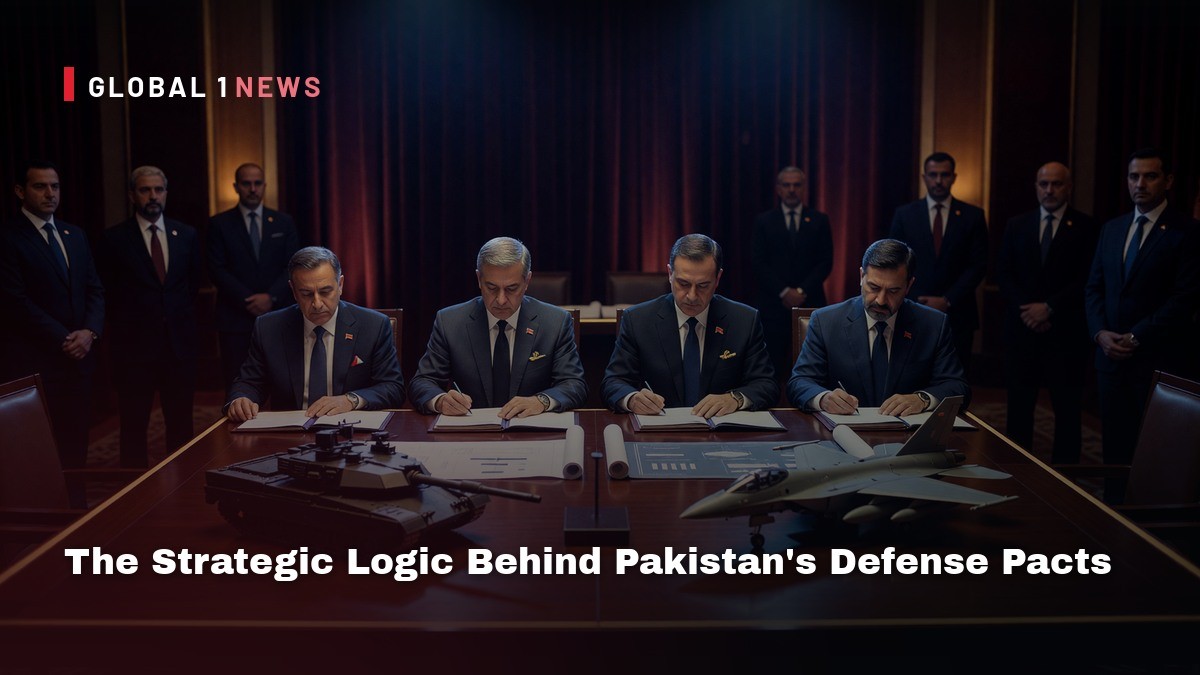
On 21 October 2026, Pakistan, Türkiye, Qatar and Indonesia signed the Badr Pact in Doha, a quadrilateral framework that formalizes cooperation in defence manufacturing, joint research and development, technical training and industrial capacity building. The memorandum of understanding, issued jointly by the four foreign ministries, signals a deepening of Pakistan’s multilateral security outreach and reflects a broader strategic calculus that has unfolded across West Asia and the wider Indian Ocean region since 2025. This article examines the Badr Pact within the continuum of Islamabad’s recent defence agreements, assesses its implications for regional security architecture, and situates the development within the longer‑term trajectory of Pakistan’s defence industrial policy.
Contextualising the Badr Pact within Pakistan’s recent defence diplomacy
The Badr Pact is the latest in a series of defence pacts that Pakistan has concluded over the past year. In September 2025, Islamabad signed the Strategic Mutual Defence Agreement with Saudi Arabia, a bilateral treaty that obliges each side to treat aggression against the other as aggression against itself. This was followed in August 2026 by the Makkah Joint Defence Agreement, signed jointly with Türkiye and Saudi Arabia, which contains an explicit collective defence commitment. In the same month, Pakistan and Kuwait executed a Protocol Agreement expanding military cooperation in training and capacity building. The Badr Pact therefore adds a multilateral industrial cooperation dimension to a pattern of increasingly comprehensive security partnerships.
These agreements collectively illustrate a shift from ad‑hoc procurement arrangements toward institutionalised, mutually binding security frameworks. The joint statements accompanying each pact underscore a shared intent to integrate defence capabilities, standardise training, and develop joint production lines, thereby moving beyond mere arms sales toward deeper strategic convergence.
Strategic engagement with the Muslim world amid shifting regional alignments
One of the primary drivers of Pakistan’s recent pacts is its expanding engagement with key Muslim states as West Asian security dynamics undergo rapid realignment. The source material notes that Pakistan’s conventional performance during the previous year’s clashes with India restored a measure of international strategic credibility. Simultaneously, Islamabad has acted as a visible mediator between Iran and the United States, maintaining communication channels at a time when many actors are constrained by competing alliances.
These dual roles—demonstrated military capability and diplomatic mediation—have reinforced perceptions of Pakistan as a “useful middle power” capable of bridging competing blocs. In a region where traditional security umbrellas, such as the U.S.‑led coalition, have shown limitations amid the U.S.–Iran confrontation, states are increasingly valuing partnerships with a country that can navigate multiple camps while offering credible operational expertise.
Industrial cooperation as a cornerstone of Pakistan’s defence strategy
Beyond geopolitical considerations, Pakistan’s defence pacts embed a clear industrial agenda: the transition from a buyer‑seller relationship to co‑production partnerships. The source cites a Dawn newspaper analysis observing that each recent defence agreement includes an explicit clause for joint defence production and investment. This reflects a long‑standing policy objective to embed foreign partners within Pakistan’s defence industrial base, thereby securing technology transfer and reducing dependence on external procurement.
Historical precedents illustrate the efficacy of this approach. Cooperation with China has yielded the JF‑17 fighter programme, a joint venture that expanded Pakistan’s aerospace manufacturing capacity. Likewise, ties with Türkiye have broadened into naval shipbuilding projects, evidencing a diversification of industrial collaboration across domains. The Badr Pact extends this model to include Qatar and Indonesia, promising to leverage complementary strengths in defence sectors for joint research, development and production.
Export ambitions and the quest for a competitive defence industry
Pakistan’s drive to develop a more competitive defence industry also aims at expanding arms exports. Recent months have seen heightened reporting of export discussions involving platforms such as the JF‑17, indicating an ambition to market Pakistani and co‑produced equipment to customers in Africa, West Asia and beyond. Participation in international defence exhibitions, where Pakistan showcases domestically developed and jointly produced systems, further underscores this export‑oriented strategy.
The new pacts, including the Badr Pact, provide pathways to attract foreign investment, secure technology transfers, and enhance the credibility of Pakistani offerings. By linking industrial capacity building with export potential, Pakistan seeks to create a virtuous cycle: stronger production capabilities generate more attractive export packages, which in turn draw additional investment and expertise, reinforcing self‑reliance.
Implications for the emerging West Asian security architecture
Collectively, the Badr Pact and the preceding agreements signal Islamabad’s growing role in shaping a nascent security architecture in West Asia. Through these frameworks, Pakistan is positioned to contribute to the security of its partners via military training, operational expertise and joint manufacturing, while simultaneously reaping benefits in the form of foreign investment, technology transfer and industrial self‑sufficiency.
From a geopolitical perspective, the multilateral nature of the Badr Pact introduces a new layer of collective security that complements bilateral treaties such as the Strategic Mutual Defence Agreement with Saudi Arabia. By binding multiple Muslim states in a shared industrial and training agenda, the pact could serve as a nucleus for a broader coalition of like‑minded countries seeking alternatives to traditional great‑power security umbrellas.
Potential constraints and challenges ahead
While the opportunities presented by the Badr Pact are considerable, Pakistan must navigate several constraints. The expanding list of commitments may strain its defence budget and logistical capacity, particularly as it seeks to balance existing procurement programmes with new joint production initiatives. Moreover, the necessity of harmonising standards, certification processes and export controls across four diverse partners could complicate implementation.
Strategically, Pakistan will need to manage the expectations of each partner, ensuring that the benefits of technology transfer and industrial participation are perceived as equitable. Any perception of imbalance could jeopardise the cohesion of the quadrilateral framework and undermine the broader objective of a stable, collaborative security architecture.
Forward‑looking assessment: the Badr Pact as a catalyst for regional resilience
In sum, the Badr Pact represents a strategic inflection point for Pakistan’s defence diplomacy. By embedding industrial cooperation within a multilateral security framework, Islamabad is advancing a model that blends geopolitical alignment, capacity building and export ambition. If effectively managed, this approach could enhance regional resilience, offering partner states a reliable source of joint training, technology and production that is less vulnerable to external geopolitical shocks.
Future research should monitor the operationalisation of the Badr Pact’s provisions—particularly joint R&D milestones, production line integration and training exchanges—to gauge its impact on Pakistan’s defence industrial trajectory and on the broader balance of power in West Asia. As the region continues to grapple with shifting alliances and security uncertainties, the success or failure of such multilateral industrial arrangements will likely shape the contours of collective defence and economic cooperation for years to come.
This article was produced with AI-assisted research and editorial support. Reporting is based on the source material cited below. Sources: The Diplomat; thediplomat.com; Global1.News (29 October 2026).
By Prof. David Park, Staff Writer
What's Your Reaction?
 Like
0
 Dislike
0
 Love
0
 Funny
0
 Wow
0
 Sad
0
 Angry
0

East Asia/Technology Correspondent at Global1.News. Seoul-based voice covering Korean politics, technology, business, and culture. Analyzes how technology and geopolitics intersect across East Asia.












Comments (0)