
Thailand's Myanmar Gambit Tests ASEAN's Unity and Strategic Patience
Thailand's decision to host Myanmar's junta leader Min Aung Hlaing and push for ASEAN reintegration without progress on the Five-Point Consensus risks fracturing the bloc's unified stance and eroding its regional credibility, analysts warn.
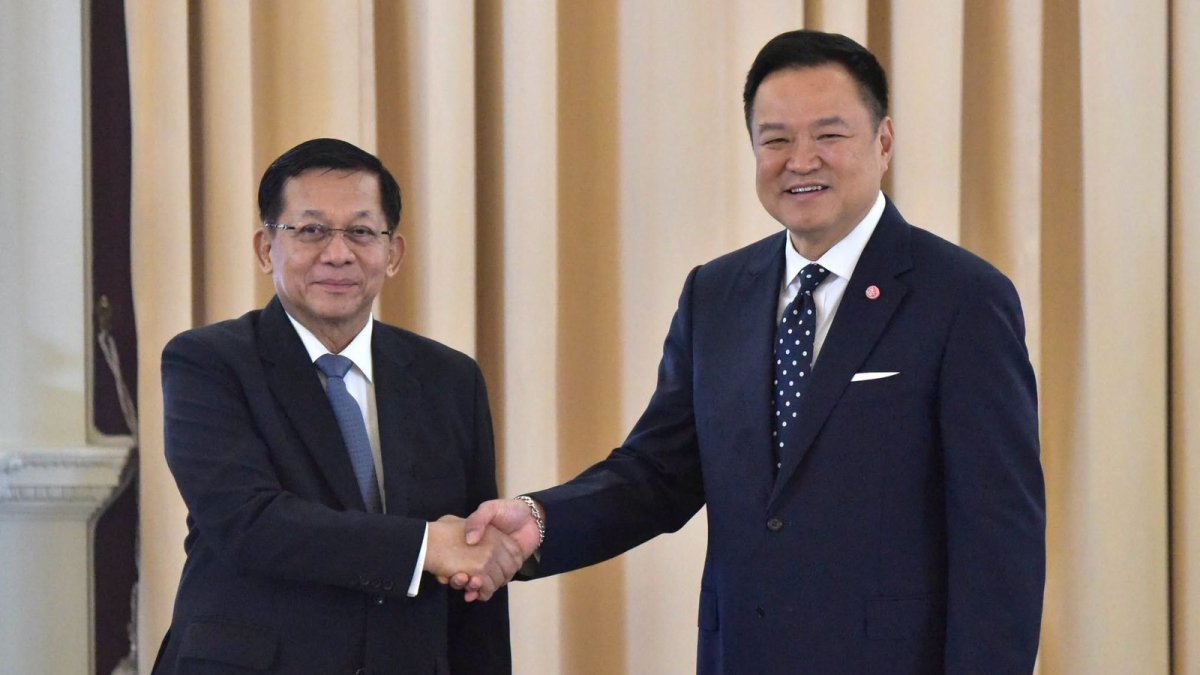
The decision by Thailand's Prime Minister Anutin Charnvirakul to host Myanmar's military-appointed leader Min Aung Hlaing in Bangkok on August 6, 2026, marks a significant departure from the consensus-based approach that has defined the Association of Southeast Asian Nations' (ASEAN) response to the Myanmar crisis since the 2021 coup. By extending an official invitation, pledging to work toward Myanmar's reintegration into the bloc, and signing three memoranda of understanding in labor, water, and space cooperation, Bangkok has effectively chosen bilateral pragmatism over multilateral principle. While Thailand's motivations are rooted in immediate national security concerns ranging from migrant flows to cross-border crime, the move risks undermining ASEAN's collective leverage and creating a dangerous precedent for how the bloc manages internal discord.
Thailand's Unilateral Reengagement with Myanmar's Junta Risks Fracturing ASEAN's Unified Stance and Eroding the Bloc's Regional Credibility
Seoul - August 17, 2026 - The two-day visit, which concluded on August 7, 2026, was framed by Bangkok as a step toward stabilizing a volatile neighborhood. Yet for Min Aung Hlaing, the trip represented a major diplomatic victory after years of relative isolation imposed by ASEAN member states following the military's seizure of power in February 2021. The junta leader's itinerary included an appearance before the Thai parliament, where he invited Thai business leaders to invest in the war-torn country-a move that drew immediate protests from Thai civil society and at least one member of parliament, who shouted calls for peace and humanity during the session. The optics of a junta chief being welcomed in a democratic legislature were not lost on regional observers, nor were the implications for ASEAN's stated commitment to the Five-Point Consensus, the bloc's peace plan that has been largely ignored by Naypyidaw since its adoption in April 2021.
A Pragmatic Gambit Rooted in National Security Imperatives
Thailand's calculus is not difficult to understand. Among ASEAN members, Thailand is the foreign country most directly impacted by Myanmar's civil war. The conflict has generated a massive inflow of legal and illegal migrants across the shared border, fueled cross-border crime, and enabled the proliferation of online scam networks that have victimized citizens across the region. Bangkok's primary objective is to reduce tensions along the Thai-Myanmar border, a goal that requires some level of functional engagement with the authorities who control territory on the other side. Prime Minister Anutin has articulated a policy of "calibrated reengagement," betting that sustained dialogue will yield concessions and cooperation from the military-appointed government. As evidence of progress, Anutin cited a recent meeting between detained leader Daw Aung San Suu Kyi and a representative of the International Committee of the Red Cross, suggesting the situation is moving in the right direction. Thai Foreign Minister Sihasak Phuangketkeow went further, stating that Myanmar would undertake further positive steps and allow ASEAN representatives to meet with Aung San Suu Kyi.
This optimism, however, rests on a fragile evidentiary basis. Myanmar has openly criticized the Five-Point Consensus and shown no intention of making meaningful progress on its core provisions, which include an immediate cessation of violence and constructive dialogue among all parties. By officially inviting Min Aung Hlaing without requiring demonstrable efforts toward implementing the consensus, Thailand has arguably lent legitimacy to the junta leader while receiving little in return beyond vague promises. The three memoranda of understanding signed during the visit, covering labor, water, and space cooperation, are functional agreements that do little to address the underlying political crisis.
Divergence from ASEAN's Collective Approach
The strategic significance of Thailand's move extends far beyond bilateral relations. Professor Thitinan Pongsudhirak of Chulalongkorn University has argued that Bangkok's approach diverges from the ASEAN consensus and creates particular difficulties for the Philippines, which currently holds the ASEAN chairmanship, and Singapore, which is slated to take the helm in 2027. The Philippines has maintained a firm line on Myanmar, with Foreign Secretary Ma. Theresa Lazaro, serving as ASEAN's special envoy on Myanmar, stating in July 2026 that the country's readmission to ASEAN was still "far off" without significant progress in implementing the Five-Point Consensus. She made similar remarks following the 59th ASEAN Foreign Ministers' Meeting in Pasay City, underscoring Manila's commitment to the bloc's established framework.
Thailand's unilateral initiative now places two observably different approaches in parallel: the official ASEAN position, which conditions engagement on progress toward the consensus, and Bangkok's bilateral path, which prioritizes pragmatic accommodation. This divergence undermines the bloc's unified position and weakens the collective leverage that ASEAN has sought to maintain, however imperfectly, since the crisis began. It also raises questions about the viability of ASEAN centrality-the principle that the bloc should remain the primary driver of regional security architecture-at a time when great power competition is intensifying and external actors are increasingly willing to fill perceived governance gaps.
The Limits of Accommodation in a Fragmented Conflict
The core problem with Thailand's approach lies in its fundamental misreading of the conflict dynamics. Writing in The Diplomat, Thu Htet, a DPhil candidate in Southeast Asian Studies at the University of Oxford, argues that there is little hope of achieving genuine peace by accommodating the military-appointed government while excluding various stakeholders, particularly revolutionary groups and ethnic organizations. Myanmar's civil war is not a two-party conflict between the junta and a unified opposition; it is a multi-faceted struggle involving numerous armed resistance groups, ethnic militias, and pro-democracy forces that control significant territory and populations. Any sustainable resolution must involve these actors, yet Thailand's engagement strategy appears designed to work exclusively with the military-appointed authorities, effectively sidelining the very groups that would need to be party to any lasting settlement.
Moreover, the junta's diplomatic isolation has been one of the few tools available to ASEAN and the broader international community to pressure Naypyidaw toward meaningful dialogue. By breaking that isolation without securing concrete commitments, Thailand has reduced the cost of intransigence for the military leadership. The junta could now point to a major ASEAN member's willingness to engage as evidence that its international standing is improving, potentially emboldening it to resist compromise. This dynamic is particularly concerning given that the Five-Point Consensus has already failed to stop the war, and the little leverage ASEAN still possesses is now being further eroded by Bangkok's unilateral actions.
South Korea's Stake in ASEAN Centrality and Regional Stability
For South Korea, the implications of Thailand's gambit are significant, though Seoul's direct involvement in the Myanmar issue remains limited. As a participant in the ASEAN Plus Three process-which brings together ASEAN, China, Japan, and South Korea-Seoul has consistently emphasized its support for ASEAN centrality and for the peaceful resolution of the Myanmar crisis. The ASEAN Plus Three Foreign Ministers' Meeting in July 2026 reaffirmed members' commitment to strengthening regional resilience, supply chains, and food and energy security amid global uncertainties, reflecting the broader economic and strategic interdependence that defines the region. South Korean companies maintain substantial operations in Myanmar, and Seoul has preserved diplomatic channels with Naypyidaw while publicly supporting ASEAN's Five-Point Consensus. If Thailand's unilateral engagement undermines ASEAN's credibility as a regional actor in promoting peace and stability, Seoul's own reliance on the bloc as a cornerstone of its Indo-Pacific strategy becomes more precarious. A weakened ASEAN, fractured by internal disagreements over how to handle Myanmar, would be less capable of fulfilling that role, and the precedent set by Thailand could encourage other member states to pursue bilateral approaches on contentious issues.
ASEAN's Creative Reinterpretation of Non-Interference
The broader context of ASEAN's approach to Myanmar reveals a bloc struggling to reconcile its foundational principles with the realities of an intractable internal conflict. ASEAN has undertaken creative reinterpretations of its founding principle of non-interference, framing the Myanmar conflict as having "adversely impacted regional stability" while insisting that solutions must be "Myanmar-owned and Myanmar-led." Successive ASEAN chairs have maintained this line, attempting to balance respect for national sovereignty with the recognition that the crisis has transnational consequences. This delicate balancing act has allowed the bloc to remain engaged without directly challenging the junta's legitimacy, but it has also produced a policy that is often criticized as ineffective and overly cautious.
Thailand's move represents a more radical departure from this careful positioning. By officially hosting Min Aung Hlaing and pledging to work toward Myanmar's reintegration, Bangkok has effectively concluded that ASEAN's exclusion of the junta leader made him increasingly uncooperative and that a softer, more accommodative approach is necessary. This reflects growing impatience within some ASEAN circles with the bloc's inability to make progress on Myanmar, but it also risks abandoning the principles that have allowed ASEAN to maintain a semblance of unity on the issue. The Asia Times has characterized this dynamic as "talking to the dead," arguing that the failure of the Five-Point Consensus to stop the war is not an argument for surrendering the little leverage ASEAN still possesses. The East Asia Forum, meanwhile, has noted that Bangkok seeks to spearhead ASEAN re-engagement with Myanmar, positioning itself for its 2028 ASEAN chairmanship with a pragmatic path forward.
The Long-Term Risks to ASEAN's Regional Role
The longer-term consequences of Thailand's gambit extend beyond the immediate question of Myanmar's reintegration. ASEAN's credibility as a regional actor depends on its ability to maintain a unified position on matters of shared concern. When a member state unilaterally breaks ranks, it signals to external powers and internal stakeholders alike that the bloc's consensus-based decision-making is fragile and can be circumvented when national interests dictate. This is particularly damaging in the context of Myanmar, where ASEAN's role has been criticized as ineffective but nonetheless represents the primary regional framework for addressing the crisis.
Thailand's optimism that its calibrated reengagement will yield concessions is, at best, an unproven hypothesis. The junta has shown no inclination to implement the Five-Point Consensus, and its willingness to engage with Thailand may simply reflect a desire to break its diplomatic isolation rather than a genuine commitment to political reform. The invitation extended to Thai business leaders to invest in Myanmar, for example, is more likely an attempt to secure economic lifelines for a regime facing international sanctions and a collapsing economy than a sign of openness to meaningful dialogue with opposition forces.
For ASEAN as a whole, the challenge is to find a way to manage Thailand's unilateralism without allowing it to become the new norm. The Philippines and Singapore, as current and incoming chairs, will need to navigate this delicate situation carefully, seeking to maintain the bloc's unified position while acknowledging the legitimate security concerns that drive Bangkok's approach. The alternative, allowing two parallel approaches to run indefinitely, would not only undermine ASEAN's effectiveness on Myanmar but also erode its role as a regional actor in promoting peace and stability more broadly. As the crisis in Myanmar enters its sixth year, the stakes for ASEAN's credibility and cohesion have never been higher.
This article was produced with AI-assisted research and editorial support. Sources: The Diplomat, Reuters-affiliated reporting, East Asia Forum, and ASEAN statements.
By Prof. David Park, Staff Writer
What's Your Reaction?
 Like
0
Like
0
 Dislike
0
Dislike
0
 Love
0
Love
0
 Funny
0
Funny
0
 Wow
0
Wow
0
 Sad
0
Sad
0
 Angry
0
Angry
0

East Asia/Technology Correspondent at Global1.News. Seoul-based voice covering Korean politics, technology, business, and culture. Analyzes how technology and geopolitics intersect across East Asia.














Comments (0)