
Thai PM says defense ties with US won't be used to negotiate tariffs
The Meeting at Government House Prime Minister Anutin Charnvirakul welcomed Elbridge Colby, the United States Under Secretary of Defense for Policy, to Government House in Bangkok on Thursday afternoon. The meeting marked Colby's first official visit to Thailand, part of a broader regional tour this week that has taken him through the Philippines, Indonesia, Thailand, and Cambodia.
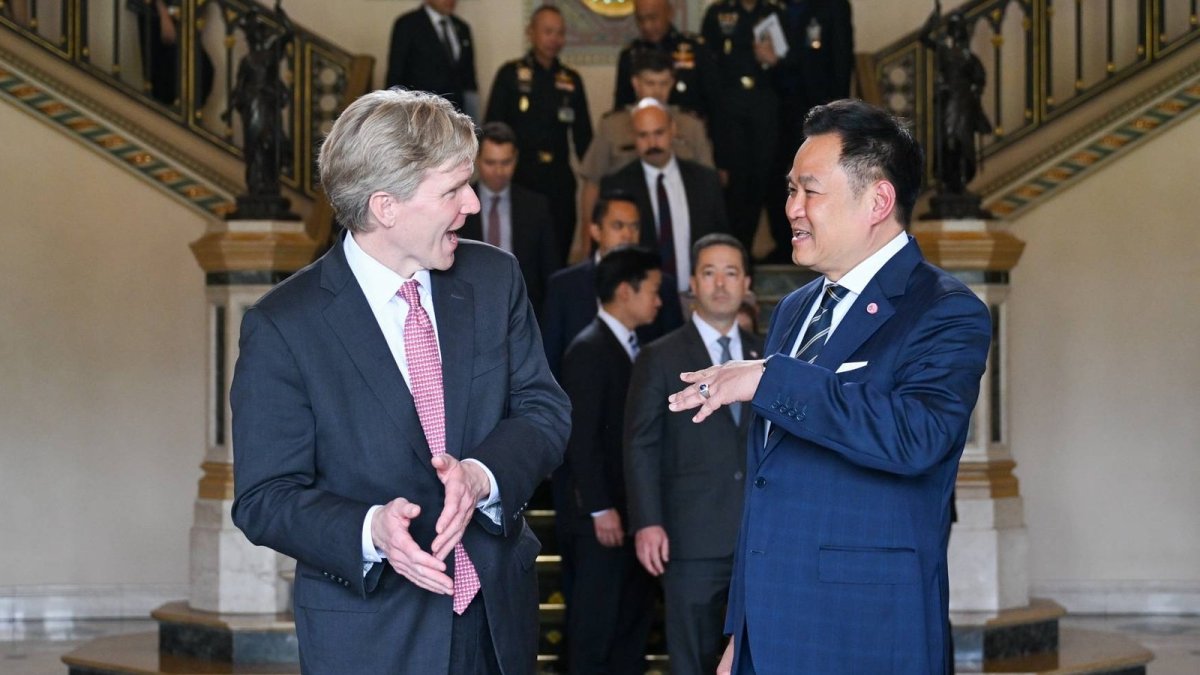
The Meeting at Government House
Prime Minister Anutin Charnvirakul welcomed Elbridge Colby, the United States Under Secretary of Defense for Policy, to Government House in Bangkok on Thursday afternoon. The meeting marked Colby's first official visit to Thailand, part of a broader regional tour this week that has taken him through the Philippines, Indonesia, Thailand, and Cambodia.
Government spokesperson Rachada Dhnadirek said Anutin opened the talks by highlighting the positive trajectory of Thai-US relations. The prime minister, who also serves as interior minister, used the occasion to address a question that has been circulating in diplomatic circles for weeks: whether Thailand would link its long-standing military partnership with Washington to the ongoing trade negotiations between the two countries.
The answer, delivered with characteristic directness, was a firm no.
'Not a Bargaining Chip': Anutin's Position
"Trade and security discussions proceed on the basis of mutual interests and through the relevant mechanisms for each area," Anutin said, according to the government readout of the meeting. The prime minister stressed that security cooperation is a key pillar of the bilateral relationship, but made clear that Thailand does not have a policy of linking defense cooperation to trade negotiations.
The statement carries particular weight given recent reports. The Straits Times had earlier suggested that Bangkok was considering using its military alliance as leverage in trade talks, with warnings that high tariffs could affect joint exercises such as Cobra Gold. Thursday's meeting appears designed to put that speculation to rest.
Anutin's message was consistent throughout the discussion: Thailand values its security partnership with the United States on its own merits, and trade matters will be handled through their own channels. The prime minister reaffirmed Thailand's commitment to concluding an Agreement on Reciprocal Trade (ART) with the United States as soon as possible, signaling that Bangkok remains eager to resolve the tariff question through negotiation rather than confrontation.
A 193-Year Alliance
The historical backdrop to Thursday's meeting is worth emphasizing. Thailand and the United States mark 193 years of formal relations this year, dating back to the 1833 Treaty of Amity and Commerce. That agreement, signed during the reign of King Rama III, established diplomatic and commercial ties that have endured through wars, coups, and countless shifts in the global order.
Anutin highlighted this deep history in his remarks, saying the alliance has benefited both countries and contributed to peace, security, and stability in the region. He called for the two nations to strengthen their alliance in response to a changing international environment and emerging security threats.
For Thai readers, this history is not abstract. The US-Thai alliance has been a cornerstone of Thailand's security posture for nearly two centuries. From the Vietnam War era to the present day, the relationship has weathered periods of strain — including the 1997 Asian financial crisis and the 2014 military coup — but has always recovered. The 193-year milestone is a reminder that this partnership has proven remarkably resilient.
What Washington Is Saying
Colby, for his part, described Thailand as an important US ally and said Washington places strategic importance on the region. He reaffirmed the US commitment to strengthening security cooperation with Thailand to address increasingly complex challenges and a rapidly changing security environment.
The Under Secretary's language was notable for its warmth. He said the United States values working with countries that share common principles and goals for maintaining regional peace and security — a formulation that places Thailand firmly within Washington's circle of trusted partners in Southeast Asia.
Colby's regional tour itself is significant. His itinerary — the Philippines, Indonesia, Thailand, and Cambodia — tracks the arc of US strategic interests in Southeast Asia. The visit comes at a time when Washington is seeking to deepen its engagement with ASEAN member states amid intensifying competition with China for influence in the region.
The two sides agreed to deepen security cooperation, including efforts to strengthen their ability to respond to modern security challenges, modernize Thailand's armed forces, and expand defense industry cooperation. These are concrete commitments, not just diplomatic pleasantries.
Defense Modernisation and the Trade Talks
The trade backdrop adds urgency to Thursday's message. Thailand has been racing to conclude its Agreement on Reciprocal Trade with the United States, with officials in Bangkok earlier targeting late July for completing the negotiations. Washington has already finalised similar reciprocal trade agreements with Cambodia, Malaysia and Indonesia in recent months, raising expectations that a Thai deal may follow on comparable terms.
Keeping the two tracks separate is also a strategic choice. By insisting that defense cooperation stands on its own merits, Bangkok avoids handing Washington a bargaining lever in the tariff talks, while preserving the security partnership that underpins Thailand's defense posture. The prime minister's phrasing on Thursday, that trade and security discussions proceed "through the relevant mechanisms for each area," suggests a government confident it can manage both relationships without conflating them.
For Thai businesses, the stakes are high. The United States remains one of Thailand's largest trading partners, and the prospect of sustained tariffs has weighed on export-dependent industries from electronics to agricultural products. Anutin's assurance that security cooperation will not be used as a bargaining chip suggests the government believes it can secure a favorable trade deal without sacrificing its defense relationship.
Regional Ripples: Thailand, Cambodia and ASEAN
Thursday's talks also touched on matters closer to home. Anutin raised the Thailand-Cambodia border situation, thanking US President Donald Trump for his constructive role in supporting efforts to ease tensions. The prime minister reaffirmed Thailand's commitment to international law, good-neighborly relations, and a peaceful resolution through bilateral mechanisms, including implementation of the Kuala Lumpur Accords.
The reference to the Kuala Lumpur Accords is significant. These agreements, which provide a framework for border management and dispute resolution between Thailand and Cambodia, have been central to efforts to prevent the kind of armed clashes that occurred along the border in 2011. Anutin's emphasis on peaceful resolution through bilateral mechanisms signals that Bangkok prefers to handle the Cambodia question directly, without external mediation.
Anutin also raised cooperation against transnational crime, referring to his meeting with FBI Director Kash Patel in July. The two sides discussed strengthening law enforcement cooperation, particularly efforts to prevent and combat transnational crime in the region. This is a growing concern for Thailand, which has become a transit point for drug trafficking, human smuggling, and cybercrime syndicates operating across Southeast Asia.
For ASEAN observers, the meeting sends a clear signal: Thailand remains firmly anchored in its alliance with the United States, even as it navigates complex relationships with China and its immediate neighbors. The balance is delicate, but Thursday's talks suggest Bangkok is managing it with care.
What This Means for Thai Readers
For ordinary Thais, the significance of Thursday's meeting may seem remote. But the implications are concrete.
First, the assurance that defense cooperation will not be used as a bargaining chip in trade talks should reassure Thai exporters and workers in export-dependent industries. The government is signaling that it will pursue trade negotiations on their merits, without risking the security partnership that underpins Thailand's defense posture.
Second, the agreement to modernize Thailand's armed forces and expand defense industry cooperation could have tangible economic benefits. Defense industry partnerships often bring technology transfer, job creation, and opportunities for Thai companies to participate in regional supply chains.
Third, the emphasis on transnational crime cooperation reflects a real concern for Thai communities. From the Golden Triangle drug trade to online scam operations targeting Thai citizens, transnational crime is not an abstract issue — it affects daily life. Closer cooperation with the FBI and other US agencies could yield practical results in combating these threats.
Finally, the reaffirmation of the 193-year alliance is a reminder of Thailand's unique position in Southeast Asia. As the only country in the region never colonized by a Western power, Thailand has long prided itself on maintaining independence while building strong partnerships. Thursday's meeting suggests that tradition continues.
The road ahead is not without challenges. The ART negotiations remain unresolved, and the tariff question will not disappear overnight. But Thursday's talks at Government House offered a measure of clarity: Thailand's security partnership with the United States is not for sale, and trade matters will be settled on their own terms.
This article was produced with AI-assisted research and editorial support. Sources: Khaosod English, Government House readout, The Straits Times, Nation Thailand.
By Ann Srisawat, Staff Writer
What's Your Reaction?
 Like
0
Like
0
 Dislike
0
Dislike
0
 Love
0
Love
0
 Funny
0
Funny
0
 Wow
0
Wow
0
 Sad
0
Sad
0
 Angry
0
Angry
0

Southeast Asia Correspondent at Global1.News. Based in Bangkok, covering Thai and Southeast Asian politics, economy, technology, and culture. Deep regional perspective on one of the world's most dynamic regions.














Comments (0)