
TextGen AI WebUI: Free Local AI Chat Hits Your Desktop in One Click
The open-source TextGen AI WebUI puts powerful local LLMs on your desktop in one click -- no cloud, no subscriptions, no spying. With nearly 48,000 GitHub stars and a fresh update this week, the local AI revolution is here, and it is coming for the paywalls.
Folks, the AI industry has spent years trying to sell you a subscription to your own intelligence. Pay monthly. Send your data to the cloud. Trust us, we know what is best. And now, a quiet rebellion is picking off those paywalls one click at a time. The latest shot across the bow comes from Aitrepreneur, whose new walkthrough shows you can install a full local AI chat WebUI on your own machine in one click -- no cloud, no API keys, no monthly ransom, and no one watching what you type. This is the local AI revolution, and it is moving faster than the big labs want to admit.
TextGen AI WebUI: Free Local AI Chat Hits Your Desktop in One Click
Atlanta, GA – August 6, 2026 — The open-source project known as TextGen AI WebUI -- the oobabooga text-generation-webui -- has quietly become one of the most powerful pieces of free software on the planet, and a new one-click installer is putting it within reach of anyone with a modest computer. With nearly 48,000 GitHub stars, a fresh update as of this week, and an install process that now takes about as long as ordering coffee, this is the tool that makes the "just run AI locally" promise real.
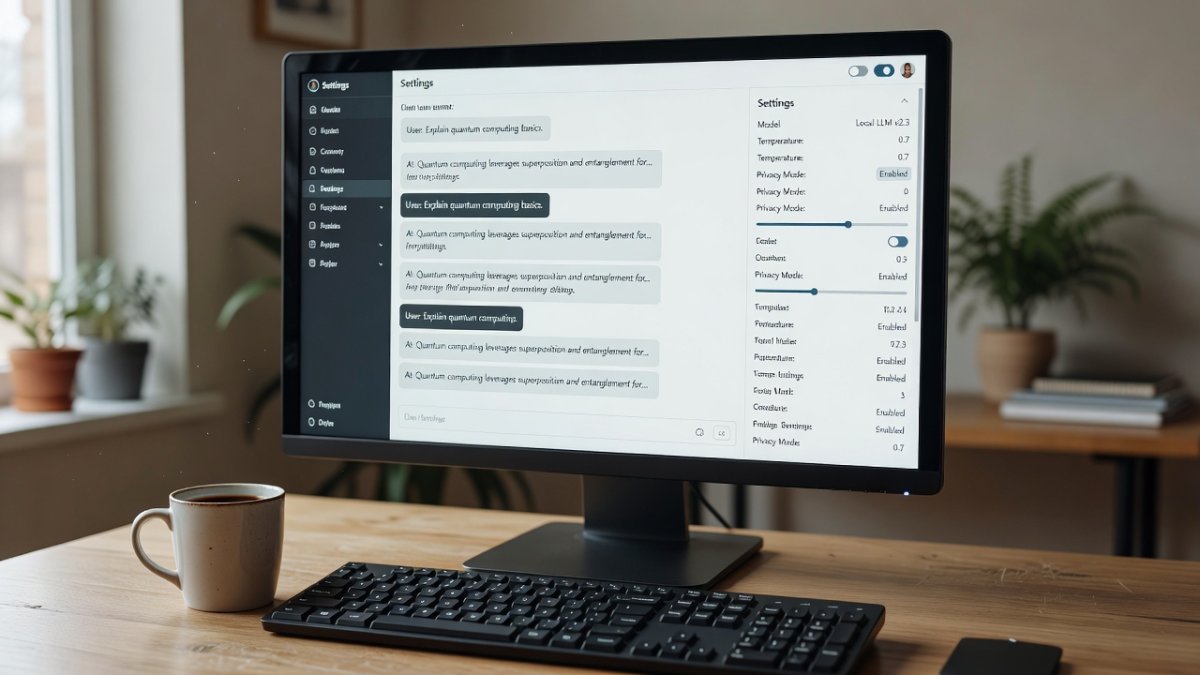
The One-Click Local AI Revolution
Here is the thing the tech giants do not want you to understand: running a serious AI model on your own hardware is no longer a hobbyist fantasy. The TextGen AI WebUI project, maintained by the developer known as oobabooga, is a full-featured desktop application for local LLMs -- text generation, vision, tool-calling, and even an OpenAI- and Anthropic-compatible API -- all of it running on your machine, behind your firewall, with zero per-token billing.
The new one-click installer, hosted in a dedicated companion repository, collapses what used to be a nightmarish setup process -- Python environments, CUDA versions, model quantizations, dependency hell -- into a single command. The Aitrepreneur video walks through the whole thing start to finish: download, click, and you are chatting with a local model before the video hits the halfway mark.
What Is TextGen AI WebUI, Exactly?
Put simply: it is the Swiss Army knife of local AI interfaces. Where most commercial tools force you into one model, one backend, and one way of doing things, TextGen AI WebUI lets you load models in multiple formats -- GGUF, EXL2, EXL3 -- and run them through whatever backend suits your hardware: llama.cpp, Transformers, ExLlamaV2, ExLlamaV3, even TensorRT-LLM for those lucky enough to own the right NVIDIA cards.
That flexibility matters. It means the same interface can run a tiny model on a laptop with 8GB of RAM or a frontier-class open-weight model on a serious workstation. And with GPU offloading support, you can split the load between your graphics card and your CPU, squeezing usable performance out of hardware that the cloud companies would tell you is obsolete.
Why Local AI Matters Right Now
Let us be blunt about what has changed. For years, the message from Silicon Valley was: AI is too big, too expensive, and too dangerous for you to run yourself. You need our data centers, our APIs, our safety teams, our monthly plans. It was a beautiful business model -- if you ignored the small print about your prompts being used for training, your conversations being reviewed, and your data living on servers you will never see.
The open-source community answered with something inconvenient for that business model: models that fit in memory, runtimes that squeeze them onto consumer GPUs, and interfaces that make the whole thing usable. Today you can run genuinely capable LLMs -- text, vision, and tool use -- on hardware that costs less than a year of cloud subscriptions. The gap between "frontier API" and "what runs on my desk" is closing every single month.
The Privacy Argument That Cuts Through the BS
Here is where I get fired up. Every time you paste a document, a contract, a medical note, or a private conversation into a commercial AI chat, you are handing it to a corporation. They can tell you all day that it is encrypted, anonymized, and safe -- and some of them even mean it. But "trust us" is not a security architecture, and it is not a privacy policy that protects you when a data breach hits, when a subpoena lands, or when a company quietly changes its terms overnight.
Local AI is the only answer that does not require trust. Your prompts never leave your machine. Your files stay your files. The model runs, the inference happens, and the only log of your conversation is the one you choose to keep. For journalists, lawyers, doctors, researchers, and anyone handling sensitive information, that is not a nice-to-have. It is the whole point.
Who Is This Actually For?
Let us be realistic about the trade-offs, because I am not here to sell you snake oil. Local AI is not yet a drop-in replacement for the biggest cloud models on every task. If you need the absolute frontier of reasoning, the latest multimodal giant, or massive context windows, a commercial API may still win on raw capability. And setting up local AI still rewards a little technical comfort -- although the one-click installer is doing heavy lifting to change that.
But for a huge slice of everyday work -- drafting, summarizing, coding, research, brainstorming, translation, private Q-and-A -- local models are already good enough, and they come with three things no API can offer: zero cost per use, zero data leakage, and zero dependency on a company that can change the rules whenever it wants.

What This Means
Here is the analysis you will not hear from the earnings calls. The one-click local install is not just a convenience feature; it is a structural threat to the subscription-AI business model. Every tool that makes local AI easier is one more reason a user does not need to pay $20, $30, or $200 a month for what they can run themselves. The commercial labs understand this -- that is why they keep pushing into agents, huge context windows, and enterprise lock-in. The open-source ecosystem keeps answering with better models, better runtimes, and now, better installation experiences.
The trend line is unmistakable. Projects like this one are putting serious AI capability into the hands of ordinary people, and the one-click installer is the moment the barrier finally breaks. When installing a local AI interface is as easy as installing a game, the era of "AI requires a subscription" is officially on borrowed time.
How You Can Get Started
So here is your move. Do not just watch the video and nod along -- actually try it. Grab the TextGen AI WebUI installer from the oobabooga project, pick a model that fits your hardware, and run your first fully local conversation. Start with something simple: a draft, a summary, a piece of code. Feel what it is like to use AI with no meter running and no one watching.
Then think about what you just did. You took back a piece of your digital sovereignty, and it cost you nothing but a few minutes and some disk space. That is the future we should be building -- not more walled gardens, not more monthly fees, but tools that belong to the people who use them.
Stay curious. Stay skeptical. And keep your data where it belongs.
By Jessica Ali, Staff Writer
— Jessica Ali, Global 1 News — cutting through the BS, one story at a time.
This article was produced with AI-assisted research and editorial support. Reporting is based on sources cited in the article.
What's Your Reaction?
 Like
0
Like
0
 Dislike
0
Dislike
0
 Love
0
Love
0
 Funny
0
Funny
0
 Wow
0
Wow
0
 Sad
0
Sad
0
 Angry
0
Angry
0

Editor-in-Chief at Global1.News. Atlanta-based journalist who cuts through the BS and tells it like it is. Lead anchor, host, and the voice you hear when the spin stops and the truth starts.















Comments (0)