
Taiwan-Vatican Ties: The Dynamic Interplay Under Pope Leo XIV
Since Pope Leo XIV’s accession in May 2025, the diplomatic choreography between the Holy See and the Republic of China (Taiwan) has moved from symbolic gestures to a series of concrete, multilevel engagements.
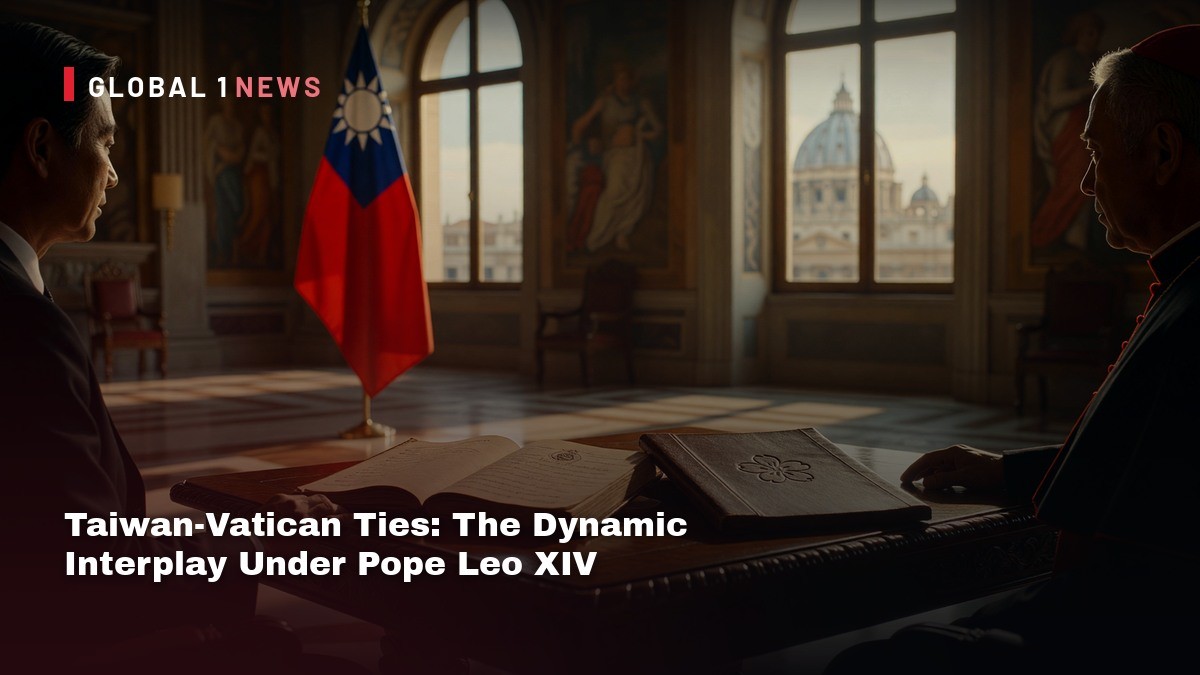
Since Pope Leo XIV’s accession in May 2025, the diplomatic choreography between the Holy See and the Republic of China (Taiwan) has moved from symbolic gestures to a series of concrete, multilevel engagements. While the pontiff has maintained Pope Francis’s “engagement” and “openness” strategy toward Beijing—most notably by preserving the 2018 provisional agreement on bishop appointments—the Leo‑era has also amplified Taiwan‑Vatican interaction across scientific, theological, and diplomatic arenas. This article traces the recent cascade of events that illuminate how Taiwan’s “Integrated Diplomacy” of values, alliances and trade is being operationalized in Europe, and assesses the broader implications for Northeast Asian geopolitics.
Continuity and Acceleration of the Sino‑Vatican Framework
The 2018 provisional agreement, signed between the Holy See and the People’s Republic of China, established a joint mechanism for appointing bishops and secured Beijing’s formal recognition of the Pope as the supreme head of the Catholic Church. Pope Leo XIV has not altered this framework; rather, he has “accelerated the bishop‑appointment process,” ushering in a “rejuvenated” roster of Chinese prelates. This continuity signals to the international community that the Vatican remains committed to a diplomatic pathway with Beijing, even as it simultaneously cultivates deeper ties with Taipei.
From a Korean diplomatic perspective, the Vatican’s dual‑track approach mirrors Seoul’s own balancing act between the United States and China. By preserving the Sino‑Vatican agreement while expanding practical cooperation with Taiwan, the Holy See demonstrates a nuanced hedging strategy that could inform future Korean foreign‑policy calculations, especially as Seoul navigates its own “values‑based” alliances in the Indo‑Pacific.
Scientific Diplomacy: Academia Sinica’s Pontifical Engagement
Between 23 and 26 September 2026, Chen Chien‑Jen—former vice president of Taiwan and current president of Academia Sinica—participated in the Pontifical Academy of Sciences (PAS) meeting and its biennial plenary session in Vatican City. Chen presided over the seventh session, titled “Medicine, Neuroscience, and Human Well‑being,” and co‑authored a joint statement, “The Future of Science in a Changing World,” with the PAS. This document serves as an action plan for the international scientific community, positioning Taiwan as a key contributor to global scientific discourse.
The significance of this engagement lies in its “practical, multifaceted” nature. By leveraging the Holy See’s global platform, Taiwan showcases its research capacity beyond the high‑tech sector, echoing Korea’s own strategy of coupling technological prowess with soft power through cultural and scientific outreach. The event underscores how academic diplomacy can reinforce bilateral ties without overt political bargaining.
Ecclesiastical Participation: Taiwanese Bishops and Vatican Dicasteries
From 7 to 15 October 2026, Bishop John Lee Keh‑mien, president of the Chinese Regional Bishops’ Conference in Taiwan, attended a major Vatican conference hosted by Pope Leo XIV. The gathering commemorated the 10th anniversary of Pope Francis’s apostolic exhortation Amoris Laetitia and welcomed 187 invited guests, including 111 presidents of episcopal conferences worldwide. Taiwanese representation extended beyond the bishop to Professor Chou Te‑yu and Consultor Yeh Chia‑yen, both members of the Dicastery for the Laity, Family and Life.
This high‑level participation demonstrates that Taiwanese clergy are not merely peripheral observers but active contributors to global Catholic deliberations. Their presence in Vatican dicasteries reflects a deepening of “values‑based” diplomacy, wherein shared religious commitments become a conduit for broader political dialogue—a pattern observable in Korea’s own engagement with the Vatican through the Korean Catholic Bishops’ Conference.
Theological Integration: Appointment to the International Theological Commission
On 19 October 2026, Pope Leo XIV appointed Sister Hu Shu‑qin, an associate professor at Fu Jen Faculty of Theology of St. Robert Bellarmine, to the International Theological Commission for the 2026‑2031 term. Sister Hu is the first ethnic Chinese theologian to join the commission since Archbishop Savio Hon Tai‑Fai, S.D.B., who served from 2004 to 2014. Her appointment signals the Vatican’s recognition of Taiwan’s scholarly contributions to Catholic theology.
For Korean observers, the inclusion of a Taiwanese theologian in a premier Vatican body highlights the potential of academic meritocracy to transcend geopolitical divides. It suggests that sustained investment in theological education—exemplified by Fu Jen’s robust programs—can yield diplomatic dividends, a lesson that Korean Catholic institutions may emulate as they seek greater influence within the universal Church.
Synodal Outreach: The “Church of the Sheaves” Conference
From 22 to 24 October 2026, the Dicastery for Evangelization hosted the “Church of the Sheaves” international conference in Rome, under the theme “A Church for All: Synodal in Method, Missionary in Spirit, Credible in Love.” Over a hundred scholars gathered to discuss synodality—a shift from a top‑down missionary model to a reciprocal exchange of gifts among local churches. Professor Tan Liang‑chen, an assistant professor and public Catholic theologian at Fu Jen Faculty of Theology, attended as Taiwan’s representative.
The conference’s emphasis on “mutual listening and sharing” aligns with Taiwan’s diplomatic narrative of “values‑based” engagement. By presenting Taiwanese theological perspectives within a synodal framework, Taiwan reinforces its image as a mature, pluralistic society—an attribute that resonates with Korean policy circles that prioritize democratic values in their foreign‑policy calculus.
Integrated Diplomacy: Taiwan’s Strategic Use of Values, Alliances, and Trade
Taiwan’s Ministry of Foreign Affairs has articulated an “Integrated Diplomacy” strategy that weaves together “Values,” “Alliances,” and “Trade.” The recent series of Vatican engagements exemplifies how this approach operates in practice: religious and academic exchanges amplify Taiwan’s “values” narrative; participation in Vatican dicasteries and conferences cultivates “alliances” with a sovereign entity that remains Taiwan’s sole diplomatic partner in Europe; and the visibility of Taiwanese scientific and theological expertise complements “trade” by showcasing the island’s broader contribution to global knowledge economies.
From a Korean geopolitical lens, Taiwan’s model offers a template for leveraging non‑traditional diplomatic channels—religious institutions, academic bodies, and cultural platforms—to offset diplomatic isolation. As the Sino‑Vatican relationship evolves, the Holy See’s continued openness to Taiwanese actors may serve as a stabilizing factor, providing both Taipei and Seoul with a diplomatic conduit that is less susceptible to the vicissitudes of great‑power politics.
Future Trajectories: Implications for Regional Stability
Looking ahead, the deepening of Taiwan‑Vatican ties under Pope Leo XIV must be read within the broader context of shifting Sino‑Vatican dynamics. While the Vatican maintains its provisional agreement with Beijing, the pontiff’s parallel cultivation of Taiwanese scientific, theological, and diplomatic participation suggests a calibrated diversification of partnerships. For Korea, this dual‑track diplomacy underscores the importance of maintaining flexible, values‑driven foreign‑policy options that can adapt to changing great‑power calculations.
In sum, the past year has witnessed a series of “small yet monumental steps” that collectively reinforce Taiwan’s diplomatic resilience. By embedding its presence in the Vatican’s scientific, theological, and evangelization arenas, Taiwan not only secures a steadfast ally in Europe but also projects a model of “integrated diplomacy” that could inform Seoul’s own strategic outreach in an increasingly complex Northeast Asian security environment.
This article was produced with AI-assisted research and editorial support. Reporting is based on the source material cited below. Sources: The Diplomat; thediplomat.com; Global1.News (27 October 2026).
By Prof. David Park, Staff Writer
What's Your Reaction?
 Like
0
 Dislike
0
 Love
0
 Funny
0
 Wow
0
 Sad
0
 Angry
0
East Asia/Technology Correspondent at Global1.News. Seoul-based voice covering Korean politics, technology, business, and culture. Analyzes how technology and geopolitics intersect across East Asia.










Comments (0)