
South Korea's Lee Jae-myung Reshuffles Cabinet: Six New Ministers in Bid to Reboot Economy and Defense
President Lee Jae-myung moved Sunday to reset his administration, nominating six new ministers in a broad Cabinet reshuffle aimed at reviving a sagging economy, steadying national defense, and countering a slide in public support that has seen his approval rating hit new lows. The shakeup, announced
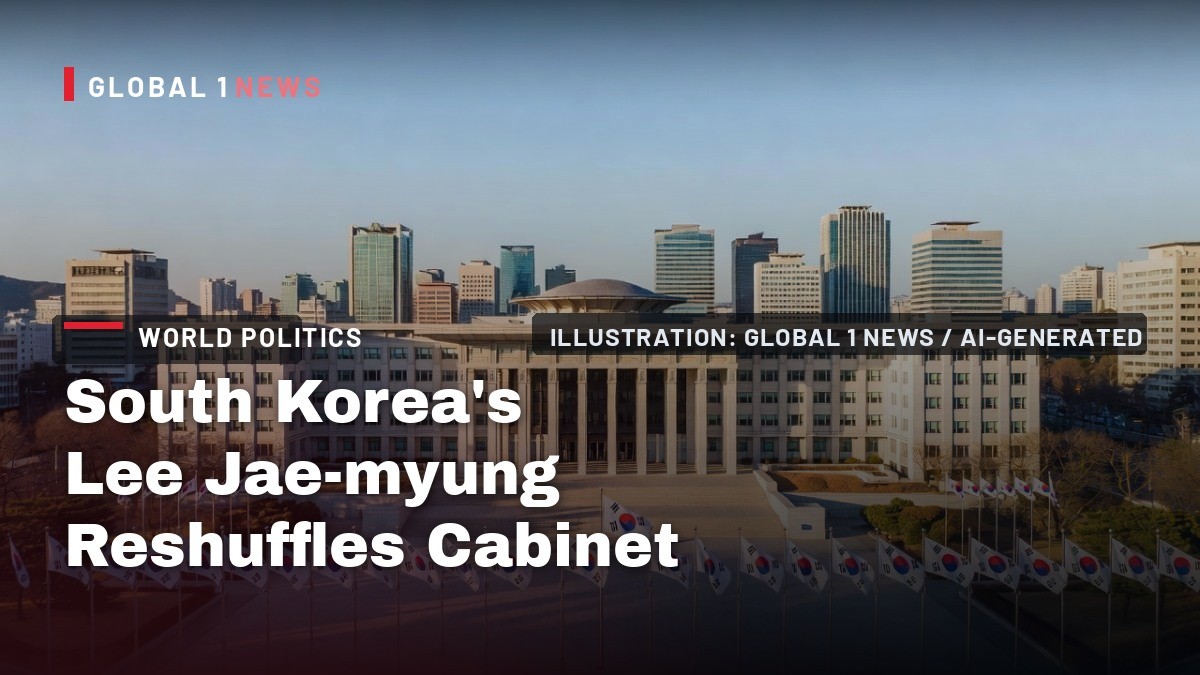
President Lee Jae-myung moved Sunday to reset his administration, nominating six new ministers in a broad Cabinet reshuffle aimed at reviving a sagging economy, steadying national defense, and countering a slide in public support that has seen his approval rating hit new lows. The shakeup, announced by presidential chief of staff Kang Hoon-sik at Cheong Wa Dae, marks the first major Cabinet overhaul since Lee took office in June 2025, roughly 14 months into his term.
South Korea's Lee Jae-myung Reshuffles Cabinet: Six New Ministers in Bid to Reboot Economy and Defense
SEOUL, South Korea — President Lee Jae-myung announced a sweeping Cabinet reshuffle on Sunday, August 30, 2026, nominating six new ministers in a bid to inject fresh energy into his administration as it confronts falling approval ratings, housing price pressures, and stock market volatility. The nominations, unveiled by presidential chief of staff Kang Hoon-sik at a press briefing at Cheong Wa Dae, target the economic, defense, justice, infrastructure, gender equality, and small business portfolios, with an eye toward delivering what the president’s office called “tangible changes for the people.”
The Six Nominees and Their Portfolios
The reshuffle spans the core of Lee’s Cabinet, bringing in a mix of career bureaucrats, ruling party lawmakers, and one opposition figure. The six nominees are: Lee Hyoung-il, nominated as deputy prime minister for economic affairs and minister of finance and economy; Kang Shin-chul, nominated as minister of national defense; Rep. Kim Seung-won, nominated as minister of justice; Hong Jee-sun, nominated as minister of land, infrastructure and transport; Rep. Yong Hye-in, nominated as minister of gender equality and family; and Rep. Lee So-young, nominated as minister of SMEs and Startups.
Each nomination carries distinct weight. Lee Hyoung-il, a career finance ministry official, is tasked with steering the economy through a period of uncertainty. Kang Shin-chul, a retired four-star Army general, returns the defense ministry to a career military figure after a civilian politician held the post. Kim Seung-won, a hardline prosecutorial reform advocate, takes on the justice portfolio. Hong Jee-sun, a career bureaucrat with deep experience in housing and urban development, steps in to manage land and infrastructure. Yong Hye-in, the youngest nominee and a member of an opposition party, brings a working mother’s perspective to gender equality. And Lee So-young, a lawyer specializing in climate and environmental law, takes the helm at the SMEs and Startups ministry.
Presidential chief of staff Kang Hoon-sik described the selections as leaders with “dynamism and expertise” who will deliver “tangible changes for the people” and lead the country toward “a great leap forward.” He said Lee has advised officials to “inject new vitality into people’s livelihoods and growth, and expedite innovation in future industries, including AI.”

Kang Shin-chul: A Career Soldier Returns to Defense
The nomination of Kang Shin-chul as defense minister marks a significant shift. Kang, born in 1968 in Seoul, is currently South Korea’s ambassador to Saudi Arabia, a post he took up in February after retiring from the military in September 2025. A retired four-star Army general, Kang previously served as deputy commander of the South Korea-U.S. Combined Forces Command (CFC), one of the most sensitive and senior positions in the alliance structure.
Kang’s military career spans 35 years. He graduated from the Korea Military Academy as part of the 46th class and was commissioned as an infantry second lieutenant in 1990. Over the decades, he held a series of key posts: chief of policy division at the CFC, military aide to the defense minister, commander of the 11th Mechanized Infantry Division, head of the Operations Directorate at the Joint Chiefs of Staff, and secretary for national defense policy at the presidential National Security Office from 2021 to 2022 under President Moon Jae-in.
Notably, Kang served as CFC deputy commander during the period of the Dec. 3, 2024 martial law declaration, a turbulent chapter in South Korea’s recent political history. His experience during that period, combined with his deep understanding of the U.S.-South Korea alliance, positions him as a steady hand for the defense ministry. He replaces Ahn Gyu-back, a civilian politician, meaning the post now returns to a career military figure after a period of civilian leadership.
Kim Seung-won: Prosecutorial Reform at the Justice Ministry
Rep. Kim Seung-won, the nominee for minister of justice, brings a long history of advocacy for prosecutorial reform. A ruling Democratic Party of Korea lawmaker representing Suwon, Gyeonggi Province, Kim won his seat in 2020. His legal pedigree is substantial: he passed the bar exam in 1996, served as a judge, practiced law, and joined the Moon Jae-in administration’s presidential office in 2018.
Kim framed his nomination in sweeping terms, saying South Korea stands “on the cusp of a major transformation of the criminal justice system that has remained in place for 70 years.” He pledged to uncover substantive truth more swiftly, protect public safety, and safeguard crime victims’ rights. His appointment signals a continued push by the Lee administration to reshape the prosecutorial apparatus, a contentious issue that has defined much of South Korea’s recent political battles.
Kim’s hardline stance on prosecutorial reform is well documented. As a lawmaker, he has been a vocal critic of the prosecution service’s powers and has advocated for structural changes to limit its influence. His move to the justice ministry puts him in a position to implement those changes directly, though he will first need to clear a confirmation hearing at the National Assembly.
Yong Hye-in: A Working Mother and Opposition Figure in the Cabinet
Rep. Yong Hye-in, nominated as minister of gender equality and family, is the youngest of the six nominees and the first ministerial nominee born in the 1990s. Born in 1990, Yong is the floor leader of the minor Basic Income Party, an opposition party, and a two-term lawmaker with a background in civic activism.
Yong’s profile is distinctive in South Korean politics. In May 2021, she appeared at a National Assembly press conference carrying her 59-day-old son while a sitting lawmaker, a moment that drew national attention and highlighted the challenges faced by working parents. She said she received the news of her nomination “on a weekend morning while caring for my six-year-old child,” adding that she feels a greater responsibility as a working mother in her 30s and as a member of an opposition party sharing responsibility for state affairs.
Her appointment is notable not just for her age but for her party affiliation. Tapping an opposition figure for a Cabinet post is an unusual move in South Korean politics, and it suggests Lee is seeking to broaden his government’s appeal. Yong’s focus on family policy and gender equality, informed by her own experiences, could bring a fresh perspective to a ministry that has often been at the center of contentious social debates.
Economic Team: Lee Hyoung-il and the Megaproject Push
The centerpiece of the reshuffle is the nomination of Lee Hyoung-il as deputy prime minister for economic affairs and minister of finance and economy. Lee, born in 1971, is currently first vice minister of finance and economy, and he is a career bureaucrat who joined the finance ministry in 1993. His resume includes stints as a senior economist at the World Bank and as commissioner of Statistics Korea from July 2023 to June 2025, before he became vice minister in June 2025.
In his statement, Lee said the Korean economy needed “a great leap forward toward an irreplaceable Korea,” pledging three megaprojects, a rebound in potential growth, and efforts to address polarization. The megaproject initiative, unveiled in late June, has the government working with tech conglomerates to promote large-scale investments in semiconductor production and AI-related facilities, with a focus on regional areas. Lee’s appointment puts him at the helm of that initiative, which is central to the administration’s economic strategy.
The economic stakes are high. Lee’s administration has leaned on the semiconductor boom for policy space, but concerns over runaway housing prices and stock market volatility have weighed on public sentiment. The new finance minister will be expected to manage these pressures while advancing the megaproject agenda. His background as a career bureaucrat, rather than a politician, suggests a focus on technocratic competence over political messaging.
Why Now: Approval Ratings and Public Pressure
The reshuffle comes at a critical juncture for the Lee administration. A Gallup Korea poll published Aug. 28, 2026 showed disapproval topping 50% and approval at a new low for Lee’s term. Korea JoongAng Daily reported approval below 40% in a poll released Wednesday, Aug. 26, prompting the presidential office to pledge a focus on livelihoods and the economy.
The timing is no coincidence. With approval ratings sliding, the administration is under pressure to demonstrate responsiveness to public concerns. Housing prices have been a persistent sore point, and stock market volatility has added to economic anxiety. The reshuffle is an attempt to reset the narrative, bringing in fresh faces and signaling a renewed focus on the issues that matter most to voters.
Experts quoted by The Korea Times described the shuffle as largely routine but reflecting the administration’s response to criticism over falling approval ratings. The choice of nominees—a mix of career officials and lawmakers with specific expertise—suggests an effort to project competence and stability rather than ideological purity. The inclusion of Yong Hye-in, an opposition figure, adds a layer of political calculation, potentially aimed at broadening the government’s base of support.
The Megaproject Initiative and AI/Semiconductor Focus
Central to the economic reboot is the megaproject initiative, which the administration has positioned as a cornerstone of its growth strategy. The initiative, unveiled in late June, involves collaboration between the government and tech conglomerates to drive large-scale investments in semiconductor production and AI-related facilities, with a particular emphasis on regional development.
Lee Hyoung-il’s nomination as finance minister places him at the center of this effort. His pledge of “three megaprojects” and a rebound in potential growth signals an ambitious agenda, though details remain to be fleshed out. The administration has also created a new post—presidential aide for the megaproject initiative—which has been filled by Lee Won-ju, a senior official at the environment ministry.
The AI and semiconductor focus is strategic. South Korea’s economy is heavily reliant on the semiconductor sector, and the global AI boom has created new opportunities for growth. By tying the megaproject initiative to these industries, the administration is betting on high-tech manufacturing to drive job creation and regional investment. The appointment of Rep. Lee Hai-min of the minor Rebuilding Korea Party as presidential secretary for AI policy and future planning underscores the priority placed on this area.
What Happens Next: Confirmation Hearings and Political Analysis
The six minister nominees are to undergo confirmation hearings at the National Assembly, a process that could prove contentious. While the ruling Democratic Party holds a majority, the inclusion of Yong Hye-in from the Basic Income Party and the broader political context could invite scrutiny. The hearings will test the nominees’ qualifications and their ability to withstand political pressure.
Political analysts see the reshuffle as a calculated move by Lee to regain momentum. The appointments of Kim Kyoung-soo, former South Gyeongsang governor, as special aide for political affairs, and Lee Won-ju as megaproject aide, add political and administrative heft to the presidential office. The mix of career bureaucrats and lawmakers suggests an administration seeking to balance technical expertise with political connectivity.

The confirmation hearings will be closely watched, particularly for Kang Shin-chul, whose role during the Dec. 3, 2024 martial law period may draw questions, and for Yong Hye-in, whose opposition party affiliation could complicate her path. But if confirmed, the new ministers will face immediate pressure to deliver on the administration’s promises of economic revival and tangible improvements in daily life.
For now, the reshuffle represents a bet by Lee that fresh faces and a renewed focus on the economy can reverse his political fortunes. Whether it succeeds will depend on the nominees’ performance in hearings and their ability to translate policy pledges into results.
This article was produced with AI-assisted research and editorial support. Sources: Yonhap News Agency, The Korea Times, The Korea Herald, Korea JoongAng Daily, Chosun.
By Jessica Ali, Staff Writer
What's Your Reaction?
 Like
0
Like
0
 Dislike
0
Dislike
0
 Love
0
Love
0
 Funny
0
Funny
0
 Wow
0
Wow
0
 Sad
0
Sad
0
 Angry
0
Angry
0

Editor-in-Chief at Global1.News. Atlanta-based journalist who cuts through the BS and tells it like it is. Lead anchor, host, and the voice you hear when the spin stops and the truth starts.












Comments (0)