
Mali music star Salif Keïta cancels South African concerts over 'xenophobic violence'
The "Golden Voice of Africa" has gone silent in South Africa. Salif Keïta, the 77-year-old Malian musician whose career spans five decades and whose sound helped carry African music onto the global stage, has cancelled his scheduled performances at next month's Macufe festival in Free State
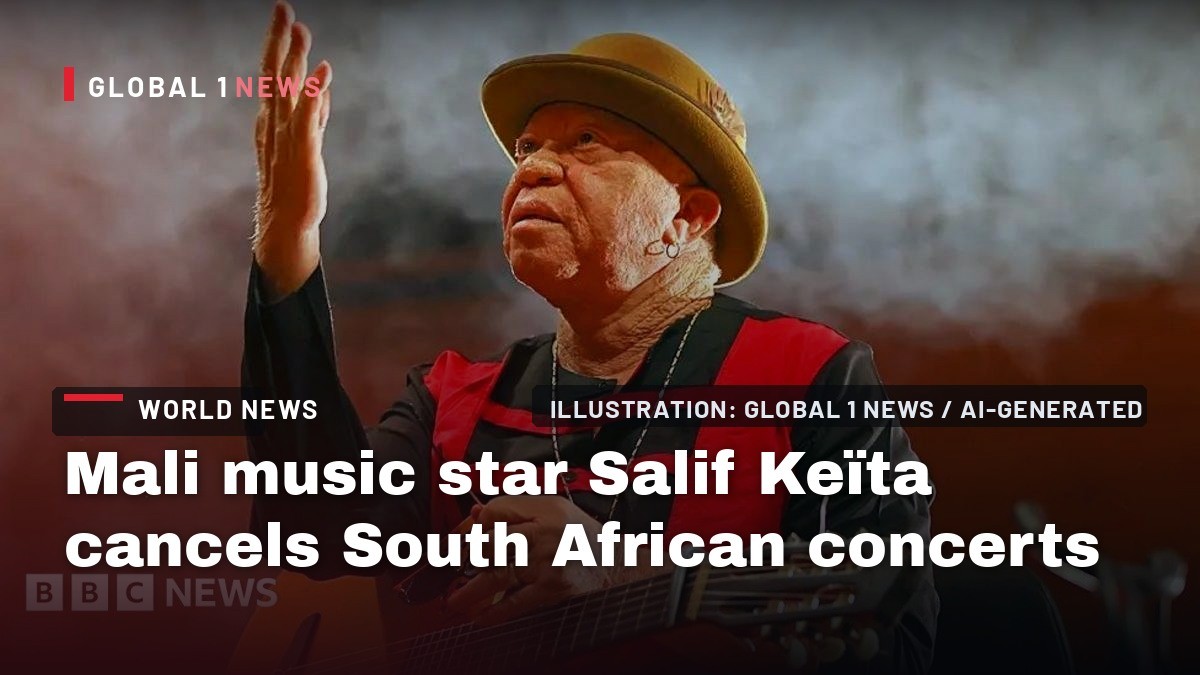
The "Golden Voice of Africa" has gone silent in South Africa. Salif Keïta, the 77-year-old Malian musician whose career spans five decades and whose sound helped carry African music onto the global stage, has cancelled his scheduled performances at next month's Macufe festival in Free State province. His reason is stark: he cannot ignore what he calls "xenophobic violence against our African brothers and sisters."
The decision lands at a moment of deep tension across the continent's southern tip. South Africa, Africa's wealthiest nation and a magnet for migrants seeking opportunity, is convulsed by protests demanding that undocumented foreigners leave. An unofficial deadline of 30 September looms, and tens of thousands have already packed up their lives and gone home. Keïta's move, announced this week, has been met with disappointment by the Free State government, but it has also given voice to a growing unease among Africans watching the crisis unfold from afar.
A Rejection of Hate, Not of South Africans
In a message explaining his decision, Keïta was careful to draw a line between the politics of the moment and the people he has known for decades. "When I see migrants attacked, I do not see 'politics'. I see people looking for work, safety, and dignity," he said. The cancellation, he insisted, was "a rejection of hate" rather than a rejection of South Africans themselves. He left the door open for a return, adding that the current wave of hostility does not "match the South Africa I know." That distinction matters. Keïta is not a casual observer of the continent's affairs. He has been a cultural ambassador for Africa since the 1980s, blending Malian traditions with international influences and earning a reputation as one of the most influential musicians the continent has ever produced. His voice has carried messages of unity, pride, and resilience for half a century. When he speaks, people listen — and his words carry weight far beyond the concert halls he has chosen to skip. The Free State's culture department said it "regrets the decision taken by the renowned musician" and emphasised that the Macufe festival is meant to be a celebration of African unity. That framing makes Keïta's absence all the more poignant. A festival built on the idea of bringing Africans together will now proceed without one of the continent's most beloved voices, precisely because of the forces pulling Africans apart.Homecoming Under a Cloud: The Tanzanian Returnees
The news of Keïta's cancellation arrived on the same day as the first group of 173 Tanzanians touched down in Dar es Salaam, part of a voluntary repatriation programme that has seen more than 160,000 people leave South Africa since May, according to a count by the AFP news agency. For some, the flight home from Durban — a city that has seen some of the biggest protests — marked the end of decades spent building a life in South Africa. Abdul Idi went to South Africa in 2006, hoping to build a better life. He returned this week grateful to be alive, describing his final months there as "difficult and dangerous." His words were simple but devastating: "Foreigners are not wanted there." Rashid Ramadhan, 53, had spent 30 years in South Africa. He told reporters how he and others had been forced out of their accommodation in Durban and had been living outside for the past two months. Their jobs were gone. Life had become increasingly difficult. Thirty years — a lifetime of work, relationships, and memories — reduced to a desperate wait for a flight home. These are not abstract statistics. They are people who left everything behind. Malawians, Zimbabweans, Zambians, Ghanaians, and Nigerians have all been among those returning home under similar schemes. Each one carries a story of displacement, fear, and loss.The March and March Movement and the 30 September Deadline
The pressure on migrants is not easing. The anti-migrant group March and March has announced a second wave of nationwide protests set for 30 September, promising that this action will be "bigger and better organised" than the demonstrations on 30 June, which were accompanied by violence in some areas. Earlier this month, the group made a pointed appeal to leaders attending the Southern African Development Community (Sadc) summit in Durban, telling them to "fetch your people." The message was blunt: South Africa's patience with undocumented migrants has run out, and those who came seeking opportunity are now being told, in no uncertain terms, that they are no longer welcome. The South African government has walked a careful line. While cracking down on illegal immigration, officials have insisted that those who have taken the law into their own hands have been arrested. But the reality on the ground is messier. Protesters accuse undocumented migrants of placing pressure on public services and of being involved in crime. Migrants, in turn, describe intimidation, attacks, and a climate of fear that has made daily life unbearable.Ghana's Defiant Rejection of MTN's Donation
The fallout from the crisis is rippling across the continent in unexpected ways. Ghana's government has rejected a donation of about $1.7m (£1.25m) from MTN Ghana, a subsidiary of South African telecoms giant MTN Group, which had offered the money to support Ghanaians repatriated from South Africa. Ghana's foreign ministry said the government was committed to funding the evacuation and reintegration of its repatriated citizens itself. The rejection is a statement of principle — a refusal to accept charity from a South African-linked company at a moment when Ghanaian citizens are fleeing South Africa under duress. It is also a reminder that the crisis is not just a South African problem. It is a continental one, with economic, political, and emotional consequences that reach far beyond the protests in Durban and Johannesburg. Those returning home often need significant support. They have abandoned their livelihoods, their homes, and many of their possessions. Reintegration is not simply a matter of stepping off a plane. It means rebuilding lives from scratch, often with little more than the clothes on their backs. Ghana's decision to handle this itself, rather than accept corporate assistance, signals a determination to manage the crisis on its own terms.What This Moment Says About Pan-African Solidarity
Salif Keïta's cancellation is more than a personal decision by a famous musician. It is a cultural intervention — a reminder that the bonds between African nations are not just political or economic, but deeply emotional and historical. The idea of African unity has been a thread running through the continent's post-independence history, from the founding of the Organisation of African Unity to the establishment of the African Union. Music has been one of the most powerful vehicles for that idea, and Keïta has been one of its most prominent voices. When he says that the xenophobia does not match the South Africa he knows, he is speaking from experience. He has performed there, collaborated with South African artists, and witnessed the country's transformation. His decision to cancel is not a rejection of that history. It is a demand that the country live up to its own ideals. But the crisis also exposes the limits of Pan-African solidarity in the face of economic pressure. South Africa's unemployment rate is high, public services are strained, and many South Africans feel that undocumented migrants are competing for scarce resources. The anger driving the protests is real, even if its targets are often the most vulnerable people in society. The voluntary repatriation programmes offer one path forward, but they are a painful one. Tens of thousands of people have already left, and more are expected to follow before the 30 September deadline. For those who remain, the uncertainty is unbearable. For those who have left, the task of rebuilding begins.A Continent Watching and Waiting
Keïta's decision has been met with disappointment in Free State, but across the continent, it has been met with something closer to recognition. Many Africans are watching the crisis unfold with a mixture of sadness and anxiety. The dream of a united Africa, where people can move freely and build lives across borders, feels more distant than it has in years. The musician's words — "I see people looking for work, safety, and dignity" — capture what is at stake. Migration is not a crime. It is a human response to circumstance. People move because they are seeking something better, whether that is a job, a safe place to raise a family, or simply a chance to survive. When that search is met with violence and hostility, it diminishes everyone. Keïta has left the door open for a return. He has said his cancellation is not a rejection of South Africans, but of hate. That distinction offers a sliver of hope — a suggestion that this moment, painful as it is, does not have to define the future. The Golden Voice of Africa has gone quiet for now, but it has not been silenced. The question is whether South Africa, and the continent as a whole, will listen to what it has to say. By Amara Diop, Staff Writer This article was produced with AI-assisted research and editorial support. Sources: BBC Africa (bbc.com/news/world/africa)What's Your Reaction?
 Like
0
Like
0
 Dislike
0
Dislike
0
 Love
0
Love
0
 Funny
0
Funny
0
 Wow
0
Wow
0
 Sad
0
Sad
0
 Angry
0
Angry
0

Amara Diop
West Africa/Sahel Correspondent at Global1.News. Dakar-based journalist covering politics, security, climate, and development across Francophone and Anglophone West Africa. Tells the stories of a region undergoing profound transformation.












Comments (0)