
Russian Glide Bombs Strike Twice at Ukraine Aid Point
Russian glide bombs struck a humanitarian aid point at a school in Komyshuvakha twice on Monday, killing at least 31 people with more than 45 missing, a week before Ukraine, Russian and US teams meet in Abu Dhabi.
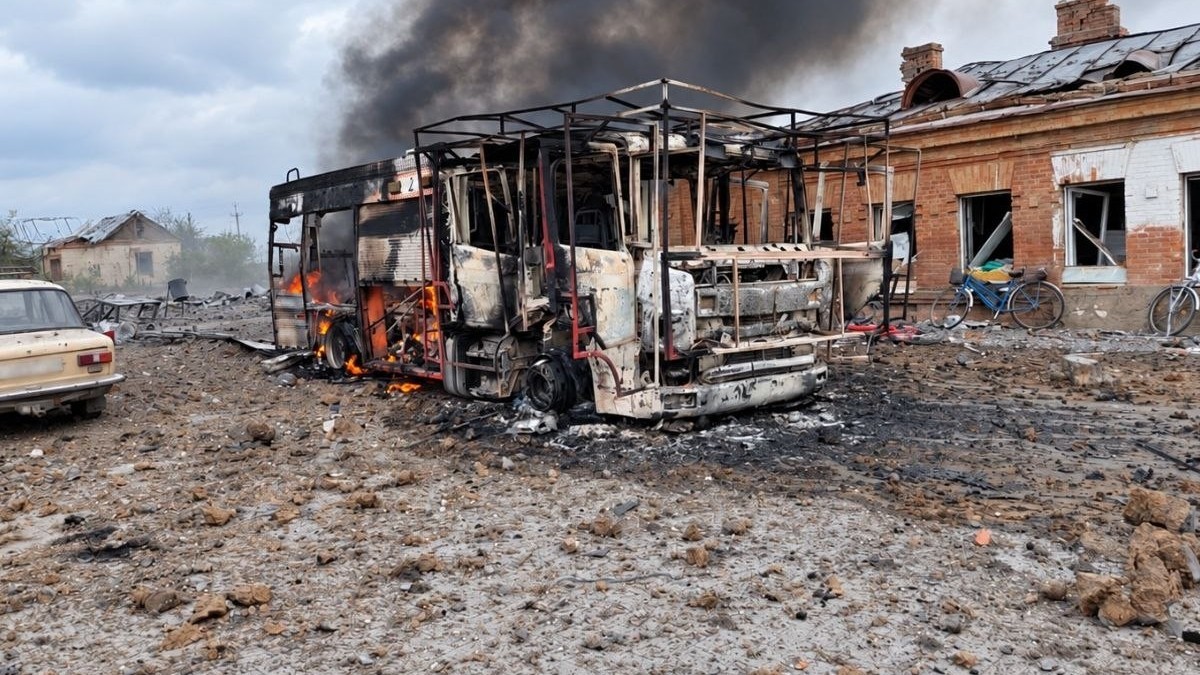
Russian guided aerial bombs struck a humanitarian aid distribution point at a school in the village of Komyshuvakha on Monday, then struck again as people took cover inside the building. Rescue teams worked through Tuesday in an area repeatedly disrupted by drone attacks, and the death toll rose again, according to regional officials. The attack came as teams from Ukraine, Russia and the United States prepare to meet in Abu Dhabi.
Russian Glide Bombs Strike Twice at Ukraine Aid Point
Komyshuvakha, Ukraine — The village lies in south-eastern Zaporizhzhia region, close enough to the front line that its school has not held classes for a long time. Residents who remained used the building as a weekly humanitarian aid distribution point and as a shelter. It was hit on Monday morning, and the search for survivors continued into Tuesday as the regional toll rose.
Nine Bombs on a Village Waiting for Food
Ukrainian officials say the weapons used at Komyshuvakha were guided aerial glide bombs. According to Mykhailo Semikin, acting head of the Zaporizhzhia regional military administration, at least nine of the bombs struck the village, each weighing about 3,000 kilograms. The Associated Press described them as "bunker-busting bombs, some filled with nearly 1.5 tonnes of explosives." No specific munition model has been confirmed as used.
President Volodymyr Zelenskyy posted video from the site showing a large crater and rescuers searching the rubble.
"The scale of the tragedy is terrifying," Semikin said.
He called it "one of the worst tragedies in terms of the number of civilian victims in our region since the start of the full-scale war," and said of the people who died: "They had come for help - not to a military facility, not to a frontline position, but to a place where they were supposed to receive support."
Three days of mourning were declared across Zaporizhzhia region, with Tuesday observed as a day of mourning.
A School With No Students, and a Queue Every Monday
The school in Komyshuvakha had stopped operating as an educational establishment because of its proximity to the front line, and there were no classes there, according to President Volodymyr Zelenskyy. It served instead as a weekly humanitarian aid distribution point and as a shelter.
"The Russians could not have been unaware that the local residents who remained in Komyshuvakha received humanitarian aid there every week," he said.
Residents who had remained in the village gathered at the building every Monday to collect aid packages, including food. On 2 November, aid was distributed there between 10 a.m. and noon. The UN human rights monitoring mission in Ukraine reported that local authorities announced the distribution the day before on a social media channel with nearly 5,000 subscribers.
The building was used as a shelter as well as a distribution point, and it was serving both purposes when the bombs arrived.
The Second Wave Hit the Shelter
The sequence described by Ukrainian officials was a double tap. Bombs fell as people were arriving for the distribution, and a second wave struck the shelter where survivors had taken cover.
"The Russians struck first just as people were arriving – a few aerial bombs. Then there was a second strike – more air bombs, this time on the shelter. A vile terrorist strike," President Volodymyr Zelenskyy said.
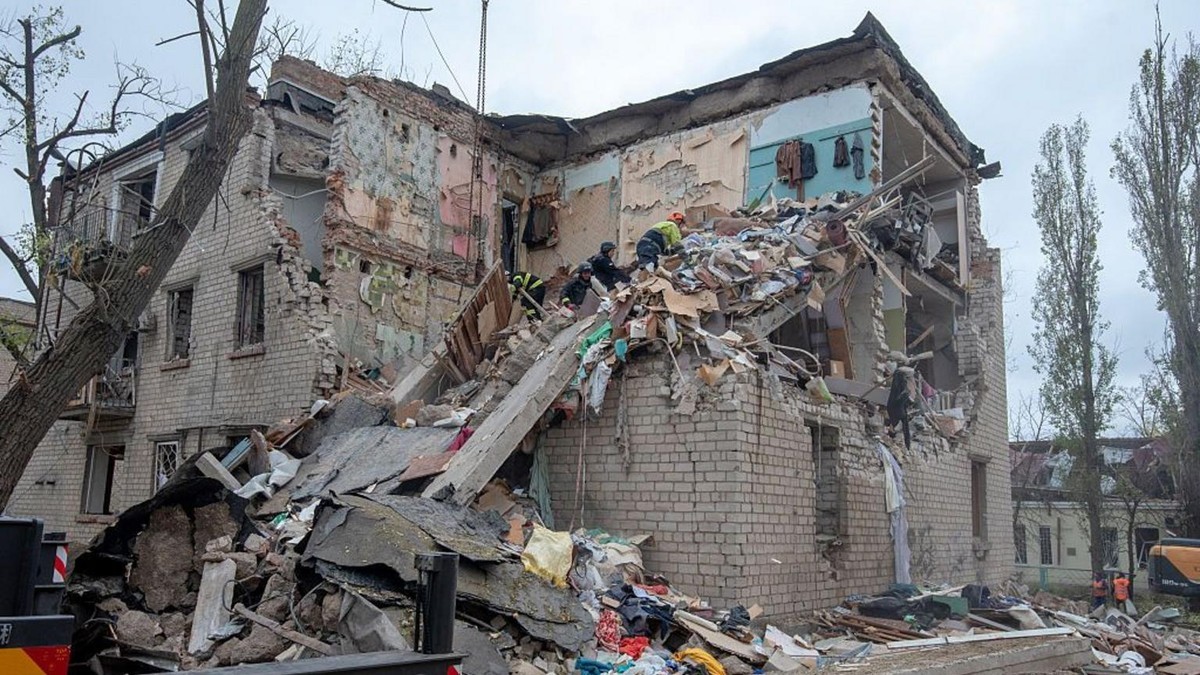
Mykhailo Semikin, acting head of the Zaporizhzhia regional military administration, said the aid centre collapsed from a "direct hit".
The UN human rights monitoring mission in Ukraine said multiple glide bombs struck the school building in the morning while the aid distribution was taking place. The statement did not address intent, and no authority has adjudicated it.
Rescue work was repeatedly disrupted by Russian drone attacks in the area that had been bombed, according to Semikin. The BBC reported that search teams were at times forced to halt because of drone attacks in the area.
A Toll That Rose All Day
No casualty figure is final. President Volodymyr Zelenskyy's first public statement on Monday put the death toll at 18. Early reports the same day carried 24. By Monday evening Ukrainian emergency services reported 26 dead. Regina Kharchenko, secretary of the Zaporizhzhia city council, reported that 27 people were missing.
On Tuesday Mykhailo Semikin, acting head of the regional military administration, confirmed 29 dead and 48 missing. At that stage he reported a further 10 people injured. The latest confirmed figure, reported by Semikin on Tuesday, was 31 dead. The Associated Press reported that more than 45 residents were still missing.
Among the dead were four police officers and two rescue workers, according to Ukraine's State Emergency Service. Five people were being treated in hospital, including two rescue workers, The Guardian reported. The Associated Press put the number of injured at "at least five".
Zelenskyy said more than 50 people could be trapped under the rubble.
The UN Mission Names the Test
Danielle Bell, head of the UN human rights monitoring mission in Ukraine, framed the attack as a question of what Russian forces knew before they bombed the school, and set out a two-part test.
"Dozens were killed while civilians gathered to receive humanitarian aid in Komyshuvakha — the timing and location of the humanitarian distribution was well publicised," she said.
"Either the Russian armed forces knew that there was a humanitarian distribution taking place, or they failed to take the most basic steps to find out what was happening in this village they were planning to attack," she said.
"In either case, this attack seems to have violated the most fundamental principles of international humanitarian law."
The mission said the attack used "powerful aerial glide bombs". It did not describe the strike as a war crime, and no court has made a finding. The statement offers two possibilities and applies the same legal conclusion to both.
Across Nine Regions, One Night
Russia launched 289 attack drones, 17 ballistic missiles and 59 cruise missiles across nine regions, President Volodymyr Zelenskyy reported in an online post. The barrage triggered emergency power cuts.
"The Russians think America won't notice this signal of theirs. But we need to notice and stop such terror. We need to help Ukraine defend its skies; otherwise, Russia will never stop its missile strikes," he said. Zelenskyy noted that the barrage coincided with the United States midterm elections.
In the Kharkiv region, a combined missile and drone attack wounded at least 62 people, according to Oleh Syniehubov, head of the regional military administration. A strike damaged a medical facility in the Nemyshlianskyi district, shattered windows in four apartment buildings and damaged cars. More than 200 patients were transferred to other medical facilities.
In the Dnipro area, rescuers pulled a woman alive from the rubble on Tuesday morning. The Associated Press reported one person killed and 17 wounded. NDTV, citing regional head Oleksandr Hanzha, reported two killed and 20 wounded.
What Moscow Has Said
The Russian military has not publicly commented on the strike on Komyshuvakha, and no Russian account of what happened in the village has been published. Ukrainian officials have attributed the attack to Russian aircraft; Moscow has not responded to that accusation.
Russia's Defence Ministry reported that its air defences shot down 856 Ukrainian drones overnight. Moscow mayor Sergei Sobyanin said 493 drones were fired toward the Russian capital.
Separately, a Ukrainian drone attack wounded two employees at an oil refinery in the Russian city of Yaroslavl, according to the regional governor, Mikhail Yevrayev.
The BBC reported that since the talks were suspended in February, Moscow has stepped up attacks as Kyiv virtually ran out of Western-supplied interceptors to defend against missiles.
A Week Before the Talks Resume
Teams from Ukraine, Russia and the United States are due to resume three-way peace talks in Abu Dhabi on 10 and 11 November, Steve Witkoff, US President Donald Trump's special envoy, announced on X. It will be the first trilateral meeting since February.
Witkoff said the discussions would focus on "post-war security arrangements, de-escalation, humanitarian efforts, and next steps toward peace." Vladimir Putin agreed to the new round after meeting Witkoff in St Petersburg on 21 October. No major breakthrough is expected.
Volodymyr Zelenskyy was in Berlin on Tuesday to meet German Chancellor Friedrich Merz. Germany has become Ukraine's largest supporter since Trump returned to office and withdrew US financial support; Washington still provides intelligence to Ukraine.
Witkoff also announced that US negotiators would meet European and NATO officials in Brussels on Wednesday. Ukraine, the United States, France, Germany, Britain, NATO and the World Bank will take part, the European Commission said.
The Truce That Ended the Same Day
A limited local ceasefire in the Kherson region, brokered by US First Lady Melania Trump, had allowed a humanitarian evacuation of civilians from the Russian-occupied town of Oleshky in the previous week. The arrangement was time-limited, and it expired on Monday, in a different region of southern Ukraine from Zaporizhzhia.
That same day, guided aerial bombs struck the school in Komyshuvakha.
"There was a moment when the next steps could have shown that progress toward peace was possible," President Volodymyr Zelenskyy said, referring to the evacuation. "With such killings, Russia is sending the exact opposite signal - Russia is counting on further killings."
He called the strike "yet another proof that Russia does not want any de-escalation".
"There must be a response to this – a response from the world. A strong and tough response. A response to Russia. And support for Ukraine," he said.
What Is Established, and What Is Not
Established: guided aerial glide bombs struck the school building in Komyshuvakha on Monday morning while civilians were collecting humanitarian aid there, and Ukrainian officials describe a second wave that hit the shelter where people had taken cover.
Not established: intent. Nobody has adjudicated whether that second strike was aimed at rescuers and survivors.
Not established: a final casualty total. The figures moved through the day and no authority has published a definitive number.
Not established: any legal finding. The UN mission's assessment is a statement about the laws of war, not a court ruling, and no prosecution has followed.
Established: the distribution was a weekly event, announced in advance, and residents had gathered for it when the bombs fell.
By Jessica Ali, Staff Writer
This article was produced with AI-assisted research and editorial support. Sources: Associated Press, BBC News, CBC News, The Guardian, Al Jazeera, FRANCE 24, RFI, EU Today, NDTV, South China Morning Post, The Independent, and the UN human rights monitoring mission in Ukraine. Photographs: BBC News. Cover: Global 1 News editorial image.
What's Your Reaction?
 Like
0
 Dislike
0
 Love
0
 Funny
0
 Wow
0
 Sad
0
 Angry
0

Editor-in-Chief at Global1.News. Atlanta-based journalist who cuts through the BS and tells it like it is. Lead anchor, host, and the voice you hear when the spin stops and the truth starts.













Comments (0)