
Foxconn details quantum ambitions, wants to become world’s “largest quantum computer manufacturer”
Foxconn’s latest ambition reads like a classic founder’s playbook: identify a high‑margin niche, partner with the tech owners, and scale the manufacturing muscle without the R&D risk.
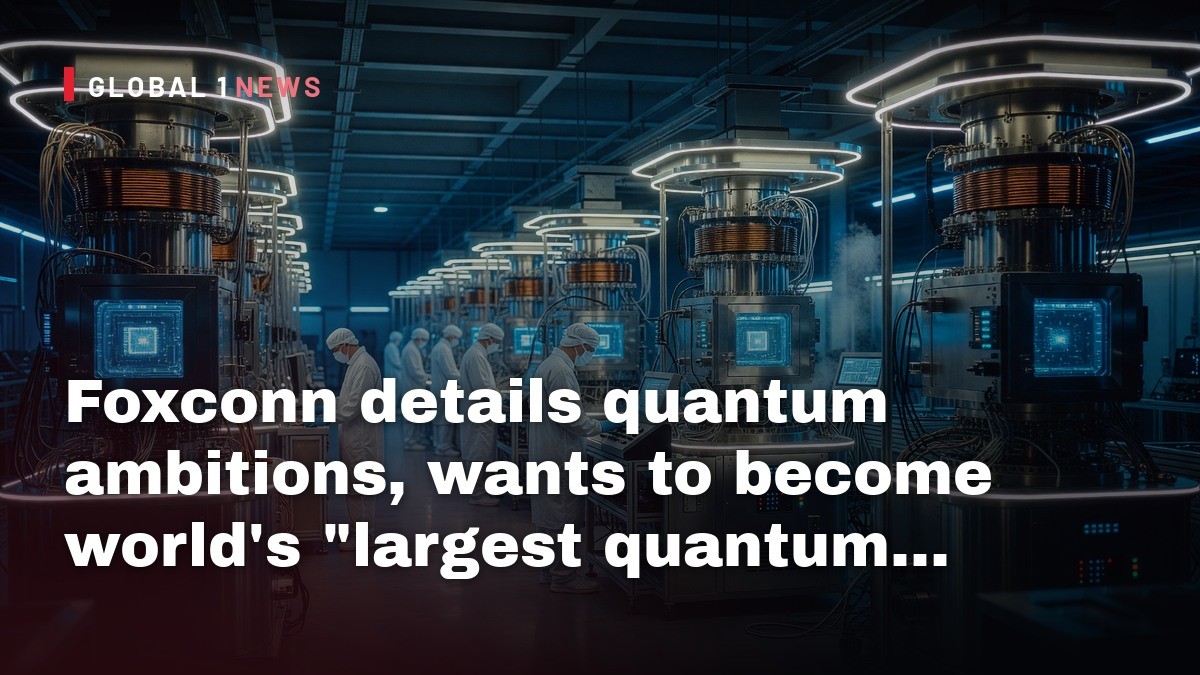
Foxconn’s latest ambition reads like a classic founder’s playbook: identify a high‑margin niche, partner with the tech owners, and scale the manufacturing muscle without the R&D risk. Chairman Young Liu told CNBC the Taiwanese giant wants to be the world’s biggest quantum‑computer manufacturer, but he made it crystal clear that Foxconn will stay in the “manufacturing” lane, leaving the quantum IP to the hardware specialists. In other words, Foxconn is positioning itself as the assembly line for a technology that, according to Liu, won’t be commercially viable for at least another two years.
Why Foxconn is eyeing quantum now
The move isn’t a sudden whim. Foxconn has already proven it can pivot from consumer gadgets to the bleeding‑edge AI hardware market, becoming the largest producer of Nvidia servers. That pivot gave it a revenue boost in August 2025 that finally outstripped its consumer electronics division for the first time in its history. The lesson here is simple: when a new compute class starts to attract deep pockets and hype, Foxconn jumps in as the contract manufacturer, letting the tech owners focus on breakthroughs while it handles the volume and cost efficiencies.
From a risk perspective, this strategy is low‑cost, high‑leverage. The company doesn’t have to fund quantum R&D, which remains a research‑heavy, long‑term gamble. Instead, it can lock in supply‑chain contracts, secure early‑stage tooling, and lock in pricing that beats the hyperscalers’ “pay‑as‑you‑go” models. For independent hosting providers, the takeaway is clear: if you can partner with a manufacturer that already knows how to mass‑produce high‑performance compute, you can shave years off your own hardware refresh cycles and avoid the premium pricing that cloud giants charge for niche workloads.
The two‑year horizon and what it means
Liu’s blunt admission that quantum won’t be commercially viable for at least two years is a reality check for anyone chasing hype. It aligns with the broader industry sentiment that quantum is still a research‑grade tool, not a replacement for CPUs or GPUs. For us in the hosting world, that means quantum isn’t a near‑term threat to our core infrastructure, but it does hint at future workloads that could demand a hybrid stack.
When the technology finally matures, the “special function” Liu describes will likely be limited to a handful of problem domains—cryptography, complex simulations, and certain AI model optimisations. That translates into a very narrow market for quantum hardware, meaning only a few hyperscalers or niche cloud providers will initially spin up quantum nodes. Independent providers can stay ahead by watching the early adopters and preparing integration pathways now, rather than scrambling when the first commercial quantum service lands.
Manufacturing focus: a double‑edged sword
Foxconn’s promise to become the largest quantum computer manufacturer “without owning that technology” is both its strength and its weakness. On the plus side, the company can leverage its massive fab capacity, supply‑chain clout, and cost discipline to undercut smaller players and even the big cloud providers who still have to build bespoke assembly lines for each quantum chip generation.
On the flip side, the reliance on external IP means Foxconn’s fortunes are tied to the success of the quantum hardware firms it partners with. If those firms hit technical roadblocks—or if the market never expands beyond a few specialised labs—Foxconn could end up with a fleet of idle production lines. For independent hosting firms, the lesson is to diversify: don’t put all your eggs in a single quantum vendor’s basket. Keep your core stack on proven silicon while experimenting with quantum‑ready APIs that can be swapped in when the hardware finally arrives.
Comparing Foxconn’s play to the hyperscalers
The hyperscalers have been busy touting “quantum‑as‑a‑service” offerings, but they typically price those services at a premium that reflects both the scarcity of qubits and the cost of operating cryogenic facilities. Foxconn’s model sidesteps that pricing pressure by acting as the OEM, potentially driving down the per‑unit cost of quantum modules for downstream providers.
However, the hyperscalers also have the advantage of owning the full stack—from qubit design to cloud integration—so they can bundle quantum time with their existing services, locking customers into their ecosystems. Foxconn will need to partner with cloud platforms that are willing to act as distributors of its quantum hardware, or else risk being a high‑volume manufacturer with no clear go‑to‑market channel. Independent hosting providers should watch which cloud partners align with Foxconn; those alliances could become the cheapest path to quantum resources once the tech matures.
Impact on the AI‑driven server market
Foxconn’s rise as the largest Nvidia server producer gave it a foothold in the AI boom, and the quantum push is a natural extension of that trajectory. The company’s ability to churn out AI‑optimised servers at scale has already shifted its revenue mix, as seen in the August 2025 earnings report. Adding quantum to that mix could further cement Foxconn’s role as the go‑to contract manufacturer for next‑gen compute.
For hosting providers, the implication is twofold: first, the cost curve for AI‑accelerated hardware will keep dropping as Foxconn scales, which is good news for margins. Second, the emergence of quantum as a third compute tier could force providers to rethink workload placement—classical for most tasks, GPUs for deep‑learning, and quantum for the few problems that truly need it. Building a flexible orchestration layer now will pay dividends when quantum finally becomes a production reality.
Actionable steps for independent providers
Given the timeline and the manufacturing‑centric approach Foxconn is taking, independent hosting firms should start by mapping out potential quantum‑ready workloads in their client portfolios. Identify any niche applications—financial modelling, drug discovery, complex optimisation—that could benefit from a quantum accelerator in the next few years.
Next, establish relationships with the quantum hardware startups that Foxconn is likely to partner with. Even if you’re not buying hardware today, early dialogue can give you insight into integration requirements, API standards, and pricing models. Finally, invest in hybrid orchestration tools that can route jobs to classical, GPU, or future quantum nodes without a major re‑architecture. That way, when Foxconn finally ships quantum modules at scale, you’ll be ready to plug them into your stack and offer a differentiated service without paying the hyperscalers’ premium.
Bottom line: a measured gamble, not a panic button
Foxconn’s quantum ambition is a classic founder’s play—leverage massive manufacturing chops, stay out of the risky IP race, and ride the wave of a nascent technology that promises high margins once it clears the research hurdle. The company’s own timeline—at least two years before commercial viability—means there’s no need for panic among independent hosting providers. Instead, treat this as a signal to start preparing for a third compute tier while continuing to optimise your classical and GPU workloads.
In the end, the real risk is not the arrival of quantum but the failure to adapt your stack when it does. Keep an eye on Foxconn’s manufacturing announcements, line up partnerships with the quantum IP owners they’ll serve, and build a flexible, cost‑effective orchestration layer now. That’s how you turn a hype‑driven announcement into a competitive advantage without getting burned by the VC‑fueled hype train.
— Allan Ali, Founder
This article was produced with AI-assisted research and editorial support. Reporting is based on the source material cited below. Sources: Data Center Dynamics; datacenterdynamics.com; Global1.News (03 November 2026).
By Allan Ali, Global1.News
What's Your Reaction?
 Like
0
 Dislike
0
 Love
0
 Funny
0
 Wow
0
 Sad
0
 Angry
0

Publisher of Global1.News. Automation architect, systems builder, and the guy making sure the truth gets published.















Comments (0)