
Russia Suspends Natural Gas Exports to Armenia for Repair Work
Russia’s state‑controlled energy behemoth Gazprom announced on Monday that it will suspend natural gas deliveries to Armenia for a scheduled maintenance operation on the North Caucasus‑Transcaucasia Gas Pipeline.
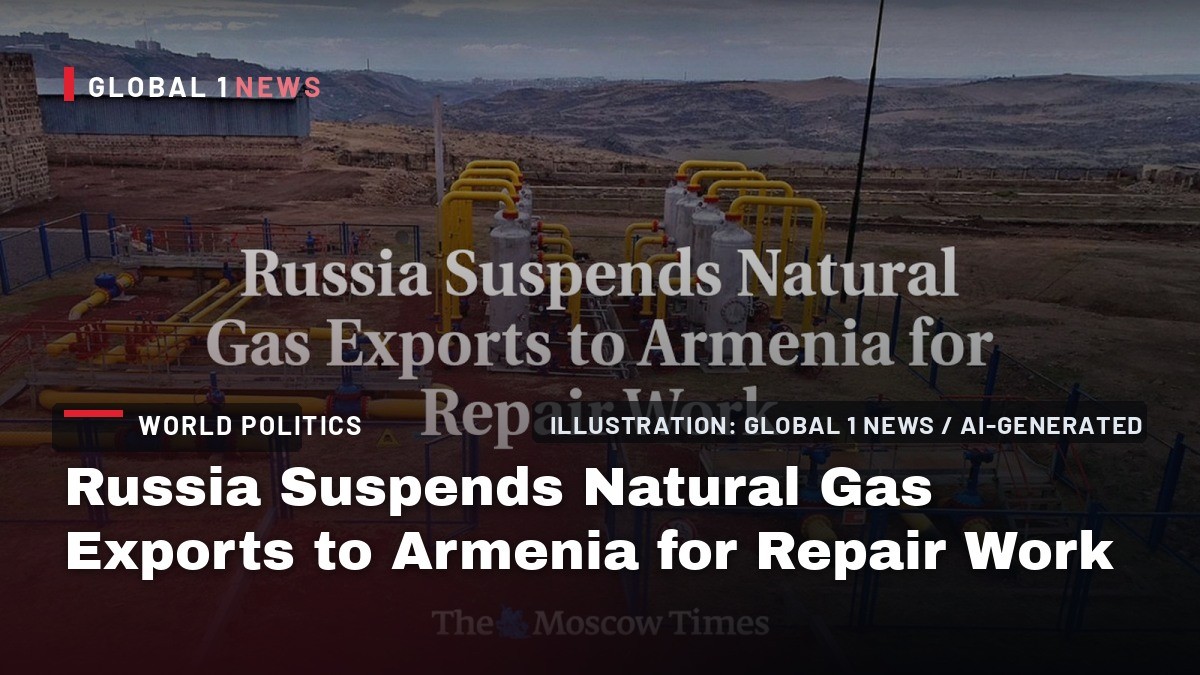
Russia’s state‑controlled energy behemoth Gazprom announced on Monday that it will suspend natural gas deliveries to Armenia for a scheduled maintenance operation on the North Caucasus‑Transcaucasia Gas Pipeline. The shutdown, set to begin on Tuesday and continue until September 25, will affect the flow of Russian gas that accounts for the overwhelming majority of Armenia’s imports. While the interruption is presented as a technical necessity, the timing coincides with a noticeable shift in Yerevan’s foreign‑policy orientation, raising questions about the Kremlin’s leverage over its traditional client states in the South Caucasus.
Scope of the suspension and immediate supply arrangements
Gazprom’s regional subsidiary, Gazprom Armenia, confirmed that the pipeline—running from southern Russia through Georgia into Armenia—will be taken offline for repair work. The company stated that during the maintenance period Armenian energy customers will be supplied from domestic reserves and will receive additional imports from Iran. No specific volumes were disclosed, but the arrangement signals a reliance on alternative sources to bridge the gap left by the halted Russian flow.
The suspension follows a pattern of short‑term operational interruptions that Gazprom has employed in other export corridors, often framed as routine maintenance. However, the explicit mention of Iranian imports underscores Tehran’s growing role as an energy partner for Yerevan, a development that Moscow has historically viewed with suspicion.
Russia’s share of Armenian gas imports
According to the Interfax news agency, Russia supplied 2.7 billion cubic metres of natural gas to Armenia in 2025, representing 82 percent of the South Caucasus nation’s total gas imports. This dominant share has been underpinned by a bilateral pricing agreement that sets the price at $177.5 per 1,000 cubic metres—a discounted rate that reflects the strategic nature of the Russian‑Armenian energy relationship.
The price concession, which is set to expire at the end of the year, has long been a tool for Moscow to maintain influence in Yerevan’s energy market. The impending expiration adds a layer of uncertainty to the bilateral arrangement, potentially prompting both sides to reassess the terms of their cooperation as the regional geopolitical landscape evolves.
Geopolitical backdrop: Armenia’s pivot toward Europe
While the pipeline shutdown is officially described as a maintenance operation, it occurs against a backdrop of deteriorating relations between Russia and Armenia. The Moscow Times reports that Armenia, though formally allied with Russia, has been deepening ties with the European Union in recent years—a development that has reportedly displeased the Kremlin.
President Vladimir Putin has publicly demanded that Armenia hold a national referendum on whether to pursue deeper European integration or remain within the Moscow‑led Eurasian Economic Union. This demand reflects a broader Kremlin strategy to test the loyalty of its allies by linking political concessions to economic dependencies, particularly in the energy sector.
Armenian leadership’s response and EU aspirations
Prime Minister Nikol Pashinyan has signalled a willingness to explore a formal EU accession pathway. In a statement last month, he indicated that Armenia could begin the formal application process “in the near future,” and that a subsequent referendum would be held to decide on EU membership. This stance aligns with a broader policy shift toward diversification of political and economic partnerships.
On the same day as the pipeline announcement, Pashinyan reiterated Armenia’s intent to diversify its energy sources, describing the challenges facing the country as “unprecedented.” By framing energy diversification as a response to “unprecedented challenges,” the Armenian leadership implicitly acknowledges the strategic vulnerability created by its heavy reliance on Russian gas.
Implications for the South Caucasus energy market
The temporary suspension of Russian gas to Armenia forces the latter to lean more heavily on Iranian imports. Iran’s role as an alternative supplier has been expanding, reflecting Tehran’s broader strategy to increase its influence in the South Caucasus through energy diplomacy. This shift could recalibrate regional energy flows, especially if the maintenance period extends beyond the scheduled end date or if similar disruptions recur.
Moreover, the reliance on domestic reserves highlights Armenia’s limited buffer capacity. The country’s ability to sustain industrial and residential consumption without Russian gas will depend on the adequacy of its own storage facilities and the reliability of Iranian deliveries, both of which are subject to external political pressures.
Kremlin’s leverage and potential policy adjustments
The expiration of the discounted gas pricing agreement at the end of 2026 provides Moscow with a bargaining chip. Should Yerevan pursue a formal EU application, the Kremlin may be inclined to adjust the pricing terms or impose additional conditions to retain its market share. Conversely, a successful diversification toward Iranian gas could diminish Russia’s leverage, prompting a reassessment of its energy strategy in the South Caucasus.
Gazprom’s decision to announce the maintenance publicly, rather than quietly, may also serve a dual purpose: to demonstrate operational transparency while signalling to Yerevan that the Russian energy supply remains subject to Moscow’s control. This messaging aligns with broader Kremlin tactics of using energy dependence as a lever in diplomatic negotiations.
Broader context: repression of independent reporting
The Moscow Times, the source of this information, disclosed that Russia’s Prosecutor General’s Office has designated the outlet as an “undesirable” organization, criminalising its work and exposing its staff to prosecution. This label follows an earlier designation as a “foreign agent.” The crackdown on independent journalism underscores the Kremlin’s sensitivity to external scrutiny of its energy policies and geopolitical maneuvers.
By highlighting the suspension of gas deliveries alongside the broader political context, the report illustrates how energy infrastructure can become a flashpoint in the Kremlin’s effort to maintain influence over its allies. The repression of independent media further complicates the information environment, making it harder for external observers to gauge the full impact of such supply disruptions on regional stability.
This article was produced with AI-assisted research and editorial support. Reporting is based on the source material cited below. Sources: The Moscow Times; themoscowtimes.com; Global1.News (17 September 2026).
By Irina Volkov, Staff Writer
What's Your Reaction?
 Like
0
Like
0
 Dislike
0
Dislike
0
 Love
0
Love
0
 Funny
0
Funny
0
 Wow
0
Wow
0
 Sad
0
Sad
0
 Angry
0
Angry
0

Russia/Eastern Europe Correspondent at Global1.News. Covering Russian politics, energy, security, and the shifting dynamics of the post-Soviet space. Provides clear-eyed analysis on one of the world's most opaque regions.












Comments (0)