
Pro-monarchist Iran activists disrupt Paris event: videos
On Thursday, a heated clash erupted at the Arab World Institute (IMA) in Paris when a group of pro‑monarchist activists disrupted a gathering meant to amplify the voices of Iranian women.
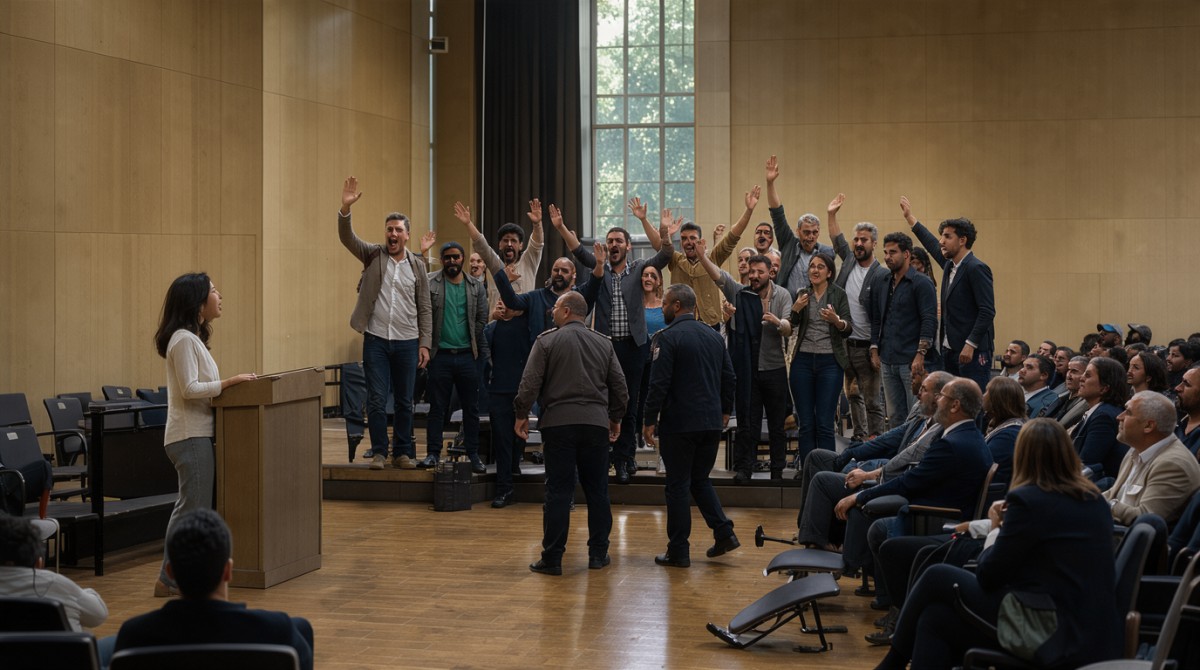
On Thursday, a heated clash erupted at the Arab World Institute (IMA) in Paris when a group of pro‑monarchist activists disrupted a gathering meant to amplify the voices of Iranian women. The incident, captured on video and widely shared on social media, underscores the deepening fissures within the Iranian diaspora—a split that reverberates across the Middle East, influences Israel’s regional calculations, and reflects broader geopolitical currents that have intensified since the February 2026 US‑Israeli strike targeting Supreme Leader Ali Khamenei.
Background to the Paris gathering
The event, attended by French Foreign Minister Jean‑Noël Barrot, was organized to mark the International Day for the Elimination of Violence against Women. Its primary aim was to broadcast the testimonies of women inside Iran, offering a platform for their grievances amid an ongoing wave of protests that began earlier this year. By inviting the French foreign minister, the organizers signaled the importance of international diplomatic attention to the plight of Iranian women, a concern that resonates strongly with Israel’s own advocacy for human rights in the region.
While the gathering was intended as a solemn forum, the presence of a vocal pro‑monarchist contingent transformed it into a flashpoint. Activists in the audience rose abruptly, brandishing the historic lion and sun flag associated with Shah Mohammad Reza Pahlavi, who was ousted in the 1979 Islamic Revolution. Their chants of “long live the shah!” and slogans praising Reza Pahlavi, the ex‑shah’s US‑based son and a prominent opposition figure, disrupted the proceedings and sparked a broader debate about the future of Iran’s political system.
Pro‑monarchist activists and their agenda
The group that took the stage identified itself with the France‑based Association Femme Azadi, a pro‑monarchist organization that frames its advocacy as a defense of Iranian women’s rights. In statements released after the incident, the association accused left‑wing Iranian activists of “hijacking the struggle of the Iranian people,” insisting that they would not allow “anyone to steal this revolution from our people.” Their rhetoric reflects a broader narrative within the diaspora that positions the pre‑1979 monarchy as a more progressive alternative to the current theocratic regime.
Paris‑based lawyer Chirinne Ardakani, whose clientele includes Nobel Peace Prize laureate Narges Mohammadi, condemned the disruption as a “serious incident” orchestrated by “far‑right monarchist activists.” Ardakani’s condemnation highlights the perception among some diaspora members that the pro‑monarchist faction is aligned with far‑right ideologies, a characterization that complicates the diaspora’s internal politics and influences how external actors, including Israel, assess opposition groups.
The left‑wing opposition’s response
Film director Sepideh Farsi described the episode as “lamentable and symptomatic of what has been going on for a long time within the Iranian diaspora.” Her remarks echo concerns among left‑wing activists that the pro‑monarchist narrative seeks to marginalize broader calls for democratic reform by framing the struggle in monarchical terms. This division is not merely symbolic; it affects coordination among opposition groups, which in turn impacts the efficacy of external support, including from Israeli NGOs that have historically backed civil‑society initiatives in Iran.
French academic Clement Therme, author of a recent study on Iran’s future, observed that while opposition factions agree on the need for regime change, they diverge sharply on strategy. He posed a stark question to his audience: “Is one ready to pay the price of war and ally with foreign powers to have a change of regime or prefer to see it collapse from within?” This dilemma resonates with Israeli policymakers who must weigh the risks of overt support for regime‑change initiatives against the potential benefits of a weakened Tehran.
Geopolitical context: post‑strike tensions
The Paris disruption occurred against a backdrop of heightened regional tension following the February 28, 2026 US‑Israeli strike that killed Supreme Leader Ali Khamenei. Although the strike failed to topple the theocratic system, it left the leadership vacuum filled by Khamenei’s son, Mojtaba, intensifying internal power struggles within Iran. The strike also amplified concerns in Israel about Iranian retaliation and the potential for broader escalation, prompting Israeli security agencies to monitor diaspora activities more closely.
For Israel, the fragmentation within the Iranian opposition presents both challenges and opportunities. On one hand, a divided diaspora can hinder the formation of a unified front capable of exerting pressure on Tehran. On the other, Israel can potentially leverage the pro‑monarchist faction’s anti‑theocratic stance to foster discreet channels of influence, especially given the group’s willingness to align with Western diplomatic platforms, as evidenced by their presence at a French‑ministerial event.
French diplomatic handling and official statements
French foreign ministry spokesperson Pascal Confavreux sought to downplay the incident, describing the “lively nature of the exchanges” as a testament to the Iranian people’s desire to have their aspirations heard. This diplomatic framing attempts to balance France’s commitment to free speech with the need to maintain public order during high‑profile events. By emphasizing the vibrancy of debate rather than the disruption itself, French officials aim to preserve the image of a tolerant, pluralistic society while avoiding direct condemnation of any particular diaspora faction.
The French approach mirrors broader European trends of allowing diaspora groups to voice divergent views, even when those views clash sharply. For Israeli observers, the French stance underscores the importance of engaging with European partners to shape narratives around Iran, particularly as Europe navigates its own security concerns regarding Iranian influence in the continent.
Implications for Israeli policy and regional stability
The Paris episode serves as a microcosm of the broader contest over Iran’s future—a contest that directly impacts Israel’s security calculations. A fragmented opposition reduces the likelihood of a coordinated external push for regime change, potentially prolonging the status quo that Israel perceives as a strategic threat. Conversely, the visibility of pro‑monarchist activism, especially when linked to Western diplomatic events, may embolden Israeli intelligence agencies to cultivate discreet relationships with groups that share a common opposition to Tehran’s theocratic leadership.
Israel’s Ministry of Economy and the Israel Innovation Authority have, in recent years, supported tech‑driven civil‑society projects aimed at bypassing Iranian censorship. The diaspora split highlighted in Paris suggests that such initiatives must be carefully calibrated to avoid alienating left‑wing activists who may view pro‑monarchist overtures as a co‑optation attempt. Maintaining a balanced approach—supporting universal human‑rights advocacy while steering clear of overt political endorsements—remains a delicate but essential strategy for Israeli policymakers.
Looking ahead: diaspora dynamics and the path forward
As the Iranian diaspora continues to grapple with internal divisions, the incident at the Arab World Institute illustrates how these fissures play out on the international stage. The clash between pro‑monarchist activists and left‑wing opponents is likely to recur at future events, especially those that attract high‑profile diplomatic attention. For observers in Israel, monitoring these dynamics offers insight into the evolving landscape of Iranian opposition—a landscape that will shape regional security, diplomatic engagements, and the broader discourse on Iran’s political trajectory.
In the months ahead, the question posed by Clement Therme—whether opposition groups will pursue external alliances or await an internal collapse—will remain central to policy debates in Jerusalem. Israel’s response will need to balance pragmatic security concerns with a principled commitment to supporting the aspirations of Iranian women and civil society, ensuring that any engagement with diaspora factions contributes to a more stable and democratic future for Iran and, by extension, a safer Middle East.
This article was produced with AI-assisted research and editorial support. Reporting is based on the source material cited below. Sources: Al-Monitor; al-monitor.com; Global1.News (27 November 2026).
By Hannah Berg, Staff Writer
What's Your Reaction?
 Like
0
 Dislike
0
 Love
0
 Funny
0
 Wow
0
 Sad
0
 Angry
0
Israel Correspondent at Global1.News. Based in Tel Aviv, covering Israeli politics, security, technology, and society. Provides balanced, deeply-sourced reporting on one of the most closely-watched regions in the world.














Comments (0)