
Pero's Bridge span slips into harbour weeks before removal
The centre span of Pero's Bridge slipped into Bristol's Floating Harbour shortly before 23:00 GMT on Saturday, damaging the hydraulic ram and leaking hydraulic oil. Nobody was hurt. The council says the spring 2027 reopening is still the plan, but the removal work is under review.
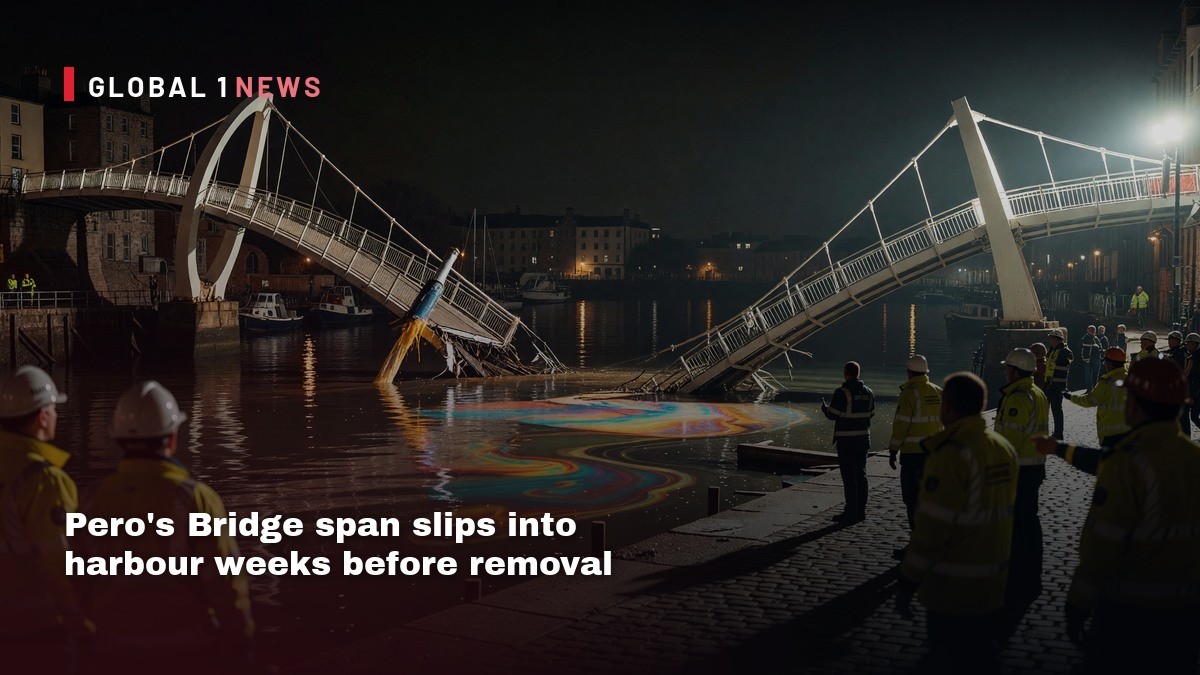
Bristol's most distinctive footbridge was already broken, already fenced off, and days away from being cut out of the harbour when a piece of it dropped into the water on Halloween night. What engineers had written down months earlier is only now in the public domain, because somebody asked for it.
Pero's Bridge span slips into harbour weeks before removal
Bristol, England - The centre span of Pero's Bridge slipped from its position shortly before 23:00 GMT on Saturday 31 October 2026, damaging the hydraulic ram and leaving a small section submerged in the Floating Harbour. Nobody was hurt. The bridge had been closed since August, when a test lift jammed the middle span in a partially raised position, and it was due to be lifted out entirely in the week starting Monday 2 November.
What Happened Shortly Before Eleven
It happened on a busy Saturday night, with Halloween revellers heading for the harbourside bars. Part of the bridge buckled in front of them, and members of the public gathered at a safe distance to watch from The Waterfront.
Andrew Brown, Liberal Democrat councillor and chair of the Harbour Committee, set out the council's account. "We can confirm that last night shortly before 11pm the centre span of Pero's Bridge slipped from its previous position causing damage to the hydraulic ram, and a small section is now submerged in the harbour," he said. "No one was injured, but a small amount of hydraulic oil leaked into the water by the Arnolfini, and we are currently on site working with environmental specialists to clear this."
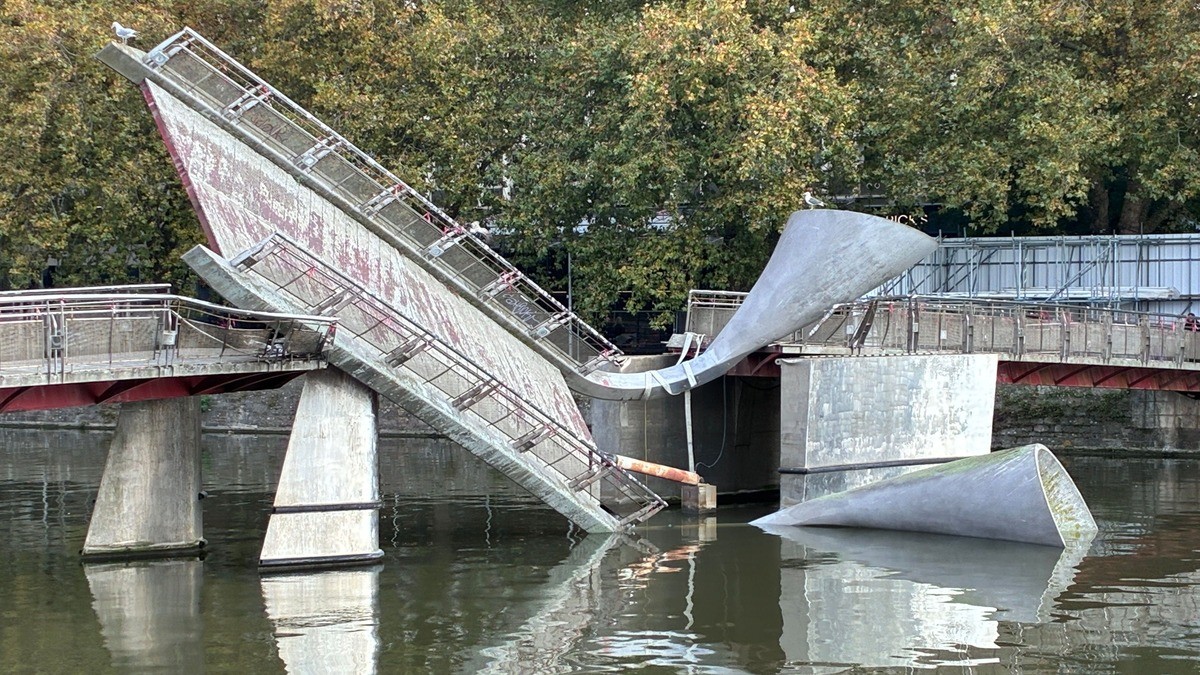
The collapse also mangled railings on the fixed western span, which Bristol Live reported "looks certain to add to the eventual cost of repairing and restoring the 1999 bridge". One horn sculpture is partially submerged; the second appears to have hit the still-afloat portion of the bridge and held it there.
A Warning Written Down Last December
The paper trail runs back further than Saturday night. An inspection in July 2025 found several "major structural issues" that required "urgent attention". In September 2025 the council agreed to spend £200,000 on emergency investigation works and banned lifting the bridge, adding weight restrictions.
In December 2025 the council commissioned the engineering firm Arup to assess the structure. Arup found severe corrosion, particularly on the western section by Millennium Square. Runners crossing could feel a slight bounce. Waterproof sealant between the decking planks had worn away, letting water into the structure and degrading the steelwork.
During previous test lifts, harbour engineers had seen a "significant quantity of rust-stained water" pouring from the middle section. Arup said this meant hollow parts were not properly sealed when the bridge was built, and that pooling water would "expedite the corrosion of the steelwork".
That report reached the public only after a Freedom of Information request.
Fifty-One Days After the Harbour Master's Report
On 23 June 2026, the Harbour Committee received a report from the Harbour Master. It said: "Test lifts revealed both electrics and hydraulics need an overhaul to get working." It added that plans for longer-term replacement of electrical, mechanical, lighting and structural repairs were under way.
Fifty-one days later, on 13 August 2026, a test lift ended in catastrophic failure. The middle section collapsed and was left wedged at a jaunty angle, stuck in a partially raised position. The bridge closed to pedestrians and to boats, and the ferry landing stage at the Cascade Steps closed with it.
A council report said the bascule lifting span "became geometrically distorted and jammed in a partially raised position", and that "the safest and most expedient means of mitigating the risk and enabling the repair programme to proceed is the urgent removal of all bridge spans".
The Ram, the Oil and the Long Wait
The bridge lifts on a hydraulic mechanism, with a pump and power pack inside a pit behind the harbour wall, reached through a steel hatch in the ground. Water sometimes enters and fills that pit. Pumps had been used in the past to clear it.
Saturday's slip damaged the hydraulic ram, and a small amount of hydraulic oil reached the water by the Arnolfini. The council says it is working with environmental specialists to clear it.
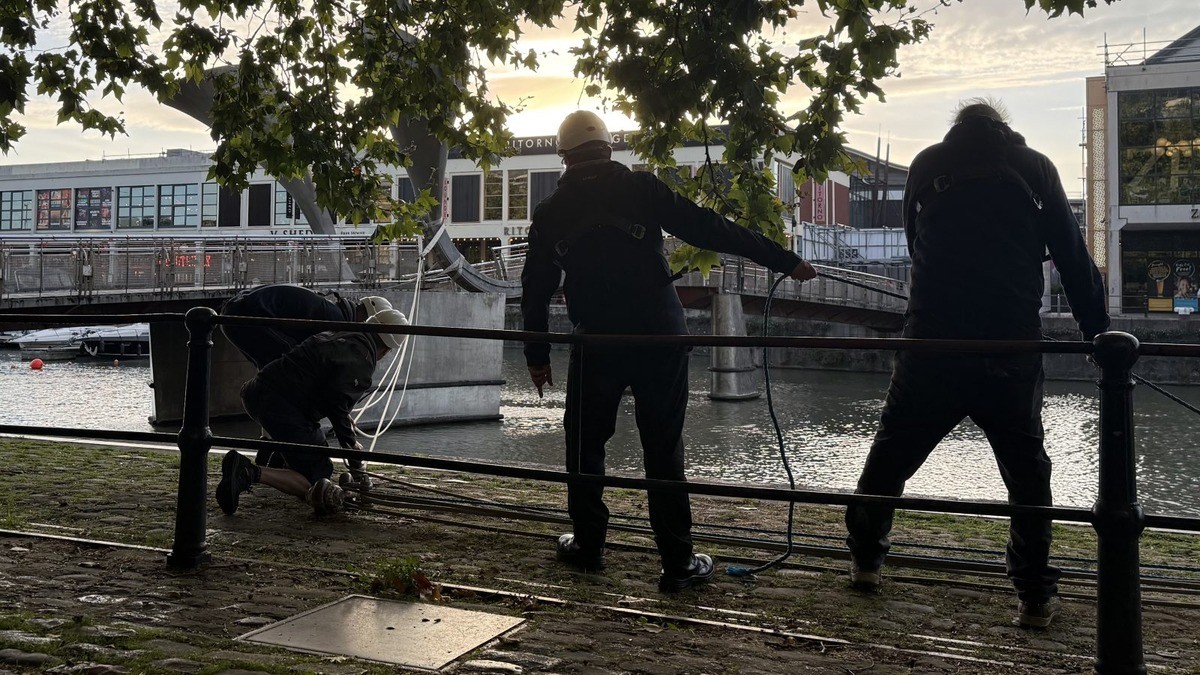
Movement had already been detected in October 2026, almost two months after the August failure. Ropes and heavy-duty reinforced webbing known as strops were attached, connecting one of the horns to a mooring bollard on Narrow Quay. Brown said the equipment needed was "expected to arrive in the harbour within weeks". As of late October it had still not arrived.
No cause has been established for Saturday night's slip.
Why Only the Middle Span Moves
Pero's Bridge has three spans. The outer two are fixed. The middle one lifts to let boats pass through to St Augustine's Reach outside the Watershed, and its horn-shaped sculptures act as counterweights for the lifting section.
Arup's December 2025 report described what happens when that lift goes wrong. "The harbour engineering team explained that if the lift is stopped part way through the lifting arc, the inertia of the bridge combined with the abrupt stop cause the bascule to rock and the rolling beams to jump free from the teeth on the roller track," it said. "This is not witnessed on site but is plausible. There is a potential risk of the bascule span becoming misaligned in such an event, or at worst, losing support."
The bridge was designed by the Irish artist Eilis O'Connell in conjunction with Ove Arup and Partners. It opened in 1999, cost £900,000 to build, and links Narrow Quay near Queen Square with Bordeaux Quay.
A Repair Bill That Has Already Been Spent Once
More than £1.5 million had already been approved for repairs before Saturday. In September 2026 the council appointed the salvage contractor Keynvor MorLift, based at Appledore in Devon, to remove the bridge entirely and float the parts by barge to Albion Dry Dock, under its "emergency procurement for urgent work" procedure.
The removal costs are being met from the existing Pero's Bridge Repairs Capital Project budget, which the council says "will reduce the funding currently available for the wider refurbishment project". Any shortfall would be "the subject of a future approval process".
ITV News West Country reported the council has previously said it expects repairs to cost upwards of £1.5 million. No new figure has been published since the ram was damaged and the railings mangled. The council still hopes to reopen the bridge in spring 2027.
Fifteen Thousand Crossings a Day
An estimated 15,000 people used the bridge daily before it closed. That is the number to hold on to, because everything else in this story is measured against it: the pedestrian route between Queen Square and Millennium Square, the walk to the harbourside bars, the shift change at the offices on Narrow Quay.
The closure did not just take a bridge out. It took a junction out. The Cascade Steps landing, the city centre stop for the harbour ferries, sits on the closed side and became inaccessible, so the operator had to move its stop to the Prince Street landing stage next to the Arnolfini.
Bristol Live recorded the commercial edge of it: the pub overlooking the bridge told the paper the crossing "used to bring a lot of footfall to the pub and was really well used".
A Pound Across the Water
One pound. That is the fare on the Harbour Hop, and it is doing the job a landmark bridge used to do for free. Folks, that is what a workaround looks like when a piece of civic infrastructure goes down twice in under three months.
Bristol Community Ferry Boats runs it daily from 11:00 to 16:00 between the Prince Street landing stage and the Lloyds Amphitheatre. It is the second cross-harbour service, alongside the route between the SS Great Britain and the Harbour Inlet.
Co-director Roisin Tobin-Brooke said: "The harbour is a community, and this is one of those times when everyone pulls together and finds a way to keep things moving." She added: "We're not looking to make money from the situation - we have our fantastic crew and fleet here so if we can help people get across the harbour for £1, we're very happy to do it."
The economics are not complicated. A community operator with a fleet already in the water can move people for a pound. A council with a repair budget committed once, and removal costs coming out of the same pot, is in a different position entirely.
The Horns, the Locks and the Name
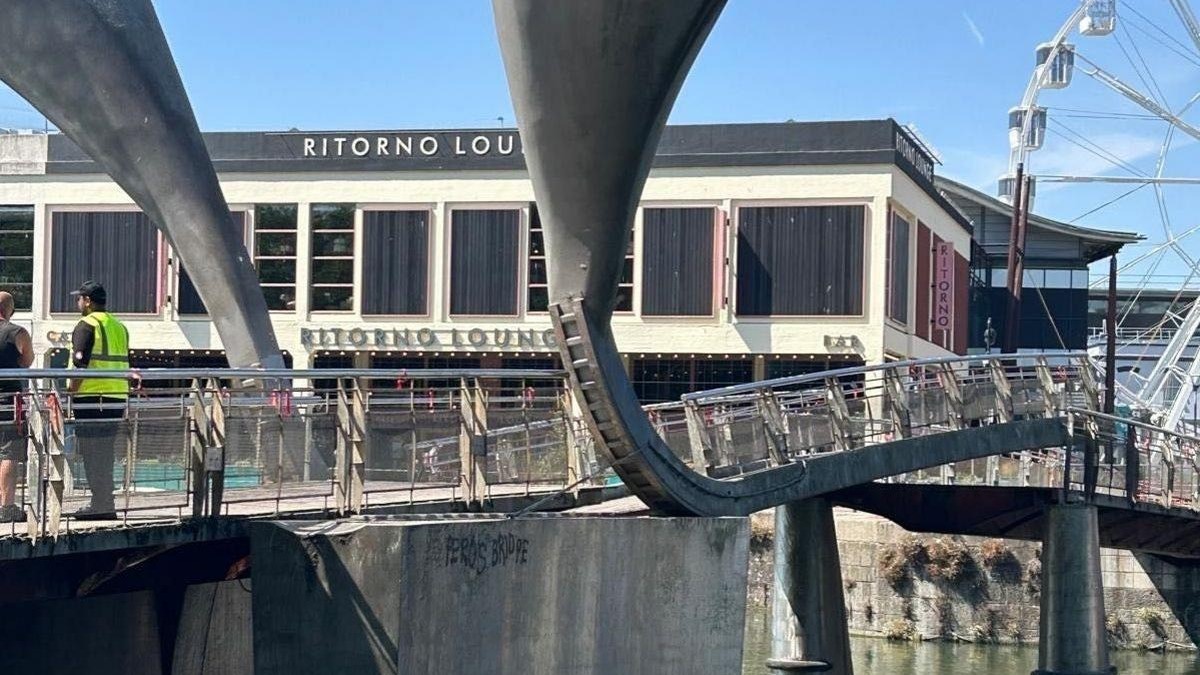
The horns are why people know the bridge without knowing its name: they are counterweights, and in recent years they carried love locks, thousands of padlocks clipped to the railings by couples who threw the key in the water. An estimated three tonnes were removed in 2025.
The name was first suggested by Paul Smith, then chair of Bristol City Council's leisure committee. He said: "I dedicated the new bridge to be named after a slave associated with Bristol, following representations from people involved in seeking recognition for slavery in Bristol."
Pero Jones was born in the West Indies and became personal servant to John Pinney, a sugar plantation owner whose home is preserved as the Georgian House Museum near Brandon Hill. He lived in Bristol for more than 25 years after being brought to the city, and died in 1798, aged about 45.
Stephen Williams, then a councillor on the leisure services committee and later Liberal Democrat MP for Bristol West, objected. He said: "I responded that this was a silly gesture by Smith. The bridge had never been commissioned for that purpose and a name that few people would know was a totally inadequate way to face up to the city's past." He wanted a statue or a specially commissioned memorial instead.
What the Council Has Not Said
The council has not said what caused Saturday's slip. The review of the removal plans is pending engineering assessment.
It has not abandoned the spring 2027 reopening. It says there is "no confirmed impact" to the programme, and that the programme is "under review". Those are different statements, and the gap between them is where the next few weeks of this story sit. Nor has it published a revised cost.
What is on the record is a sequence. July 2025: major structural issues needing urgent attention. December 2025: Arup warns in writing of a bascule span misaligning, or at worst losing support. 23 June 2026: the Harbour Master reports that electrics and hydraulics need an overhaul. 13 August 2026: a test lift jams the span. 31 October 2026: the span slips.
Harbour Notice to Mariners 48/26 had a heavy-lift barge due in the harbour in the week commencing Monday 2 November. That was the plan before Saturday night. It is now under review.
By Jessica Ali, Staff Writer
This article was produced with AI-assisted research and editorial support. Photographs: BBC News and Martin Booth/Bristol24/7 (the October recovery operation). Cover: Global 1 News editorial image. Sources: BBC News, ITV News West Country, Bristol Live, Bristol24/7, and statements from Bristol City Council and Bristol Harbour Authority.
What's Your Reaction?
 Like
0
 Dislike
0
 Love
0
 Funny
0
 Wow
0
 Sad
0
 Angry
0

Editor-in-Chief at Global1.News. Atlanta-based journalist who cuts through the BS and tells it like it is. Lead anchor, host, and the voice you hear when the spin stops and the truth starts.













Comments (0)