
Operation Economic Outcast: Washington's Financial Hammer Falls on Tehran
The United States launched "Operation Economic Outcast," its toughest sanctions wave of the six-month Iran war, targeting 60+ entities. Treasury Secretary Bessent threatened removal from the dollar system for those enabling Tehran as Iran's rial hit a record low near 2.02 million to the dollar.
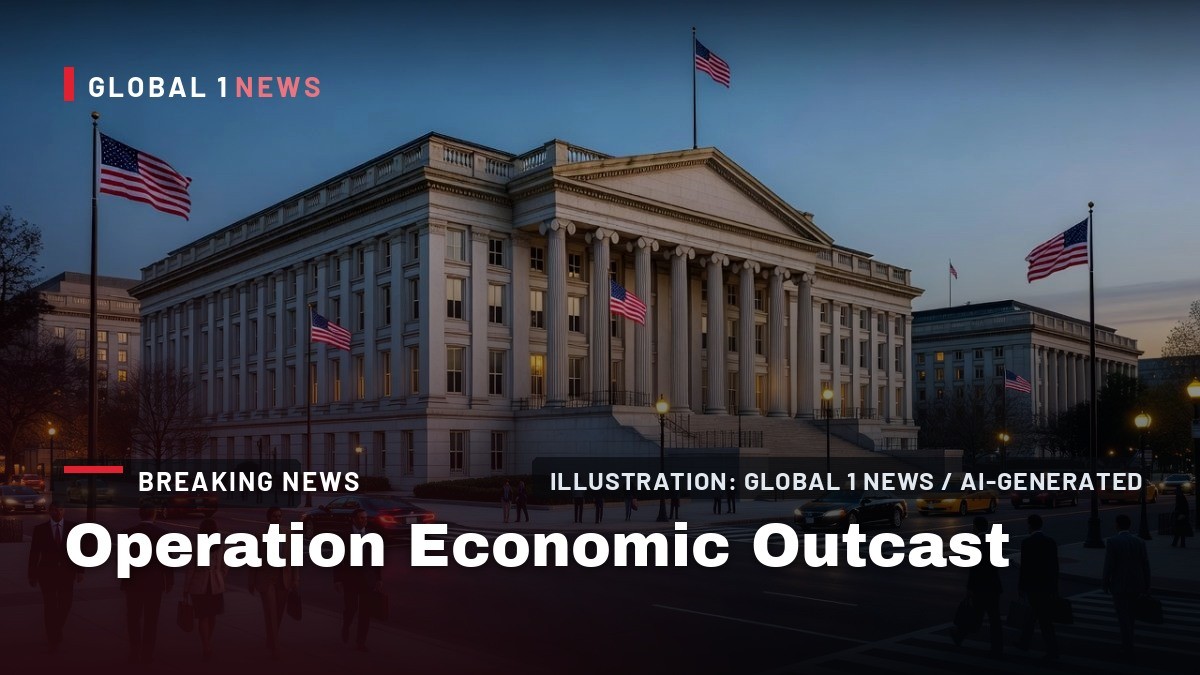
The United States has officially declared economic war on Iran's financial lifelines, with Treasury Secretary Scott Bessent unveiling what he called an "economic D-Day" against Tehran on Monday afternoon. Branded "Operation Economic Outcast," the announcement is the most aggressive sanctions wave of the nearly six-month conflict, targeting more than 60 entities, individuals, and vessels across Iran and other nations.
Speaking at a 1pm EDT press conference in Washington, Bessent delivered a stark ultimatum to the global financial community: sever all economic ties with the Iranian regime or face American retaliation. The Treasury chief warned that anyone facilitating money laundering for Tehran "will be removed from the US dollar system," a threat that reverberated through trading floors from New York to Singapore.
The package zeroes in on five critical sectors — digital assets, technology, gold, aviation, and shipping — each a potential gateway for secondary sanctions against foreign companies and governments. It marks a significant escalation from previous rounds focused primarily on oil exports and weapons procurement.
Bessent's Dollar-System Threat Targets Global Financial Plumbing
The core of Bessent's message was aimed squarely at the architecture of international finance: by threatening removal from the US dollar system, the Treasury is wielding its most powerful weapon — the ability to cut any entity off from the world's primary reserve currency and the clearing mechanisms that underpin global trade.
According to the Associated Press, Bessent warned that every country doing business with the Islamic Republic should sever those financial ties or face retaliation from Washington. The Treasury chief cast the choice in stark terms for the global financial system, putting the dollar at the center of American leverage.
President Donald Trump has been personally engaged, calling world leaders with "specific requests" to cease trading with Tehran, Bessent confirmed. The push follows Trump's pledge last week to unleash an "economic D-Day" against Iran, framing financial pressure as a way to reduce the need for further major military operations.
The timing is no accident: on Thursday, August 20, Bessent signaled intent to impose "the toughest sanctions in history" on Iran, suggesting economic measures could serve as an alternative to escalating kinetic warfare. Trump has simultaneously threatened "economic warfare" against any country providing "any type of lifeline" to Tehran.
Iran's Currency Collapse Signals Deepening Economic Pain
The market's verdict on Iran's economy was delivered before Bessent even took the podium: the rial plunged to a record low of approximately 2.02 million rials to one US dollar on Monday, according to the Institute for the Study of War. That market rate — what most Iranians actually face — stands in stark contrast to the official central bank rate of around 1.5 million rials to the dollar.
The gap between official and market rates tells a grim story of capital flight and eroding confidence. With inflation running at approximately 66 percent annually, ordinary Iranians are watching their purchasing power evaporate in real time, translating into soaring food prices, medicine shortages, and a deepening humanitarian crisis.
Iranian officials have responded with characteristic defiance. The foreign ministry called the planned sanctions "an assault on its sovereignty and economic warfare" in a statement issued Saturday, August 22. Tehran has vowed retaliation against any country that cooperates with the fresh US measures, with some officials threatening a "seismic" and "devastating" response. Others, however, have largely scoffed at Bessent's "economic D-Day" framing, suggesting the regime believes it can weather this storm as it has weathered previous sanctions campaigns.
Oil Markets Shrug Off Sanctions as Military Risk Recedes
The most telling market reaction came from the oil complex, where traders delivered a collective yawn. Prices fell more than $2 a barrel on Monday as investors took profits, viewing economic pressure as far less disruptive than military escalation. By Tuesday, Brent crude had stabilized near $92 a barrel, touching a one-week low.
The muted response reflects a market that has already priced in the sanctions. For nearly six months, Iran has operated under a US naval blockade, and the Strait of Hormuz — the chokepoint for roughly one-fifth of global oil supply — has been effectively closed. Shipping traffic through the strait remains far below pre-war levels after a series of tanker attacks in the Gulf of Oman and Red Sea.
The military dimension of this conflict continues to simmer beneath the surface. A Saudi-flagged vessel was reported struck by a missile on August 11, and Houthi forces claimed an attack on a Saudi oil tanker on August 5. These incidents underscore the persistent volatility in the region's shipping lanes, even as the financial front takes center stage.
Diplomatic Dance: Oman Agreement Hangs in the Balance
Amid the economic warfare, a fragile diplomatic thread remains: Iran says it is in the "final stage" of drafting an agreement with Oman to manage the Strait of Hormuz, and Trump has suggested a deal could be announced this week. But the agreement is likely contingent on the United States lifting sanctions — a condition that looks increasingly remote after Monday.
Iran's parliament speaker said on August 18 the waterway will remain closed until the United States meets Tehran's demands. Washington has reportedly offered sanctions relief in exchange for reopening the strait, but the chasm between the two sides suggests a breakthrough remains elusive. The Oman-mediated talks are the only visible diplomatic channel, and their fragility is compounded by the escalating economic pressure.
The strategic calculus is complex: Iran's closure of the Strait of Hormuz has already disrupted global energy flows, but the country's own economy is bleeding from the blockade and sanctions. The regime's willingness to endure prolonged pain — inflation at 66 percent, currency in freefall — will be tested as winter approaches and domestic discontent potentially grows.
China and India Face a Diplomatic Tightrope
Bessent's plan to squeeze major economies like China and India over their ties to Tehran carries significant diplomatic risk, according to analysts at the Los Angeles Times. Both nations have maintained substantial trade relationships with Iran, particularly in energy and commodities, and both have resisted past US pressure to sever them.
China, as Iran's largest oil buyer, faces an especially difficult calculation. Beijing has consistently opposed unilateral US sanctions and has sought to maintain its energy security through diversified supply sources. India, similarly, has deep historical and economic connections with Iran, including the development of the Chabahar port, which serves as a gateway to Afghanistan and Central Asia.
The United States is effectively asking these powers to choose between their economic interests and their relationship with Washington — a high-stakes gamble that could strain alliances and push Beijing and New Delhi closer together in resisting American financial hegemony.
Sanctions Architecture Targets Nuclear, Cyber, and Shipping Networks
The 60-plus entities sanctioned on Monday span a broad spectrum of Iranian activity, targeting networks accused of enabling the regime's oil sales, weapons technology development — including nuclear and missile programs — cyber operations, and aviation and shipping. The breadth suggests a comprehensive effort to choke off every revenue stream the regime relies upon.
Particular attention falls on digital assets, with the Treasury signaling that cryptocurrency exchanges and wallet providers facilitating Iranian transactions will face secondary sanctions — a novel front targeting the regime's attempts to circumvent traditional banking through decentralized finance.
Gold has also been flagged, reflecting concerns that Iran may be using precious metals to store value outside the dollar system. Aviation and shipping designations aim to ground Iranian aircraft and block the movement of goods by sea.
What Comes Next: Enforcement, Evasion, and Escalation
The immediate question now is enforcement. Sanctions are only as effective as their implementation, and Iran has demonstrated considerable sophistication in evading previous rounds through shell companies, flag-of-convenience vessels, and third-country intermediaries. The Treasury's designations across multiple countries suggest an awareness of those networks, but tracking them remains formidable.
For Washington, the diplomatic cost is already visible: European allies have reservations about secondary sanctions that could penalize their own companies, and the dollar-system threat has raised concerns about the weaponization of global financial infrastructure. The administration appears willing to accept those costs to force Iran to capitulate on its nuclear program and regional ambitions.
The coming weeks will reveal whether this economic offensive achieves what military pressure has not. Iran's leadership has shown remarkable resilience through past sanctions campaigns, but a 66 percent inflation rate, a currency at 2.02 million rials to the dollar, and closed export routes may eventually prove unsustainable. For now, the regime vows retaliation and projects defiance — but the economic math is getting harder to ignore.
By Jessica Ali, Staff Writer
This article was produced with AI-assisted research and editorial support. Sources: CNN, Reuters, The Associated Press, Al Jazeera, the Institute for the Study of War.
What's Your Reaction?
 Like
0
Like
0
 Dislike
0
Dislike
0
 Love
0
Love
0
 Funny
0
Funny
0
 Wow
0
Wow
0
 Sad
0
Sad
0
 Angry
0
Angry
0

Editor-in-Chief at Global1.News. Atlanta-based journalist who cuts through the BS and tells it like it is. Lead anchor, host, and the voice you hear when the spin stops and the truth starts.















Comments (0)