
China’s Rare Earth Strategy and the Future of the South China Sea
In August 2026, a joint Japanese‑American expedition began extracting rare‑earth‑rich mud from the seabed near Minamitorishima, a development that signals a new phase in the competition for critical minerals.
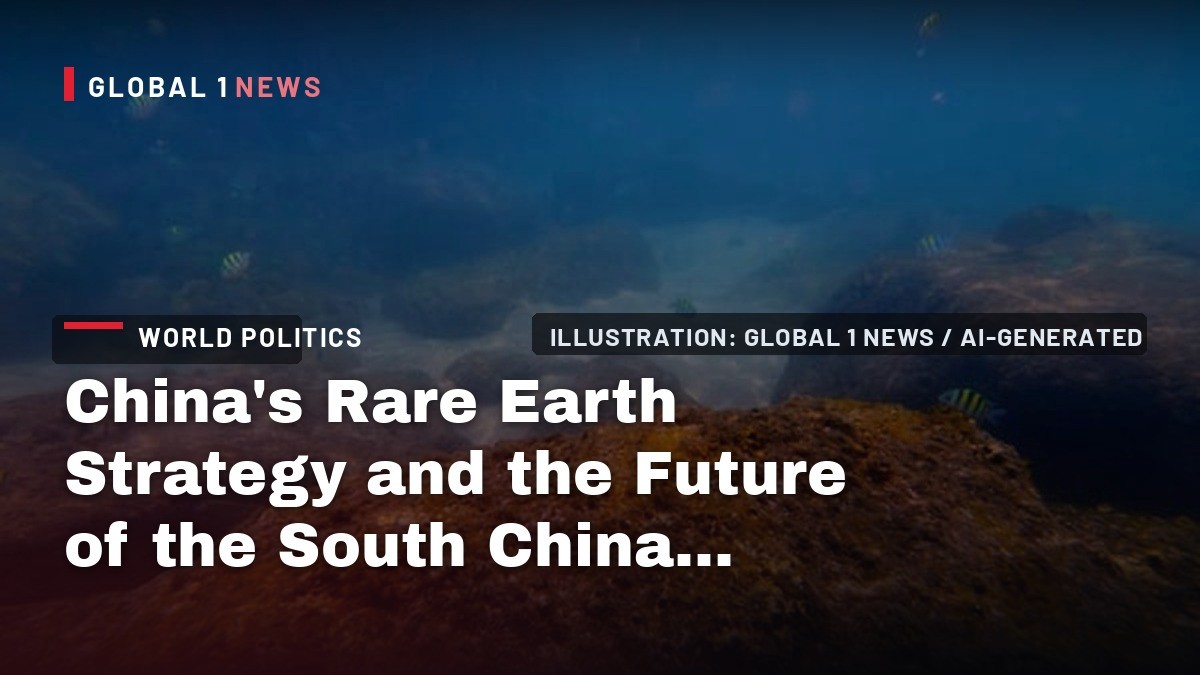
In August 2026, a joint Japanese‑American expedition began extracting rare‑earth‑rich mud from the seabed near Minamitorishima, a development that signals a new phase in the competition for critical minerals. While the South China Sea (SCS) has traditionally been framed in terms of sovereignty, shipping lanes, fisheries and hydrocarbons, the emergence of deep‑sea mineral extraction introduces a fresh strategic layer that intertwines resource security with maritime security. This article examines how China’s established rare‑earth strategy and its broader SCS posture may converge as seabed mining technologies mature, and what that convergence portends for regional geopolitics and Korean policy‑making.
China’s Rare‑Earth Dominance and Export Controls
China’s leverage in the global rare‑earth market derives less from the sheer size of its deposits than from its near‑monopoly over refining, separation and magnet production. The nation’s regulatory toolkit further amplifies this advantage. In April 2025, Beijing introduced export‑control measures covering several medium‑ and heavy‑rare‑earth‑related items, a clear illustration of how critical minerals have entered the country’s national‑security calculus. These controls enable China to manage outward flows of selected minerals, thereby shaping supply‑chain dynamics for downstream users worldwide.
For Korean ministries such as the Ministry of Trade, Industry and Energy (MOTIE) and the Ministry of Foreign Affairs (MOFA), the 2025 controls underscore the urgency of diversifying supply sources. Korean think tanks—including the Asan Institute for Policy Studies and the Korea Development Institute (KDI)—have repeatedly warned that reliance on a single refining hub creates strategic vulnerability, especially for sectors like electronics, automotive batteries and defense‑related magnetics that are critical to the nation’s industrial base.
The Emerging Maritime Dimension of Critical Minerals
Historically, the SCS dispute has been articulated through a vocabulary of sovereignty claims, maritime jurisdiction and the protection of fisheries and hydrocarbon assets. The deep‑sea mineral frontier, however, is reshaping that discourse. As governments explore alternatives to land‑based rare‑earth supply chains, attention is shifting toward seabed muds, polymetallic nodules and cobalt‑rich Fe‑Mn crusts. Although these offshore deposits are not yet commercially viable substitutes for terrestrial mines, they have entered strategic planning and industrial policy documents across the region.
In the Korean context, the Ministry of Oceans and Fisheries (MOF) and the Ministry of Education (MOE), which oversees research funding, are beginning to incorporate seabed‑resource considerations into their long‑term technology roadmaps. The convergence of resource security and maritime security creates a new analytical frontier for institutions such as the Korea Institute for International Economic Policy (KIEP), which must now assess how seabed mining could affect both supply‑chain resilience and the geopolitical calculus of the SCS.
China’s Dual Capability: Rare‑Earth Supply Chains and Deep‑Sea Exploration
China occupies a unique position at the intersection of these two strategic arenas. It already commands the rare‑earth refining chain and simultaneously pursues an active role in deep‑sea exploration. The 2016 national law on deep‑seabed resource exploration and development laid the legal foundation for Chinese entities to secure exploration contracts with the International Seabed Authority (ISA) for polymetallic nodules, sulphides and Fe‑Mn crusts. Moreover, the deployment of the Fendouzhe manned submersible—capable of diving beyond 10,000 metres in the Mariana Trench—demonstrates China’s advanced technological capacity in the deep‑sea domain.
This dual capability means that Beijing can potentially align its rare‑earth supply‑chain objectives with its maritime strategy in the SCS. Korean analysts at the Asan Institute have noted that such alignment could allow China to leverage seabed‑mapping and scientific research activities as pre‑emptive tools for securing future resource rights, thereby intertwining mineral security with claims over maritime space.
Implications for Korean Strategic Planning
For Korea, the evolving overlap between rare‑earth and maritime security raises several policy questions. First, how should the government balance its reliance on Chinese‑processed rare‑earths with the pursuit of alternative offshore sources? Second, what role should Korean research institutions play in developing the scientific and technological base needed for deep‑sea mining? Third, how might Korean diplomatic efforts within the ISA and regional fora be calibrated to address both resource‑access and sovereignty concerns?
In response, the Korean Ministry of Science and ICT (MSIT) has begun funding pilot projects on seabed‑resource extraction, while the Ministry of Foreign Affairs is engaging with the ISA to secure observation rights in the SCS. These steps reflect a broader strategic shift: Korean policy‑makers are increasingly viewing seabed resources not as an isolated economic opportunity but as a component of national security that intersects with maritime disputes.
Potential Shifts in the South China Sea Dispute Landscape
While the SCS is not presently central to China’s rare‑earth advantage, the article notes that the sea’s significance may be reinterpreted through the lens of critical‑minerals security as deep‑sea technologies mature. Studies have identified Fe‑Mn crusts and polymetallic nodules in the SCS that contain cobalt, nickel, rare‑earth elements, yttrium and other critical materials. Although these deposits are not yet commercially exploitable, their existence could eventually add a new dimension to the strategic calculus of all claimants.
If seabed mining becomes feasible, activities that were once framed as scientific or commercial could acquire heightened political sensitivity. Mapping missions, environmental assessments and regulatory proposals might be scrutinized for their implications on supply‑chain resilience, potentially intensifying diplomatic friction. Korean diplomatic channels, particularly through MOFA, will need to monitor such developments closely to anticipate any spill‑over effects on regional stability.
Regional Governance and the Role of International Institutions
The governance of deep‑sea mining is currently evolving under the auspices of the International Seabed Authority. China’s participation in the ISA, coupled with its national law on seabed exploration, positions it as a major stakeholder in shaping future regulatory frameworks. As the article suggests, the convergence of rare‑earth and maritime strategies could enable Beijing to influence rule‑making in ways that protect its existing supply‑chain advantages while opening new avenues for resource extraction.
Korea, as a signatory to the United Nations Convention on the Law of the Sea (UNCLOS) and an active participant in the ISA, has an opportunity to contribute to the development of balanced, environmentally responsible mining standards. Korean experts from KDI and KIEP can leverage their analytical capacity to propose policy options that align resource security with sustainable ocean governance, thereby reinforcing Korea’s reputation as a constructive actor in the region.
Forward‑Looking Assessment: The Next Decade of Critical‑Mineral Competition
In sum, the August 2026 Japanese‑American seabed‑mining trial marks a watershed moment in the broader competition for critical minerals. While the South China Sea remains primarily a theater of sovereignty and maritime rights, the potential for deep‑sea resources to become strategically salient is increasingly evident. China’s dual strength in rare‑earth processing and deep‑sea exploration suggests that the two domains may intersect, creating a more complex security environment for all regional actors.
For Korea, the imperative is clear: integrate seabed‑resource considerations into existing rare‑earth diversification strategies, bolster domestic research and development capacity, and engage proactively in international governance forums. By doing so, Korean policy‑makers can mitigate dependence on any single supply chain, contribute to the establishment of responsible mining norms, and preserve stability in a maritime space that is already fraught with contestation. The next decade will likely witness a gradual but decisive shift in how the South China Sea is imagined—not merely as a contested sea lane, but as a potential reservoir of the minerals that underpin future industrial and military power.
This article was produced with AI-assisted research and editorial support. Reporting is based on the source material cited below. Sources: The Diplomat; thediplomat.com; Global1.News (18 October 2026).
By Prof. David Park, Staff Writer
What's Your Reaction?
 Like
0
Like
0
 Dislike
0
Dislike
0
 Love
0
Love
0
 Funny
0
Funny
0
 Wow
0
Wow
0
 Sad
0
Sad
0
 Angry
0
Angry
0

East Asia/Technology Correspondent at Global1.News. Seoul-based voice covering Korean politics, technology, business, and culture. Analyzes how technology and geopolitics intersect across East Asia.














Comments (0)