
In Confronting China, The West Needs Partners in Southeast Asia
Leaders from across Southeast Asia will convene in Manila on 10 November for the ASEAN summit, a meeting that now carries heightened strategic weight.
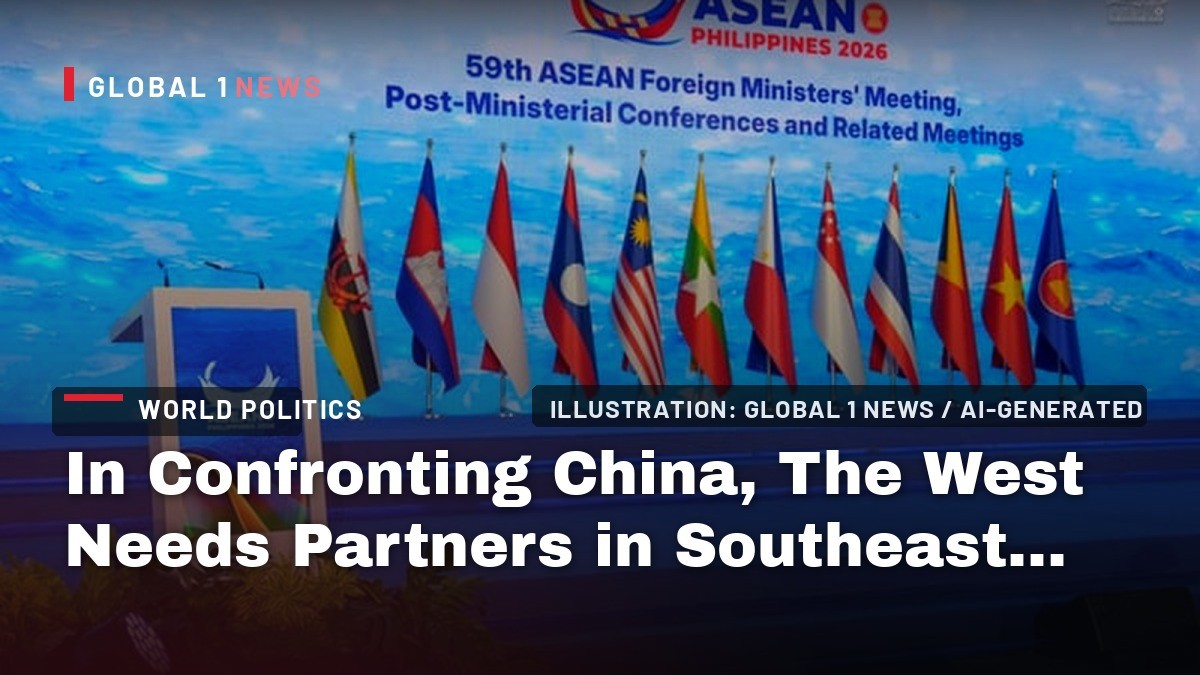
Leaders from across Southeast Asia will convene in Manila on 10 November for the ASEAN summit, a meeting that now carries heightened strategic weight. The date coincides with the expiration of the China‑U.S. trade truce that was extended at the September 24 summit between President Xi Jinping and President Donald Trump. While that summit was widely described as “heavy on pomp and light on substance,” it did secure an additional window of breathing space for Washington. With that extra time, the United States has placed engaging ASEAN leaders at the top of its diplomatic agenda, recognizing that any credible effort to confront Beijing must be anchored in the region’s political and economic realities.
Why the ASEAN Summit Matters to Washington
The extension of the China‑U.S. trade truce offers Washington a modest reprieve, but the reprieve is only valuable if it is used to deepen ties with Southeast Asian capitals. The United States now stands as ASEAN’s largest export market, a position that could be leveraged to shift the region’s dependence on Chinese intermediate goods. The strategic calculus is clear: by offering alternatives to Beijing’s supply chains, Washington hopes to nudge ASEAN economies toward a more diversified trade architecture, thereby weakening China’s leverage without provoking a direct confrontation.
U.S. officials view the Manila summit as an opportunity to present concrete economic incentives, ranging from technology transfer programmes to investment guarantees. The goal is to make the prospect of substituting Chinese inputs with American‑sourced components attractive enough to outweigh the cost of re‑tooling production lines. In doing so, the United States hopes to embed a “balanced” trade relationship that aligns with its broader objective of reindustrialising domestic manufacturing while preserving market access in Asia.
Europe’s Parallel Push for a Fairer Trade Order
Across the Atlantic, European capitals are signalling a willingness to challenge what they deem China’s “unsustainable trading practices.” The European Union’s strategic aim is twofold: to protect its own industrial base and to avoid undermining the economic stability of Southeast Asian partners. European policymakers argue that any effort to re‑industrialise must not come at the expense of the region’s development pathways, which remain heavily intertwined with Chinese supply chains.
One concrete proposal emerging from Brussels is accession to the Comprehensive and Progressive Agreement for Trans‑Pacific Partnership (CPTPP). By joining the CPTPP, the EU would gain deeper market access to Southeast Asian economies, creating a multilateral framework that could serve as a counterweight to China’s Belt and Road‑driven initiatives. The move would also signal to ASEAN members that the West is prepared to engage on equal footing, offering a rules‑based alternative to the politically‑laden trade relationships that Beijing has cultivated.
China’s Economic Constraints and Political Imperatives
Since 2020, China and ASEAN have been each other’s largest trading partners, with Southeast Asian economies relying heavily on Chinese intermediate goods. This interdependence is not merely commercial; it is also political. The Chinese Communist Party derives much of its legitimacy from delivering steady economic growth, a goal that has historically been pursued through subsidies, targeted sectoral investments, and export‑led expansion. However, recent internal pressures—weak domestic consumption, a looming demographic decline, and a modestly lower growth target for 2026—have forced Beijing to recalibrate its economic strategy.
Analysts note that China’s massive trade surplus with ASEAN—reported at $296 billion in 2025—reflects internal constraints rather than a deliberate policy to dominate the region. The surplus is largely driven by China’s export‑oriented model, which continues to prioritize external markets for manufactured goods while importing energy and commodities. The regime’s emphasis on “high‑quality growth” suggests a shift toward value‑added production, yet the underlying reliance on export markets remains a structural feature of its economy.
The Politicisation of Trade: Lessons from the U.S.‑China Dynamic
A 2020 study on China’s trade relationships highlighted a growing trend of politicisation. The research found that a positive shock to U.S. exports to China corresponded with a deterioration in bilateral relations, indicating that Chinese officials perceive increased foreign market penetration as a threat to national interests. This sensitivity underscores Beijing’s unwillingness to separate trade from its broader geopolitical agenda.
For Southeast Asian countries, the lesson is stark: deeper economic ties with China inevitably expose them to political pressures. While ASEAN members continue to seek cooperation on economic issues, they remain wary of Beijing’s use of trade surpluses, foreign aid, and infrastructure financing as levers to reward compliant partners. The Belt and Road Initiative, the Silk Road Fund, and the Asian Infrastructure Investment Bank exemplify how China blends economic assistance with strategic influence, creating a complex web of dependencies that can be difficult to unwind.
Strategic Options for the West: Balancing Pressure and Partnership
The West faces a delicate balancing act. On one hand, it seeks to curb China’s trade practices that it deems unfair, while on the other, it must avoid forcing Southeast Asian economies into a corner where they must choose between Beijing’s economic clout and Western assistance. A strategy that ignores the constrained position of ASEAN members risks alienating potential partners and undermining the very goal of a more balanced global trade system.
Washington’s approach, therefore, centres on displacing Chinese intermediate goods with alternatives that do not penalise ASEAN’s development trajectory. This could involve expanding supply‑chain resilience programmes, offering preferential tariffs for critical components, and supporting regional value‑chain integration projects that reduce reliance on a single source. Simultaneously, Brussels’ CPTPP accession would provide a multilateral platform for trade liberalisation, reinforcing the message that the West is prepared to engage constructively with Southeast Asia.
Outlook: The Manila Summit as a Pivot Point
The upcoming ASEAN summit in Manila will serve as a litmus test for the West’s ability to translate diplomatic goodwill into tangible economic alternatives for the region. Success will be measured not only by the volume of new agreements signed, but by the degree to which Southeast Asian leaders feel empowered to diversify their supply chains without jeopardising growth. If the United States and Europe can present credible, well‑structured incentives, they may begin to erode the structural dependence that has long tied ASEAN economies to Beijing.
Conversely, a failure to engage meaningfully could reinforce the perception that the West is willing to confront China without offering viable pathways for regional development. In that scenario, Beijing’s leverage—bolstered by its trade surplus, infrastructure financing, and political influence—would remain largely unchallenged. The stakes are therefore high: the Manila summit could either mark the start of a more balanced, multipolar trade architecture in Asia, or it could cement the status quo in which China continues to dominate the region’s economic landscape.
This article was produced with AI-assisted research and editorial support. Reporting is based on the source material cited below. Sources: The Diplomat; thediplomat.com; Global1.News (18 October 2026).
By Kenji Tanaka, Staff Writer
What's Your Reaction?
 Like
0
Like
0
 Dislike
0
Dislike
0
 Love
0
Love
0
 Funny
0
Funny
0
 Wow
0
Wow
0
 Sad
0
Sad
0
 Angry
0
Angry
0

Japan Correspondent at Global1.News. Tokyo-based voice covering Japanese politics, technology, economy, and culture. Tracks the intersection of tradition and innovation in one of the world's most dynamic societies.













Comments (0)