
KOSPI's Black Thursday: Circuit Breakers, a Seven-Session Slide and a Rebound Nobody Trusts
The KOSPI closed down 7.57 percent at 5,554.22 on 15 October, tripping circuit breakers in both Seoul markets after a seven-session slide, then rose 2.71 percent on 16 October as the government held two emergency market meetings.
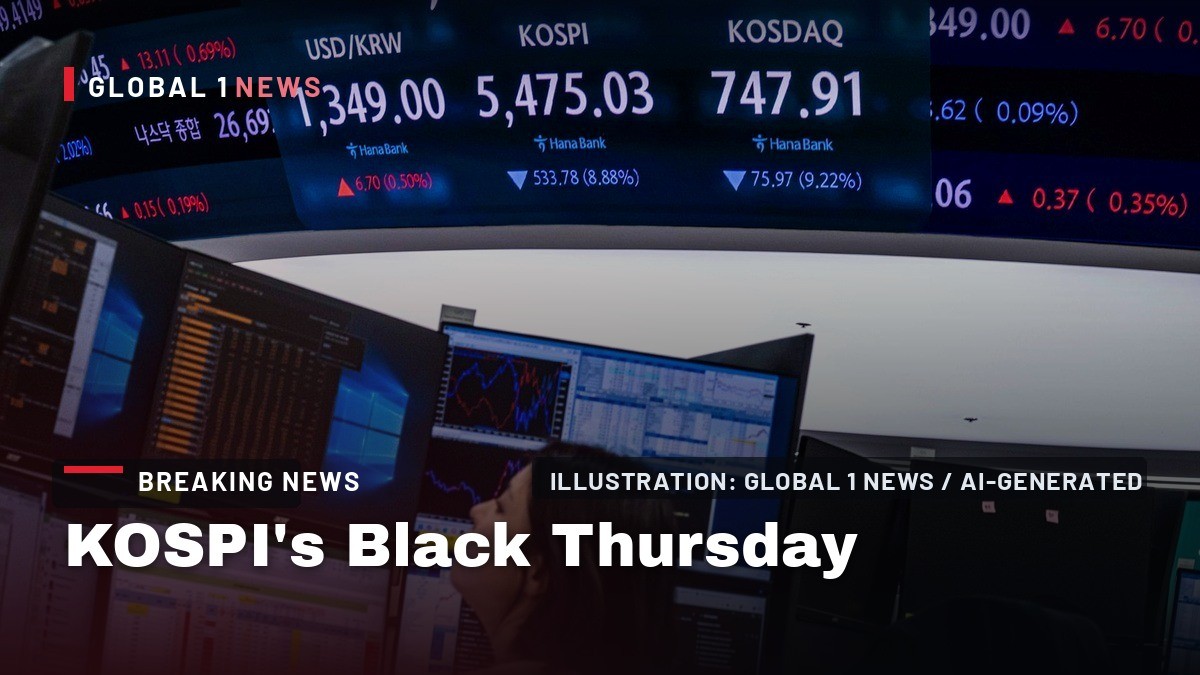
South Korea's benchmark index lost more than seven and a half percent in a single session on 15 October, tripping circuit breakers in both the main and junior markets for the first time in seventy-eight days. By the next morning it was climbing again - and the people who watch this market closest were not calling it a recovery. Here is what is documented, and what nobody has answered yet.
KOSPI's Black Thursday: Circuit Breakers, a Seven-Session Slide and a Rebound Nobody Trusts
Seoul, South Korea - 16 October 2026 - The KOSPI closed Thursday at 5,554.22, down 454.59 points, and by 10 a.m. Friday it stood at 5,704.91, up 2.71 percent, with foreign investors still selling. What follows is the record as the outlets carrying it have reported it - including where those outlets do not agree.
The Circuit Breaker That Stopped Korea's Market
Sell-side sidecars triggered in both the KOSPI and the Kosdaq early in Thursday's session, according to SBS News. Then the level-one circuit breakers hit: 12:23:13 p.m. in the Kosdaq and 12:38:12 p.m. in the KOSPI, each halting trading for twenty minutes, DigitalToday reported.
It was the first simultaneous halt in both markets since 29 July, and the fifth such simultaneous activation this year, per DigitalToday. Reuters reported the halt marked the 10th activation of a circuit breaker on the KOSPI this year and the 16th in its history.
The depth of the fall is where the accounts split. Reuters, writing at 0338 GMT, had the KOSPI down 480.76 points at 5,528.05 - an 8 percent fall and its lowest since 29 July. SBS News described a fall of more than 8 percent. DigitalToday reported the index "fell as much as 9 percent intraday, sliding to the 5,400 level," and SBS News recorded an intraday low of 5,450. Those are the same session at three different moments, and they do not agree on the number.
Seven Sessions, a Fifth of the Benchmark
Thursday was not a single bad day. It was the seventh consecutive losing session, running from 6 October through 15 October, and DigitalToday put the cumulative drop at 1,449.52 points, or about 21 percent.
Aju Press and SBS News both put the same slide at about 20 percent, and SBS News called it the longest losing streak in two years, dating to September 2024. The two figures are carried here as published.
The Asia Business Daily framed it differently again: the KOSPI opened at 7,004 on 2 October and fell to 5,554 on 15 October, a drop of about 20 percent in less than two weeks - thirteen days by the calendar. Total market capitalisation shrank by 375 trillion won in one day, to 4,581 trillion won, SBS News reported, and the junior Kosdaq closed down 7.65 percent at 760.
Volatility moved with it. The KOSPI 200 Volatility Index rose from 43.0 at the end of September to 55.4 on 15 October, according to The Asia Business Daily.
Two Chipmakers and Half the Index
Samsung Electronics closed down 9.48 percent at 210,000 won on Thursday, and SK Hynix closed down 11.06 percent at 1,262,000 won, both per DigitalToday. Those two names carry roughly half the domestic market, and the outlets do not agree on the exact share: SBS News says 47 percent, while The Asia Business Daily puts it at around 48 percent of the KOSPI's market capitalisation and refers to the pair as "Samjeon-hynix."
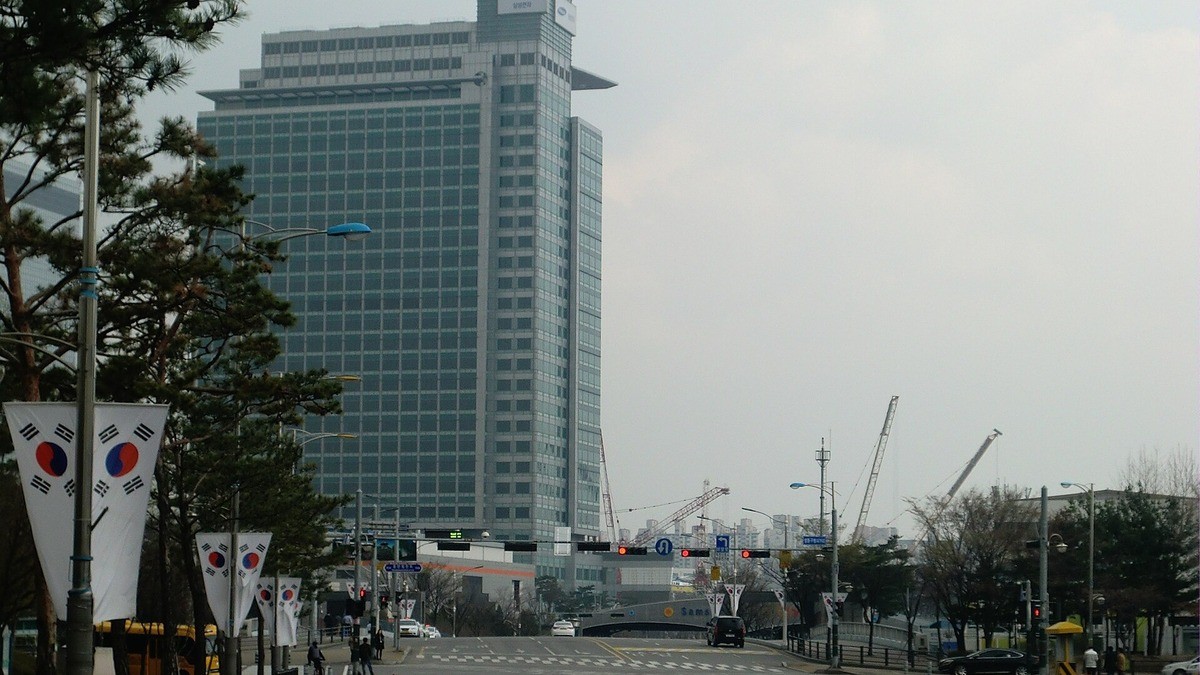
The damage ran past semiconductors. Samsung Electro-Mechanics fell 15.36 percent, SK Square 10.21 percent, Samsung Life 7.51 percent, Hyundai Motor 5.74 percent, LG Energy Solution 4.62 percent and KB Financial Group 1.57 percent, all per DigitalToday.
One name went the other way. Samsung Biologics rose 5.50 percent to 1,247,000 won - the only gainer among the top stocks by market value, according to DigitalToday. In a session that halted trading twice, that single green line is the whole list.
What Set It Off: CoreWeave, CXMT and the AI Bill
No outlet named a single cause, and none is asserted here. What the outlets did name is a stack of them.
US September consumer price inflation came in at 3.7 percent year on year against expectations of 3.6 percent, with core inflation at 2.6 percent against a 2.5 percent forecast, Aju Press reported. SBS News pointed to a technology-led selloff on Wall Street the night before, with the Philadelphia Semiconductor Index plunging more than 4 percent overnight.
Reuters tied the tech selling to what it called the CoreWeave shock: "questions about cloud company CoreWeave's debt pile fuelled worries about the financing driving the AI boom." CoreWeave's bond yields had reached highs associated with distressed debt, and its shares had slumped 15.5 percent on Wednesday before recovering some composure Thursday, per Reuters.
Reuters also cited China's ChangXin Memory Technologies reporting progress on a next-generation DRAM architecture that could intensify competition with established memory manufacturers. SBS News carried a Gartner projection that $8.5 trillion in revenue will be needed by 2030 to cover AI infrastructure investment and financing costs, against actual data-centre-related revenue expected to reach no more than $3.6 trillion.
Ten People in a Room at the Government Complex
The Financial Services Commission convened an emergency market review meeting on the afternoon of 15 October at the Government Complex Seoul, chaired by FSC Chairman Lee Eog-weon, with the Financial Supervisory Service, the Korea Exchange and market experts, according to The Asia Business Daily. Ten people attended, including the FSS deputy governor, the Korea Exchange deputy chairman, the Korea Securities Depository president, the Korea Securities Finance Corporation vice president, and research centre heads from KB Securities and Shin Young Securities.
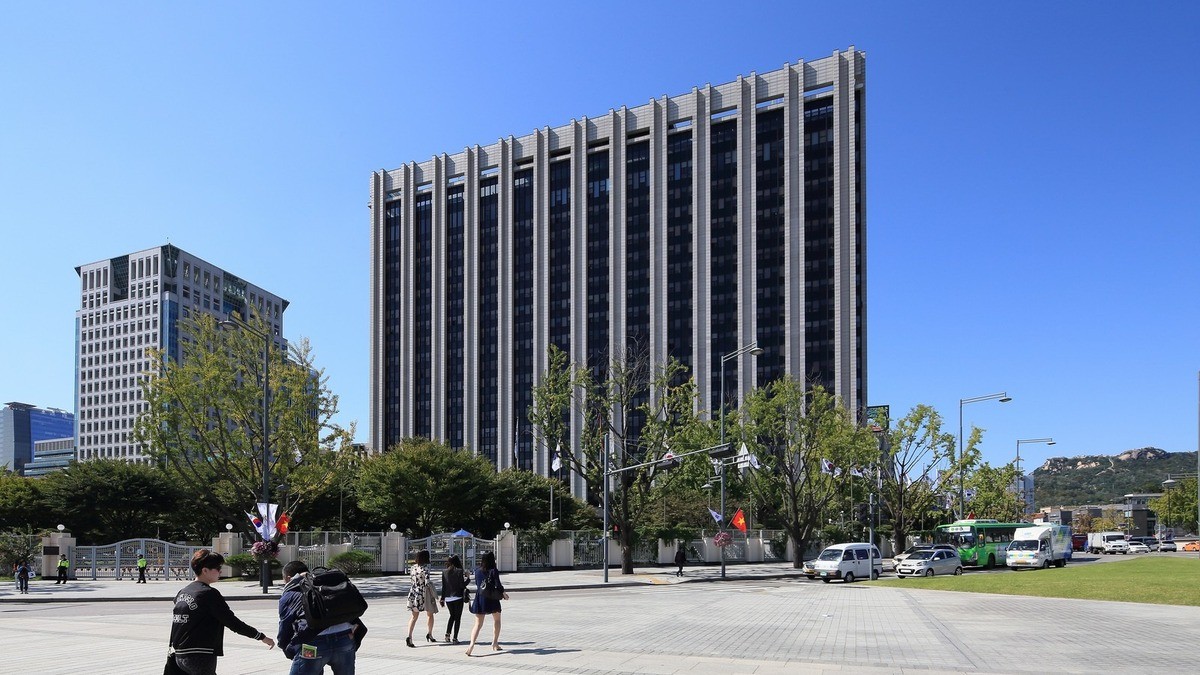
The two outlets do not agree on when it began: The Asia Business Daily's English edition says 2 p.m., while Korea Economic Daily says 2:30 p.m.
The read-out, per Yonhap and DigitalTimes, was that participants judged volatility had risen on global rate-rise expectations, uncertainty over AI semiconductor investment and earnings, and higher international oil prices - but that the market had "reacted excessively" in the speed of the fall and in supply and demand. They confirmed semiconductors, defence and shipbuilding showed sound earnings, and that foreign-exchange reserves, the current account and financial institution soundness remained solid.
The Contingency Plan Nobody Has Seen
Chairman Lee Eog-weon's instruction, as carried by Yonhap and DigitalTimes in translation from Korean: "Have vigilance even over small volatility and actively respond to financial market stability and investor protection."
He added: "Investment relying on excessive debt and credit is dangerous, and at times like this risk management is all the more important." He asked financial companies to refrain from indiscriminate extension of credit and to protect customers.
The authorities said they would apply a "no-tolerance principle" to market-disturbing activities including spreading false rumours, price manipulation and illegal short selling, and would be ready to implement a pre-prepared contingency plan swiftly if volatility widened further, per Yonhap, DigitalTimes and The Asia Business Daily.
That plan has not been published. No public account describes its contents, its triggers or its scale. What is documented is the commitment to use it, not the thing itself - and on the morning of 16 October the Ministry of Economy and Finance held a joint Market Situation Review Meeting at the Government Complex Seoul, chaired by First Vice Minister Kwon Daeyeong, with Bank of Korea Deputy Governor Kwon Minsu and FSC Secretary General Shin Jin-chang among those attending, per The Asia Business Daily. That meeting agreed to monitor the bond, foreign exchange and short-term funding markets - not just equities - for spillover.
The Morning After
The KOSPI stood at 5,704.91 as of 10 a.m. on 16 October, up 2.71 percent from Thursday's close, after opening 1.80 percent higher at 5,653.99, Aju Press reported. Reuters put the Friday gain at 2.8 percent, following a nearly 8 percent plunge. The two figures do not match, and both are carried here as filed.
Retail investors net bought 81.9 billion won and institutions net bought 169.8 billion won of KOSPI shares, while foreign investors remained net sellers, offloading 335.8 billion won, per Aju Press. Advancers outnumbered decliners 757 to 123.
Samsung Electronics rose 2.50 percent to 215,250 won and SK Hynix gained 3.01 percent to 1,300,000 won, with Samsung's preferred shares up 4.49 percent at 166,250 won, according to Aju Press. KB Financial Group added 4.59 percent, Hyundai Motor 2.88 percent, Samsung Electro-Mechanics 2.06 percent, SK Square 0.78 percent, LG Energy Solution 0.50 percent and Samsung Biologics 0.40 percent. The won strengthened to 1,344.0 per dollar from the previous close of 1,344.6.
A Regulator About to Move Two Hours South
Two days before the crash, the government confirmed on 13 October that the Financial Services Commission will relocate to Sejong in the second half of next year, per The Asia Business Daily and Korea Economic Daily. The emergency meeting came two days later. Behind the concern: 91.6 percent of financial companies' headquarters and 72.7 percent of listed companies' headquarters sit in the Seoul metropolitan area, per The Asia Business Daily.
A financial sector official said: "Since the financial institutions and companies that work with the FSC are all based in Seoul, communication with the sector in normal times could be disrupted, as could swift responses in a crisis."
An FSC official described the working rhythm at risk: "When market volatility rises, Chairman Lee sometimes calls in securities analysts who cover market trends to discuss the situation together, and at other times runs to the director general's office with a one-page report. If the FSC moves to Sejong, with working-level staff in Sejong and senior officials in Seoul, it could become difficult to report and discuss matters as swiftly as we do now."
The FSC has previously acted in crises including the savings bank crisis, corporate restructuring and the Legoland incident, per The Asia Business Daily. No account states the relocation decision caused the selloff. It is a reported concern about crisis-response capability, and nothing more.
What Is Not Known
Foreign selling is one of the splits. DigitalToday reported foreign investors net sold 3.62 trillion won on the main board on 15 October, extending their streak to eight consecutive sessions, with SBS News saying more than 3.6 trillion won. Reuters' dispatch, filed at 0338 GMT mid-session at the circuit breaker, put foreign net selling at 2.9 trillion won, or $2.15 billion at $1 = 1,347.5900 won. The Korean outlets' figure is the full-session number. The two cover different points in the day and do not agree.
There is also an overlapping cyber thread with no named culprit. FSC Secretary General Shin Jin-chang met relevant institutions on 14 October to devise responses to hacking threats driven by artificial intelligence, per The Asia Business Daily. On 3 October, during the National Foundation Day holiday, Chairman Lee and Financial Supervisory Service Governor Lee Chan-jin chaired an emergency review meeting at the Government Complex Seoul on the threat of cyberattacks. No outlet identifies who or what is behind any threat, and no breach is linked to these meetings.
Where This Goes Next
The government's own case for calm rests on numbers it cited, per The Asia Business Daily: the International Monetary Fund raised its forecast for South Korea's growth this year to 3.3 percent from 2.6 percent, operating profits at KOSPI-listed companies are forecast to rise from 312 trillion won to 969 trillion won, and the country continues to post a substantial current account surplus.
Markets analyst Kyle Rodda of Capital.com wrote in a client note carried by Reuters: "Global markets are getting very noisy once again after a period of low volatility: Wall Street is whipsawing, bond yields are swinging, currency markets are doing backflips, and commodity prices are running in multiple directions." He added that global markets "could potentially be in for a protracted period of this sort of volatility."
Regionally, Japan's Nikkei 225 rebounded 1.11 percent to 65,143.36 in morning trade after Thursday's 4.90 percent plunge, per Aju Press, while Reuters put the Nikkei's gain at 1.8 percent. Indonesia's benchmark slumped 11 percent after MSCI said the country's stock market no longer merits "emerging market" status, Reuters reported.
What to watch: whether foreign selling on both Korean markets stops, whether the FSC publishes anything about the contingency plan it says is ready, and what happens to the Sejong relocation timeline. Aju Press closed its Friday report with the caution that "continued foreign selling on both Korean markets, however, left the durability of the rebound in question." That is the open question, and it is still open.
By Jessica Ali, Staff Writer
This article was produced with AI-assisted research and editorial support. Sources: Reuters, SBS News, DigitalToday, Aju Press, The Asia Business Daily, Yonhap News Agency, DigitalTimes, Korea Economic Daily and The Korea Times.
What's Your Reaction?
 Like
0
Like
0
 Dislike
0
Dislike
0
 Love
0
Love
0
 Funny
0
Funny
0
 Wow
0
Wow
0
 Sad
0
Sad
0
 Angry
0
Angry
0

Editor-in-Chief at Global1.News. Atlanta-based journalist who cuts through the BS and tells it like it is. Lead anchor, host, and the voice you hear when the spin stops and the truth starts.














Comments (0)