
Long March 7A Explodes Over Wenchang: A Setback for China's Orbital Ambitions
A Rare Failure for a Workhorse Rocket The explosion of a Chinese Long March 7A rocket over the Wenchang Space Launch Site on Monday evening is more than a technical mishap; it is a strategic event with implications for Beijing's most ambitious space objectives.
A Rare Failure for a Workhorse Rocket
The explosion of a Chinese Long March 7A rocket over the Wenchang Space Launch Site on Monday evening is more than a technical mishap; it is a strategic event with implications for Beijing's most ambitious space objectives. The failure, which occurred at 8:02 p.m. Beijing time (12:02 UTC) on 10 August 2026, destroyed both the launch vehicle and the ChinaSat-4B communications satellite it was carrying. While no casualties have been reported, the incident punctures the aura of reliability that China's space program has cultivated over the past half-decade, and it arrives at a moment when the People's Republic is racing to establish a permanent lunar presence and build a satellite internet constellation to rival Starlink.
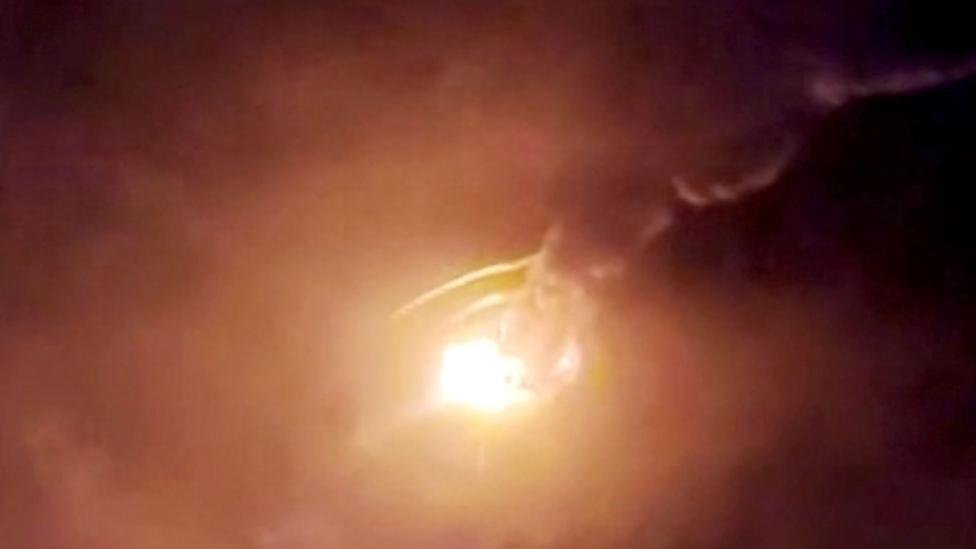
For a program that has conducted tens of launches annually-second only to the United States in global cadence-the failure is a stark reminder that the margin for error in rocketry remains razor-thin. The Long March 7A, a medium-lift vehicle designed for geostationary transfer orbit (GTO) missions, had enjoyed a string of more than a dozen successful flights since 2020. That record, however, has now been broken in spectacular fashion, with footage showing a bright flash and a massive fireball approximately 85 seconds into the ascent.
What Happened Over Wenchang
According to China's state news agency Xinhua, the rocket lifted off from Launch Complex 201 at the Wenchang Space Launch Site on Hainan Island, China's southernmost coastal launch facility. The vehicle experienced what state media described as an "in-flight anomaly" shortly after liftoff. Video footage, widely circulated by the BBC and other outlets, shows the rocket breaking apart and exploding in mid-air, scattering debris over the launch area. The ChinaSat-4B satellite, a communications platform intended for broadcast and telecommunications relay, was lost with the vehicle.
Reuters reported that this was the first failure for the Long March 7A since its maiden flight in March 2020. It is important to note, however, that the 2020 maiden flight itself ended in failure-an engine malfunction shortly after stage separation, as detailed by Gizmodo. The rocket's subsequent career, spanning missions designated Y2 through Y14 and beyond, had been unblemished until Monday's incident. The root cause of the current failure has not been announced, and Chinese authorities have not yet indicated whether an investigation has been formally launched, though such a process is standard procedure following any launch anomaly.
Why the Long March 7A Matters
The Long March 7A is not merely another rocket in China's inventory; it is a critical asset for the nation's high-orbit communications infrastructure. As a derivative of the Long March 7-the workhorse that services the Tiangong space station-the 7A variant is optimized for geostationary transfer orbit missions, placing heavy communications satellites at altitudes where they can provide fixed broadcast and data relay services. The loss of ChinaSat-4B represents a direct hit to China Satcom's operational capacity, though the company has not yet commented on redundancy or replacement plans.
Wenchang's geographic position is itself a strategic advantage. Located at approximately 19 degrees north latitude, the coastal site allows rockets to leverage the Earth's rotational velocity more effectively than inland launch pads, making it the preferred venue for China's largest vehicles, including the Long March 5, 7, and 8. The site's proximity to the sea also simplifies debris management and enables the transport of large rocket stages by ship. Any prolonged grounding of the Long March 7A would therefore ripple across China's launch manifest, delaying scheduled satellite deployments and potentially affecting commercial customers who have booked payloads on the vehicle.
The Reliability Record: A Study in Contrasts
China's space program has historically demonstrated a remarkable capacity to recover from launch failures. The most instructive precedent is the Long March 5 failure in July 2017, when the heavy-lift rocket suffered an engine malfunction during ascent. That failure triggered a comprehensive investigation and a temporary grounding of the rocket family. The program returned to flight successfully in December 2019, and the Long March 5 subsequently enabled the Chang'e lunar sample return missions and the launch of the Tianhe core module for the Tiangong space station.
The pattern is likely to repeat with the Long March 7A. Chinese space authorities typically conduct a thorough root-cause analysis, implement corrective measures, and then resume launches with a demonstration flight. The question is how long that process will take. Given the rocket's importance to GTO missions, a prolonged grounding could create a bottleneck for China's satellite deployment plans, particularly for the Guowang and Qianfan (Thousand Sails) constellations, which are intended to provide global broadband internet coverage in direct competition with SpaceX's Starlink.
National Prestige and the Party-State
For the Chinese Communist Party, the space program is not merely a scientific endeavor; it is a pillar of national prestige and a tangible demonstration of technological self-sufficiency. Every successful launch is framed in state media as evidence of the Party's leadership and the superiority of China's socialist system. Conversely, a high-profile failure such as Monday's explosion presents a communications challenge. State media, including Xinhua, have so far adhered to a cautious script, attributing the incident to a "flight anomaly" without offering technical details. This measured approach mirrors past handling of failures, where authorities prioritize transparency about the fact of the failure while withholding diagnostic specifics until the investigation concludes.
The timing of the failure is particularly awkward. China has committed to a crewed lunar landing before 2030, a goal that requires the successful development and repeated flight of the Long March 10 rocket, as well as the continued reliability of existing vehicles. While the Long March 7A is not directly involved in the lunar program, its failure raises questions about the overall quality control and operational discipline across China's launch infrastructure. Any perception of systemic reliability issues could complicate international partnerships and commercial launch contracts, which are increasingly important to China's space economy.
The Satellite Internet Race
The strategic stakes extend well beyond a single satellite. China is in the early stages of deploying two massive low-Earth-orbit constellations-Guowang, operated by China Satnet, and Qianfan, led by a Shanghai-based consortium. These networks are designed to provide global broadband coverage, challenging Starlink's dominance and offering Beijing a sovereign alternative for communications in remote regions, at sea, and in the air. The constellations require hundreds, ultimately thousands, of satellites, each of which must be launched reliably and cost-effectively.
The Long March 7A is not the primary vehicle for these low-Earth-orbit deployments-that role falls to smaller rockets such as the Long March 8 and commercial launchers. However, the failure underscores the fragility of China's launch supply chain. A single anomaly can disrupt schedules, delay revenue-generating deployments, and force a reassessment of launch cadence assumptions. In the broader US-China technological competition, which spans semiconductors, artificial intelligence, and robotics, the ability to launch satellites reliably is a strategic asset. Washington has already tightened export controls on space-related technologies, and any perceived weakness in China's launch capability could embolden hawks in the US Congress who advocate for even stricter measures.
Lessons from Past Failures
China's space program has a well-established playbook for handling launch failures. The 2017 Long March 5 incident is the canonical example: an investigation was conducted, the root cause was identified as a turbopump issue in the YF-77 engine, and corrective actions were implemented before the rocket returned to flight. The process took approximately two years, but the eventual success of the Long March 5 enabled China's most ambitious missions, including the Chang'e 5 lunar sample return and the assembly of the Tiangong station.
The Long March 7A failure is likely to follow a similar trajectory, though the timeline may be shorter given the rocket's simpler design and the maturity of its components. The key variable is whether the anomaly is traced to a systemic issue affecting other Long March variants or an isolated manufacturing defect. If the former, the grounding could extend to multiple rocket families, causing cascading delays across China's launch manifest. If the latter, the return-to-flight could occur within months. Until the investigation concludes, the global space community will be watching closely, as China's launch cadence has become a critical component of the international satellite market.
What It Means for China's Space Trajectory
The immediate consequence of Monday's failure is operational: ChinaSat-4B must be replaced, and the Long March 7A fleet will likely be grounded pending investigation. The medium-term consequence is strategic. China's space ambitions-the Tiangong station's continued operations, the Chang'e lunar exploration series, the crewed lunar landing before 2030, and the Guowang and Qianfan constellations-all depend on a reliable and predictable launch infrastructure. A single failure, while statistically inevitable in rocketry, introduces uncertainty into a program that has been characterized by rapid, confident progress.
For the United States and its allies, the failure offers a moment of reflection rather than celebration. The US-China space competition is not a zero-sum game; both nations face the inherent risks of spaceflight. The Long March 7A explosion is a reminder that even the most advanced space programs experience setbacks. How China responds-with transparency, rigorous investigation, and a successful return-to-flight-will determine whether this incident is a footnote or a turning point. Given China's demonstrated resilience in the face of past failures, the most likely outcome is a temporary pause followed by a resumption of launches. But the incident also highlights the fragility of the global space supply chain, which increasingly depends on Chinese launch capacity to meet the growing demand for satellite services.
In the end, the Long March 7A failure is a test of China's space program's maturity. The world will be watching not just for the technical diagnosis, but for how Beijing manages the narrative, the investigation, and the path back to flight. The stakes are nothing less than China's position in the new space race-and its ability to project technological power on a global stage.
By Prof. Marcus Chen, Staff Writer
This article was produced with AI-assisted research and editorial support. Sources: BBC News, Reuters, Xinhua, Channel News Asia, Space.com.
What's Your Reaction?
 Like
0
Like
0
 Dislike
0
Dislike
0
 Love
0
Love
0
 Funny
0
Funny
0
 Wow
0
Wow
0
 Sad
0
Sad
0
 Angry
0
Angry
0

World Politics Analyst at Global1.News. Based in Beijing, covering US-China relations, global trade, and geopolitical strategy. Brings deep analytical perspective to the power dynamics shaping international affairs.















Comments (0)