
Lauryn Hill and Wyclef Jean Bring 'The Score' to UK at Diaspora Calling!
On a warm August evening in Milton Keynes, England, more than 35,000 people gathered at the National Bowl as Ms. Lauryn Hill's Diaspora Calling! festival made its long-awaited United Kingdom debut — a celebration of African diasporic music, culture and community that brought together three generations of artists and fans under one open sky. Lauryn Hill and Wyclef Jean Bring 'The Score' to UK at Diaspora Calling! Debut Milton Keynes, United Kingdom — Lauryn Hill and Wyclef Jea
On a warm August evening in Milton Keynes, England, more than 35,000 people gathered at the National Bowl as Ms. Lauryn Hill's Diaspora Calling! festival made its long-awaited United Kingdom debut — a celebration of African diasporic music, culture and community that brought together three generations of artists and fans under one open sky.
Lauryn Hill and Wyclef Jean Bring 'The Score' to UK at Diaspora Calling! Debut
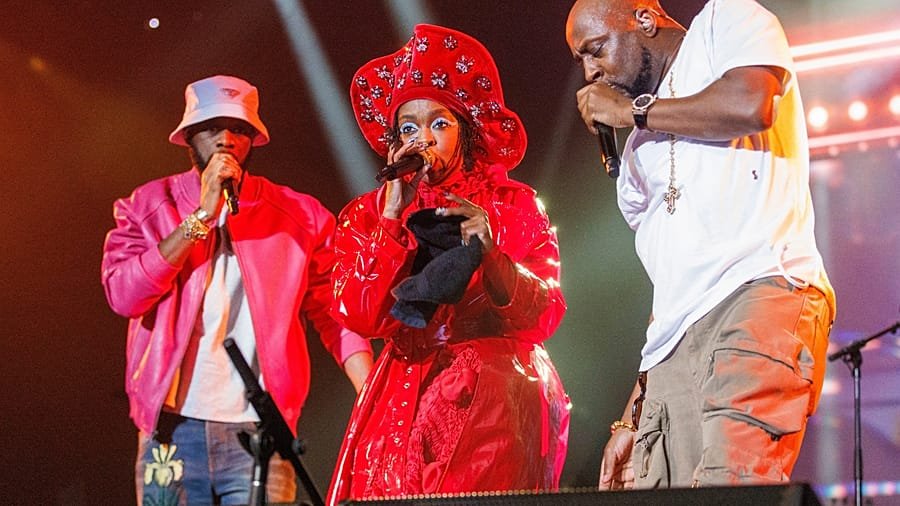
Milton Keynes, United Kingdom — Lauryn Hill and Wyclef Jean, two-thirds of the legendary Fugees, performed their landmark album "The Score" in full as Hill's Diaspora Calling! festival landed in Britain for the first time. Ten years after its inaugural edition in Brooklyn, the event at the National Bowl on Friday night turned into a cross-generational reunion rooted in the sounds and stories of the African diaspora.
A Festival Born From Diaspora Dreams
Diaspora Calling! was conceived by Ms. Lauryn Hill in 2016 as a music and arts platform celebrating the creativity, culture and shared histories of the African diaspora. What began with a curated art exhibition and live performance in Brooklyn, New York, has evolved over the past decade into a touring celebration that connects Black communities across oceans and generations. The festival's name itself carries a promise — that the scattered children of Africa, whether in the Caribbean, the Americas or Europe, share a thread that music can weave back together.
The UK debut on Friday, August 7, 2026, at Milton Keynes National Bowl marked the first edition outside the United States, fulfilling a vision that Hill has nurtured since those early Brooklyn days. For a festival built on the idea of diaspora as a living, breathing network, bringing it to Britain — home to one of Europe's largest African and Caribbean populations — was a natural and long-awaited step. The choice of the National Bowl, an iconic outdoor venue with a capacity that swallowed the massive crowd without losing intimacy, proved inspired.
The National Bowl hosted one main stage alongside a full food village celebrating diverse flavours and traders. From jollof rice to jerk chicken, from suya skewers to plantain fritters, the culinary landscape mirrored the musical lineup — a map of the diaspora in taste and sound. Families spread blankets on the grass while younger fans pressed toward the barriers, creating a layered audience that reflected the festival's multi-generational appeal.
'The Score' at 30: A Landmark Album, A Living Legacy
When The Fugees released "The Score" in 1996, few could have predicted the seismic impact it would have on global music. The album, which blended hip-hop, soul and reggae into a seamless whole, went on to become one of the best-selling hip-hop albums of all time, selling millions of copies worldwide and introducing a generation to the possibilities of what Black music could be when it refused to stay in one lane. Thirty years later, its power remains undiminished.
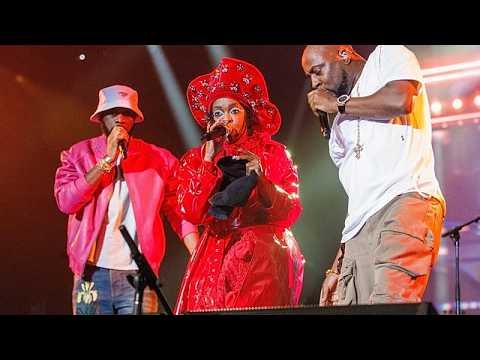
Hill and Wyclef Jean, two-thirds of the original trio, brought the album to life in full at the National Bowl, performing tracks including "Ready or Not" and "Fu Gee La" with the kind of energy that suggested the songs were as fresh to them as they were to the audience. The 30th anniversary performance was not a nostalgia trip but a reclamation — a statement that these songs, and the values they carry, remain urgently relevant in 2026.
Hill also dipped into her solo catalogue, delivering "Ex Factor", "Doo Wop (That Thing)" and "To Zion" to a crowd that sang every word back to her. The Miseducation of Lauryn Hill, her 1998 solo debut, remains a touchstone for artists across Africa and the diaspora — a template for how personal storytelling could carry political weight without losing its emotional core. Hearing those songs in the open air of Milton Keynes, surrounded by tens of thousands of voices, was a reminder of why Hill's music has endured.
Hill's set ran late and was cut off at 23:00, but fans who stayed were rewarded with an impromptu a cappella "Killing Me Softly" — the song that introduced The Fugees to the world and remains their most beloved recording. In that unadorned moment, stripped of production and amplification, the power of the song and the voice carrying it became unmistakable. Hill told the AP that performing "The Score" "was wonderful. We get the time back. We get the time back every time we do that."
A Lineup Spanning Continents and Generations
Dave Chappelle hosted the event, bringing his signature blend of wit and social commentary to the proceedings. The comedian, who has long been a bridge between American and African cultural scenes, kept the energy high between sets, his presence adding a layer of cultural gravitas to an already stacked lineup. His hosting also underscored the festival's ambition — this was not merely a concert but a cultural summit.
Erykah Badu delivered a smoky, hypnotic set that included "Apple Tree", "Window Seat", "On & On" and "Back in the Day", reminding everyone why she remains one of the most distinctive voices in contemporary soul. Her performance, like Hill's, drew on a deep well of African American musical tradition while pushing forward into new sonic territory. The crowd, many of whom had grown up with her music, responded with the kind of devotion reserved for artists who have soundtracked entire lives.
Nigerian Afrobeats star Fireboy DML warmed up the crowd with hits including "Peru", his breakout single that has become an anthem across the continent and beyond. His presence on the lineup was a testament to Afrobeats' global ascendancy — a genre that has moved from Lagos clubs to world stages in record time. For the diaspora audience, his set was a reminder that the music coming out of Africa today is not a derivative of Western forms but a powerful current in its own right.
UK rap icon Giggs surprised the crowd with Kano for "P's & Q's" and "Rudeboy", a collaboration that brought the house down. The two British rappers, both legends in their own right, represented the UK's vibrant hip-hop scene — a scene that has long drawn on African and Caribbean influences while forging its own distinct identity. Their set was a reminder that the diaspora is not a one-way street but a constant exchange of ideas, sounds and styles.
Seun Kuti and The Compozers represented Afrobeat, carrying forward the legacy of his father, Fela Kuti, with a set that blended political fire with infectious grooves. Seun's music is a direct continuation of the Afrobeat tradition — a genre born in Lagos but now claimed by the world. His performance at Diaspora Calling! was a powerful statement about the enduring relevance of politically engaged music.
Family Ties and Musical Inheritance
YG Marley told the AP that "The Score" made him want to become a rapper. "That album grew me. I make reggae music, I still make my little rap music too. And that's what made me turn into a rapper," he said, his words carrying the weight of a young artist who grew up surrounded by musical royalty yet found his own path through the Fugees' groundbreaking fusion of styles. His testimony was a living example of how music travels across generations, inspiring new creations from old sounds.
YG Marley attended his mother's shows since he was 8 years old, growing up backstage at some of the biggest concerts in the world. That early exposure shaped his understanding of music as both craft and calling — a lesson he now applies to his own career. His presence at Diaspora Calling! was not incidental but symbolic: the festival is built on the idea that musical inheritance is real, tangible and ongoing.
Zion Marley was brought onstage by his mother to sing Bob Marley & The Wailers' "Three Little Birds", a moment that brought tears to many eyes in the crowd. The young artist, carrying the weight of a legendary surname, delivered the song with a sweetness that honoured his grandfather's memory while establishing his own voice. "I want to always do my best... because I came from greats and they didn't take it half," he said, his words echoing the ethos of the entire festival.
Hill herself reflected on the journey that brought her to this moment. "I think to me what I thought about was when we started and this was the mission from the beginning... you got to reclaim that and get back on it," she told the AP. Her words spoke to the challenges of a career that has seen its share of controversy and delay, but also to the resilience that has kept her music alive for three decades.
Voices From the Crowd: Unity in a Divided Time
Festival-goer Chris Grimes captured the mood of many when he told reporters: "It rings true because you don't know when you're going to see such great artists again, so this is something which we had to go to." His words reflected the urgency that many felt — a recognition that moments like this, when legends share a stage, are rare and precious. The decision to travel to Milton Keynes, for many, was not a choice but a necessity.
Deborah Blythe offered a broader perspective: "I think in these times where we do have a divided society, to see so many people here brought together for music is a beautiful thing." Her observation spoke to the festival's deeper purpose — not just entertainment but a demonstration that music can still unite people across lines of race, class and nationality. In a moment of global polarisation, the sight of 35,000 people singing together was a powerful counter-narrative.
Attendee Elle Erinly praised the amplification of "love and unity" and noted the diversity of the crowd: "I'm seeing different patterns, different prints, beautiful people... people that are in solidarity from other cultures all here to enjoy." Her words captured the visual richness of the festival — a sea of African prints, Caribbean colours, European styles and everything in between, all united by a shared love of the music.
What Diaspora Calling! Means for African Music's Global Rise
Festivals play a crucial role in cultural preservation and exchange. They create spaces where traditions can be passed down, where young people can encounter the music of their parents and grandparents, and where the diaspora can maintain connections to cultural roots that might otherwise fade. Diaspora Calling! is part of a broader ecosystem of festivals — from Afrochella in Ghana to the Saint-Louis Jazz Festival in Senegal — that keep African culture vibrant and evolving.
Senegal's own traditions of music as unity run deep. From Mbalax, the genre that Youssou N'Dour carried to the world stage, to the acoustic poetry of Baaba Maal, Senegalese music has always understood itself as a force for social cohesion. The griot tradition, in which musicians serve as historians and peacemakers, finds echoes in the way Diaspora Calling! brings people together across differences.
What to Watch For
Artists like Fireboy DML and Seun Kuti carry the torch in different ways — one representing the new wave of Afrobeats, the other the enduring power of Afrobeat. Their presence at the festival was a reminder that African music is not monolithic but diverse, spanning genres, generations and political commitments. The future of the music lies in this diversity.
What African readers can learn from Hill's vision of unity through music is simple but profound: music has the power to bring people together across every divide. In a world that often seems determined to separate us, the festival was a reminder that we share more than we differ — and that the sounds of our ancestors can guide us toward a more connected future.
This article was produced with AI-assisted research and editorial support. Sources: Africanews, The Associated Press, Voice Online, The Pit London, Diaspora Calling! official site.
By Amara Diop, Staff Writer
What's Your Reaction?
 Like
0
Like
0
 Dislike
0
Dislike
0
 Love
0
Love
0
 Funny
0
Funny
0
 Wow
0
Wow
0
 Sad
0
Sad
0
 Angry
0
Angry
0
West Africa/Sahel Correspondent at Global1.News. Dakar-based journalist covering politics, security, climate, and development across Francophone and Anglophone West Africa. Tells the stories of a region undergoing profound transformation.











Comments (0)