
Lagarde Will Leave the ECB Early, Handing Europe a Succession Fight Before France Votes
The ECB president will step down in February 2027 so she can speak freely on politics, opening a succession race EU leaders must settle before France's presidential vote.

Christine Lagarde will leave the European Central Bank on 7 February 2027, more than eight months before her eight-year term was due to expire, and she is leaving on purpose. The woman who sets borrowing costs for 21 countries says she can no longer stand inside the neutrality the job demands. The calendar she chose will let European leaders pick her successor while Emmanuel Macron still sits in the Élysée, months before a French presidential vote that Marine Le Pen is favoured to win.
Lagarde Will Leave the ECB Early, Handing Europe a Succession Fight Before France Votes
Frankfurt, Germany — She told the Governing Council and European Council President António Costa of the decision on 29 October 2026. The Governing Council thanked her and gave her a long standing ovation. The rate decision she came to announce was forgotten by the second question.
What Lagarde Actually Said
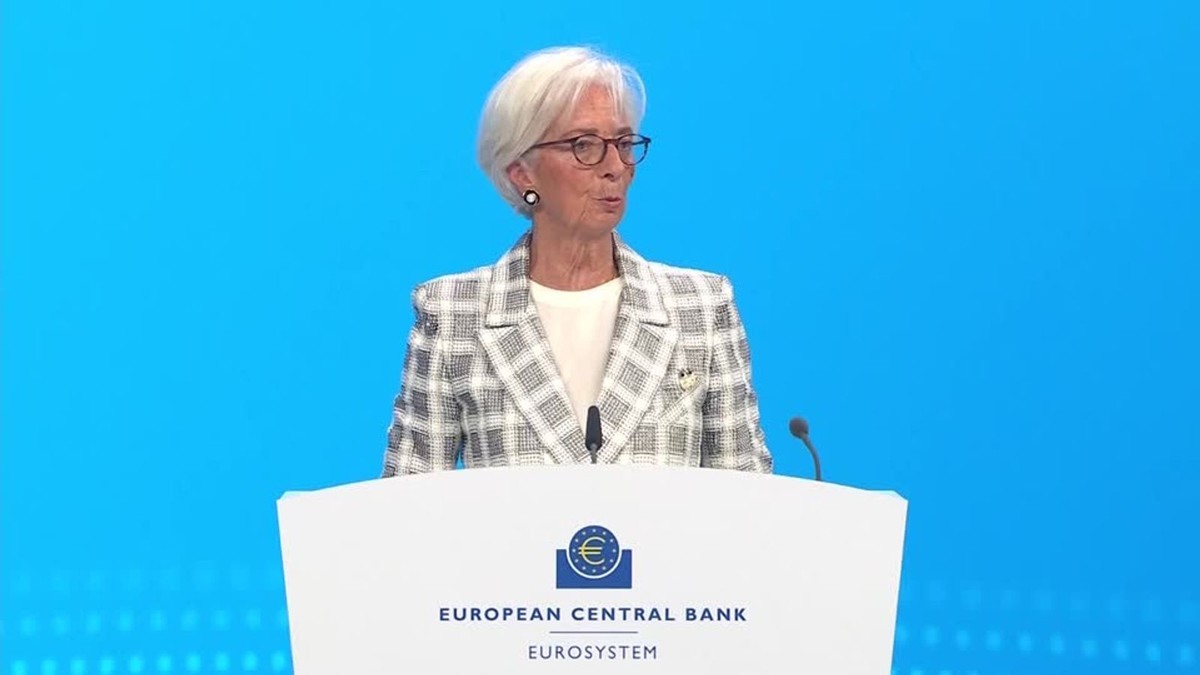
At the press conference after the rate decision, she gave a reason that had nothing to do with economics. "I want to have the freedom of speech, the freedom of expression and the freedom to engage on matters that are not monetary policy matters," Lagarde said. The neutrality of the job, she said, is "the price we pay for being independent." Then came the line that explains the timing better than any briefing: "I'm interested in the truth, and I see the truth being very often damaged, contradicted by misrepresentation." And this: "There are things that I can say — whether people will listen or not is another story. But I feel that I should say those things and I cannot do so in my current position." In a video message posted on X she called the job "a great pride and a huge privilege." She did not say what she intends to say, or where, or to whom.
The Rate Decision Buried Underneath It
The Governing Council held all three key rates. The deposit facility stays at 2.50%, main refinancing operations at 2.65%, the marginal lending facility at 2.90%. The prepared statement blamed energy: prices "have continued to rise, posing upside risks to the inflation outlook and downside risks to the growth outlook." Eurozone inflation ran at 3.8% in September, up from 3.2% in August and almost double the 2% target, Euronews reported. It was a pause in a year that already produced two hikes, the last in September. AFP reported that Lagarde disclosed the council had "debated whether a hike was appropriate," and that "unless there were major developments, the direction of travel is quite clear." The ECB also insisted it "is not pre-committing to a particular rate path." No December decision exists yet. An expectation is not a policy.
Why February, and Why France
AP reported the resignation "opens the way for European leaders to choose a successor ahead of France's presidential election next year," and that the move had been expected precisely so the choice would land "while pro-EU French President Emmanuel Macron is still in office." Euronews reported the ECB gave no reason, but that reporting since February has tied the timing to France's presidential election in April 2027. Morningstar reported the February date gives leaders room to choose a replacement before Macron leaves office. Felix Feather of Aberdeen Investments told CNBC what that actually buys: the next French president "will have no role in choosing the next ECB president — particularly significant given the political and fiscal uncertainty surrounding France." That is the whole trick of the date. Power exercised now, before an election can take it away.
The Bond Market Took Over the ECB's Job
France's borrowing costs are why the timing matters. Euronews reported French 10-year yields climbed above 5% last week for the first time since 2002, and stood near that level on Thursday with the spread over German debt at roughly 155 basis points. Moody's held France at Aa3 last Friday, with a negative outlook, while a divided parliament struggles to pass a budget. ING calculated that the yield rise since September had done the work of a 25 basis point hike in Germany, and closer to 50 in France. "The bond market has taken over the ECB's job," ING wrote. Lagarde, speaking in Bangkok earlier in October, put the remedy at France's own door: "the primary and first solution lies at home in France. And it has to do with fiscal policies." She added: "Fiscal sustainability is a crucial anchor for broader economic stability."
Two Names, Two Different Banks
AP named the leading candidates as Klaas Knot, the former Dutch central bank chief, and Pablo Hernández de Cos, general manager of the Bank for International Settlements. Bloomberg's October survey of economists made De Cos the narrow front-runner, Morningstar reported. Their reputations are not interchangeable. CNBC reported Knot "is widely seen as the more hawkish of the pair," having warned that the ECB risked doing too little during the inflation surge and raised the possibility of large increases. De Cos governed the Bank of Spain from 2018 to 2024 and chaired the Basel Committee on Banking Supervision, per Global Finance Magazine. Pierre Roke of Validus Risk Management told CNBC that a Knot appointment "would likely be read as hawkish and could support the euro," while De Cos "would signal more continuity." Carsten Brzeski of ING added the political wrinkle: Knot may find more support among northern governments, and the open question is whether Madrid backs De Cos.
Three Seats and One Package Deal
This is a package, not a post. Chief Economist Philip Lane and executive board member Isabel Schnabel, who runs market operations, also leave next year. Schnabel announced in September that she would go early, and Lane's term ends in May 2027, per Morningstar. Brzeski wrote that the ball is now with European government leaders to decide "a package deal, Lagarde, Schnabel and also Lane, probably at the European Council meeting in December." The machinery is fixed. The Council of the European Union states the executive board is appointed by the European Council in euro area composition by reinforced qualified majority under Article 283 of the Treaty on the Functioning of the European Union: at least 16 of the 21 euro area countries, representing at least 65% of the bloc's population. Six people sit on the board. Three of those seats are about to change hands.
The Neutrality Paradox She Just Named
There is an uncomfortable symmetry in her explanation. Lagarde is leaving so she can speak about matters outside monetary policy, and in 2024 her own staff said she already spent too much time on matters outside monetary policy. CNBC reported a staff survey that year "gave a heavily critical verdict on her tenure" and "suggested many felt she spent too much time discussing topics unrelated to monetary policy." She does not pretend the constraint was imaginary. "We have an obligation of neutrality, we comment on the situation with the focus on monetary policy," she said. Her argument is that the price has finally become too high. "At this time, in relation to many corners of the world, not just European corners... I think that my voice can help, my actions can help in relation to principles that are dear to my heart."
Seven Years, Two Shocks and a 1.35 Trillion Euro Bet
Lagarde succeeded Mario Draghi in 2019 and took office that November, per the Council of the European Union. CNBC reported she steered the bank through the pandemic, the Russia-Ukraine war and energy shocks that pushed European Union inflation above 11% in 2022 and ended the era of negative interest rates. AP recorded a key decision of her tenure in 2020, when the bank deployed 1.35 trillion euros in emergency pandemic bond buying. Before the ECB she was France's first female finance minister, in 2007, and the first woman to run the International Monetary Fund, from 2011. Costa credited her with "steady and determined stewardship, helping to safeguard stability and the resilience of the euro area." Brzeski's assessment was cooler: she treated the presidency "more as a moderator and chairperson of the entire Governing Council, rather than a thought leader."

What This Means Outside Europe
The ECB president sets borrowing costs for 21 countries and serves as the European Union's chief crisis fighter, AP noted, a job that reaches every household with a mortgage and every company that borrows in euros. The handover lands in a year when the politics of central banking are already raw on both sides of the Atlantic. Euronews reported the Fed held rates days before the midterms, with two officials dissenting. Brzeski reminded clients of March 2020, when Lagarde said the ECB was not there to narrow spreads, "a comment that, while correct in substance, ultimately backfired." Holger Schmieding of Berenberg told CNBC that as a former chair of the G20's Financial Stability Board, Knot "may have an edge" on financial risk. Schmieding also warned that the ECB "has no mandate and no appetite to fund French fiscal follies."
The Dates That Will Decide It
The fixed points are these. Announced 29 October 2026. Departs 7 February 2027. Her term would have ended 31 October 2027. Three press conferences remain: this week's, then 17 December and 4 February 2027, per Morningstar. Brzeski expects the package deal at the December European Council. The French first round is in April 2027, per CNBC. On how early she is actually going, the wires do not agree: AP and CNBC say nine months, CNN says eight, Euronews says around nine. The dates are settled and the interval is not, and it is not worth pretending otherwise. On what comes next, Reuters reported the World Economic Forum "could choose" her as its next chairperson in November, with a decision not yet final.
By Jessica Ali, Staff Writer
This article was produced with AI-assisted research and editorial support. Sources: European Central Bank, Reuters, AP, AFP, CNBC, Euronews, Morningstar, ING, Global Finance Magazine, Council of the European Union. Cover: Global 1 News editorial image. Photographs: Reuters, and Michael Probst/AP.
What's Your Reaction?
 Like
0
 Dislike
0
 Love
0
 Funny
0
 Wow
0
 Sad
0
 Angry
0

Editor-in-Chief at Global1.News. Atlanta-based journalist who cuts through the BS and tells it like it is. Lead anchor, host, and the voice you hear when the spin stops and the truth starts.














Comments (0)