
La Voix des Femmes: How Avignon Paid Homage to Umm Kulthum, the Star of the East
Seven artists reimagined the songs of Egyptian icon Umm Kulthum at the Festival d'Avignon's 'La Voix des femmes' concert, marking 50 years since her death with a celebration of Arab and African cultural heritage.
There is a voice that refuses to be silenced by time, a voice that crossed the Mediterranean decades ago and planted itself deep in the soil of African memory. When the Festival d'Avignon, one of the world's most storied stages, chose to honor the Egyptian diva Umm Kulthum in the summer of 2025, it was not merely a concert; it was a recognition that the Nile's greatest songstress belongs to a continent that has always understood the power of a story told in melody. More than a year later, that night in the Palais des Papes still echoes, a testament to a legacy that refuses to fade.
La Voix des Femmes: How Avignon Paid Homage to Umm Kulthum, the Star of the East
Avignon, France — On the evening of Monday, 14 July 2025, the ancient stones of the Cour d'honneur of the Palais des Papes vibrated with a sound at once familiar and entirely new. Seven artists, each carrying her own musical universe, stepped onto that hallowed stage to reinterpret the repertoire of Umm Kulthum, the Egyptian icon whose death fifty years prior had left a void no one has ever dared to fill. The concert, titled "La Voix des femmes" ("The Voice of Women"), was the centerpiece of a global wave of commemorations marking half a century since the diva's passing, and it transformed a French national holiday into a celebration of Arab and African cultural grandeur.
A Star That Never Sets: Umm Kulthum's Enduring Legacy
To speak of Umm Kulthum is to speak of a phenomenon that defies the ordinary boundaries of music. Born in a humble Nile Delta village, she rose to become the undisputed queen of Arab song, a woman whose voice was said to be capable of stopping time itself. In Egypt, she is not merely a singer; she is a national treasure, a figure so central to the country's identity that her death in 1975 was mourned as a national catastrophe, with an estimated four million people flooding the streets of Cairo for her funeral.
The 50th anniversary of her passing, marked throughout 2025, became a year of global reckoning with her legacy. Egypt declared 2025 a commemorative year, and Paris hosted three days of homage concerts in February, drawing crowds that spanned generations and continents. The Avignon tribute, arriving in July, was the crowning moment of this international reflection, a chance for European audiences to encounter the full force of her artistic weight in a setting of profound historical resonance.
Part of her enduring pull is the sheer scale of her art. Her songs were not three-minute pop confections but epic journeys, sometimes stretching over an hour, building slowly through intricate maqamat (melodic modes) toward ecstatic climaxes that left audiences in a state of collective rapture. This was music as ritual, as communal catharsis, a tradition that finds its parallel in the griot storytelling of West Africa, where the musician is not an entertainer but a keeper of memory.
Her monthly live radio concerts were events of continental importance, with millions of listeners across the Arab world tuning in and streets emptying as the broadcast began. She bridged tradition and modernity with effortless grace, moving from the classical tarab tradition to embrace electric keyboards and guitars without ever losing the soul of her art. Today, her catalog thrives on streaming platforms, where new generations discover the hypnotic power of songs like "Enta Omri," "Al Atlal," and "Alf Leila wa Leila."
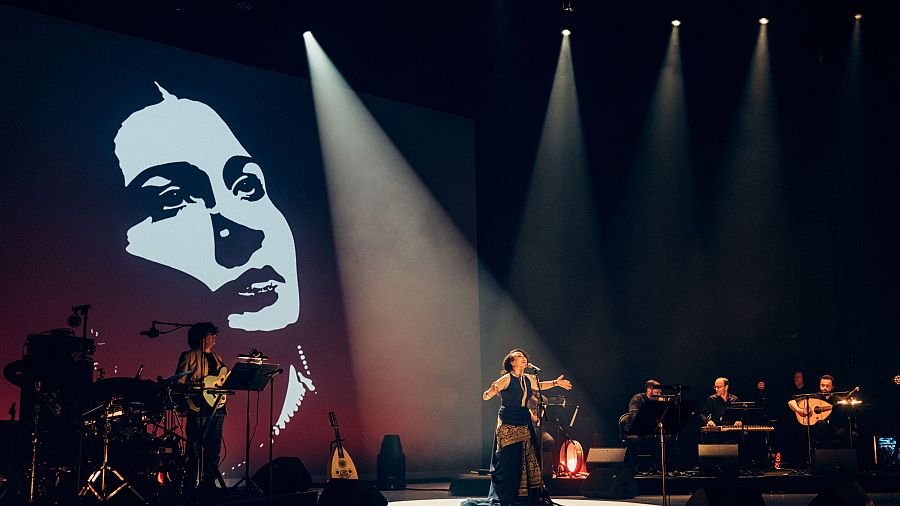
La Voix des Femmes: Seven Voices in the Cour d'honneur
The concert was conceived not as a museum piece but as a living dialogue. Seven artists — Abdullah Miniawy, Camelia Jordana, Danyl, Maryam Saleh, Natacha Atlas, Rouhnaa, and Souad Massi — each brought their own sensibility to Umm Kulthum's repertoire, guided by the steady hand of Lebanese producer Zeid Hamdan, who served as musical director. The result was what the festival program described as "a musical bridge between past and present."
Zeid Hamdan, known for his experimental approach to Arabic music, was clear about the project's intent. "Purists should not be offended; this is not about replicating Umm Kulthum but paying homage to her, expressing how we love and sing her," he said. His vision was not to recreate the past but to allow each artist to find their own path into her songs, to make them breathe with contemporary air while honoring their original spirit.
Egyptian singer Maryam Saleh, a formidable presence in the alternative Arabic music scene, echoed that sentiment. "In this concert, each performer already has their own identity, and that was what made it interesting from the start. We were all curious to see how each of us would reinterpret Umm Kulthum in our own way and what that would produce," she reflected. The audience witnessed a kaleidoscope of approaches — from the Sufi-inflected experimentalism of Abdullah Miniawy to the electronic-world fusion of Natacha Atlas, from the French-Algerian pop sensibilities of Souad Massi and Danyl to the raw contemporary edge of Camelia Jordana and Rouhnaa.
The setting added a layer of majesty. The Palais des Papes, a UNESCO World Heritage site and one of the largest Gothic palaces in Europe, provided a backdrop of medieval grandeur that suited the epic scale of Umm Kulthum's art. The festival program made clear that the aim was to highlight the grandeur and nobility of Arab culture, "too often reduced to stereotypes." In a Europe where Arab identity is frequently the subject of suspicion or caricature, this was a powerful act of reclamation. The evening transcended cultural and generational differences, captivating audiences who came with varying degrees of familiarity with her work.
The Star of the East and the Fourth Pyramid
To understand the weight of that evening, one must understand the woman at its center. Umm Kulthum was born at the turn of the twentieth century in a small village in the Nile Delta, the daughter of a village imam who introduced her to singing as a child. From these humble beginnings, she rose to become the "Star of the East" (Kawkab el-Sharq), a title that barely captures the magnitude of her fame.
In Egypt, she is often called "the fourth pyramid," a nickname that speaks to her status as a monument of national identity, as essential to the country's self-image as the ancient wonders of Giza. Her career spanned five decades, during which she became the voice of a nation navigating revolution, independence, and modernization. She sang of love and loss, of patriotism and faith, and her songs became anthems for generations of Arabs.
Her funeral in 1975 was a spectacle of grief unlike anything the modern world had seen. An estimated four million people poured into the streets of Cairo, a sea of mourners stretching for kilometers as the nation — and much of the Arab world — came to a standstill. No political leader, no military victory, no national triumph had ever drawn such a crowd. She was, quite simply, irreplaceable.
Her signature songs — "Enta Omri," "Al Atlal," "Alf Leila wa Leila" — are not merely compositions but cultural touchstones, each one a universe of emotion and technique that singers still study and audiences still revere. To hear them performed in the Cour d'honneur, reimagined by artists from across the Arab and African diaspora, was to witness the living continuity of that tradition.
Arabic at the Heart of Avignon
The tribute was not an isolated event but part of a broader embrace of Arab culture by the 79th edition of the Festival d'Avignon. Arabic was designated the guest language of the festival, a decision that signaled a commitment to cultural dialogue at a time when such dialogue is more necessary than ever. The festival, founded in 1947 and now one of the world's most important contemporary performing arts festivals, has always been a space for artistic and political engagement.
The concert was the fruit of a collaboration that spanned French cultural institutions. The original idea came from the Printemps de Bourges, a major music festival, and the show was coproduced with the Maison de la Culture de Bourges and the Institut du monde arabe in Paris. That institutional backing gave the project a weight and legitimacy that helped it attract some of the most exciting voices in contemporary Arabic music.
The choice of venue was laden with symbolism. The Palais des Papes was the seat of the papacy in the fourteenth century, a monument to European religious and political power, and here it was hosting a celebration of Arab musical heritage. The juxtaposition was not lost on observers, who saw in it a metaphor for the cultural exchanges that have always shaped the Mediterranean world.
Beyond the concert, the festival's Territoires cinématographiques film strand included screenings of Simone Bitton's documentary "Les grandes voix de la chanson arabe: Oum Kalthoum," offering audiences a deeper dive into the diva's life. This pairing of live performance and documentary reflection allowed the festival to engage with Umm Kulthum on multiple levels. It was, in the words of Zeid Hamdan, a declaration that "we are here, we exist. Our art is strong; we deserve protection, love, and respect. We are equals among all people."
From Cairo to Dakar: A Pan-African Resonance
For those of us who write from the African continent, the resonance of Umm Kulthum's music extends far beyond the Arab world. Her influence has long been felt across the Sahel and West Africa, where Arabophone music and its storytelling traditions have intermingled with local forms for centuries. The trade routes that connected North Africa to sub-Saharan Africa carried not just goods but songs, and Umm Kulthum's voice traveled those routes, finding eager ears far from the Nile.
The artists who performed in Avignon embody this pan-African and diasporic connection. Souad Massi, a French-Algerian singer-songwriter, has spent her career blending North African heritage with contemporary folk and pop. Natacha Atlas, a Belgian-Egyptian singer known for Arabic-electronic-world fusion, brought a distinctly modern sensibility to the repertoire, while Abdullah Miniawy, an Egyptian poet and vocalist known for experimental, Sufi-inflected music, pushed the boundaries of what these songs could mean today.
Souad Massi captured the essence of Umm Kulthum's significance when she said: "She represents the Arab woman: elegant, musical, and also a feminist." This speaks to a dimension of the diva's legacy often overlooked — her role as a trailblazer for women in a patriarchal society, a woman who commanded respect and authority in a male-dominated field, who controlled her own career and image at a time when few women had such agency. For women across the Arab world and Africa, she remains a symbol of what is possible.
The parallel between Umm Kulthum's art and the griot tradition of West Africa is striking. Both are rooted in oral tradition, in the power of the sung word to preserve history, transmit values, and create community. The tarab, the ecstatic emotional state her performances induced, finds its echo in the trance-like states achieved by griots and Sufi musicians across the continent. For Senegalese audiences, the reverence for Umm Kulthum is part of a broader appreciation of Arab musical traditions — a reminder that the cultural riches of the African continent are not confined by colonial borders or linguistic divisions.
What to Watch For
As we look ahead, the legacy of Umm Kulthum shows no signs of fading. Her catalog continues to find new audiences on streaming platforms, where playlists introduce her to listeners who might never have encountered her otherwise. Young artists across Africa and the Arab world are sampling and reimagining her songs, weaving her melodies into hip-hop, electronic music, and other contemporary forms, ensuring her voice remains a living presence in the music of today.
The Avignon concert was not an endpoint but a milestone in an ongoing process of cultural celebration. In the months since, there have been further tribute concerts, documentary projects, and academic symposia dedicated to her legacy. The Institut du monde arabe, which played a key role in the Avignon production, continues its work of preserving and promoting Arab culture, ensuring that figures like Umm Kulthum will not be forgotten.
There is something deeply hopeful in this continued engagement with her music. In a world that often seems fragmented, the fact that a woman who died half a century ago can still bring people together across continents and generations is a testament to the enduring power of art. Her voice, once broadcast over the radio to millions, now travels through fiber-optic cables and satellite signals, reaching even further than she could have imagined. The tribute in Avignon was a beautiful moment, but it was also a reminder of how much work remains to ensure that our cultural treasures are not lost — and of how much is gained when they are celebrated. Umm Kulthum's voice may have been silenced by death, but it has never stopped singing. That is a legacy worth honoring, today and for generations to come.
By Amara Diop, Staff Writer
This article was produced with AI-assisted research and editorial support. Sources: africanews, Festival d'Avignon, NPR.
What's Your Reaction?
 Like
0
Like
0
 Dislike
0
Dislike
0
 Love
0
Love
0
 Funny
0
Funny
0
 Wow
0
Wow
0
 Sad
0
Sad
0
 Angry
0
Angry
0

West Africa/Sahel Correspondent at Global1.News. Dakar-based journalist covering politics, security, climate, and development across Francophone and Anglophone West Africa. Tells the stories of a region undergoing profound transformation.












Comments (0)