
Cameroon’s Silent Crisis: Football Star Ajara Breaks Ranks as Femicide Toll Mounts
The killing of at least eight women in a single week has thrust Cameroon into a moment of national reckoning, with grief spilling into anger and a growing chorus demanding that the state move beyond words. The latest tragedy unfolded on Tuesday in a hotel room in the capital, Yaoundé, where a 44-year-old woman was allegedly stabbed to death by a 22-year-old man who was later arrested. The case is not isolated.
The killing of at least eight women in a single week has thrust Cameroon into a moment of national reckoning, with grief spilling into anger and a growing chorus demanding that the state move beyond words. The latest tragedy unfolded on Tuesday in a hotel room in the capital, Yaoundé, where a 44-year-old woman was allegedly stabbed to death by a 22-year-old man who was later arrested. The case is not isolated. It is part of a pattern that has seen at least 50 women killed between January and April this year alone, according to official figures, compared to 77 for the entirety of last year.
A Footballer’s Plea: “Silence is Complicity”
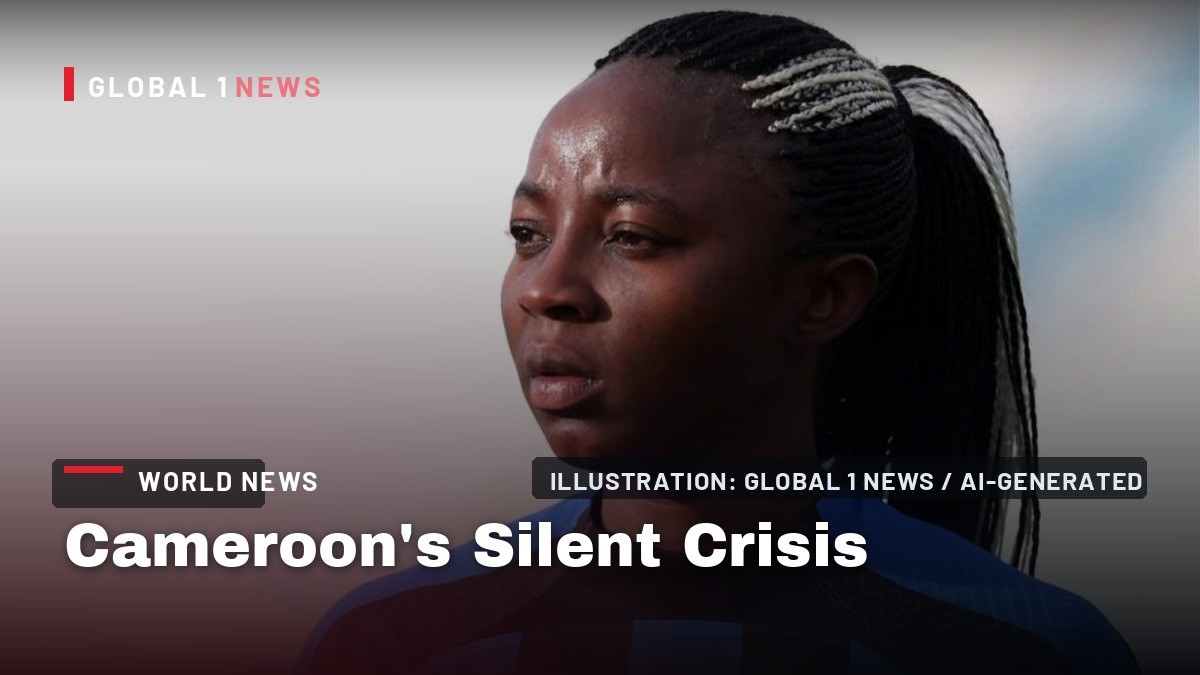
Into this fray has stepped one of Cameroon’s most celebrated sporting figures. Nchout Njoya Ajara, the 33-year-old striker who has played for Atlético Madrid and Inter Milan, has used her platform to issue a stark warning. “Being a woman in Cameroon should never be a risk,” she said in a statement that has resonated far beyond the football pitch. “In the face of the tragic wave of femicides that has hit our country in recent days, silence is complicity.”
Ajara’s words carry weight not just because of her fame, but because of her trajectory. A professional career that has taken her from Russia to Sweden, Norway, Spain, Italy, and Saudi Arabia has given her a global perspective on a crisis that is often treated as a private matter. By speaking out, she has broken a taboo that many in positions of influence prefer to maintain. Her intervention has galvanised activists who have long argued that the problem is not a lack of awareness, but a lack of political will.
Government Response: Concern, But Little Action
The government has not remained silent. In a video published by state media, the Minister for Women’s Empowerment and the Family, Marie-Thérèse Abena Ondoa, condemned the “worrying” rise in the number of killings and said the government was working to address the problem. She pointed to a bill to protect women against gender-based violence, which she said was currently being reviewed by the prime minister.
But for many, the gap between official concern and concrete action is the crux of the problem. Civil society and women’s rights groups have denounced what they perceive as the government’s delay in turning the bill into law. The bill has been in the pipeline for years, and each delay, activists argue, costs lives. The parliamentary session scheduled for November—the last one of the year—is seen as a critical window, but there is deep scepticism about whether it will be used effectively.
Activists Doubt November Session Will Deliver
Viviane Tathi, whose organisation documents cases of femicide in the country, told the BBC that she is not confident the bill will be passed at the November session. “We are worried because the November parliamentary session focuses on budgetary debates… So, we don’t know by what magic this bill will be passed,” she said. Her frustration is palpable, and it reflects a broader sense that the legislative process is moving at a pace that does not match the urgency of the crisis.
Tathi has also called for the creation of a special court to handle family disputes, which she says are the root of much of the domestic violence that leads to femicide. The idea is not new, but it has gained traction as the number of cases has climbed. A dedicated court, she argues, would allow for faster intervention and more consistent sentencing, sending a clear signal that violence against women will not be tolerated.
Opposition Accuses Government of Passivity
The political opposition has also weighed in. The Cameroon Renaissance Movement (CRM) party issued a statement expressing outrage at the “tragic recurrence of domestic femicides” and accused the government of being passive about the issue. The CRM’s criticism is pointed, but it also reflects a wider public sentiment that the state has been reactive rather than proactive. The femicide cases, most of which are attributed to domestic violence, have been reported in different parts of the country, from urban centres like Douala and Yaoundé to rural communities where reporting is even more difficult.
The pattern is deeply troubling. Many of the victims are killed by partners or family members, often after years of abuse that went unaddressed. The lack of effective protection orders, the stigma attached to reporting domestic violence, and the reluctance of police to intervene in “family matters” all contribute to a culture of impunity. For many women, the home is not a sanctuary but a place of mortal danger.
A Continental Crisis: Africa’s Grim Statistics
Cameroon’s crisis is not an anomaly. According to the latest UN data, Africa had both the highest total number of victims of femicide and the highest rate relative to its population in 2024, with an estimated 22,600 cases. The numbers are an estimate, as some cases are believed to go unreported and many governments do not consistently record the information. But even with those caveats, the scale of the problem is undeniable.
The UN data points to a systemic failure across the continent, where legal frameworks are often weak, enforcement is sporadic, and cultural norms frequently blame the victim. In many African countries, the conversation about femicide is still nascent, and the data gap makes it difficult to design effective interventions. Activists argue that the first step is to acknowledge the problem, and the second is to commit resources to solving it.
What This Means for Women Across Africa
For women across the continent, the situation in Cameroon is a mirror of their own realities. The fight for safety is not just about laws; it is about changing a culture that too often tolerates violence. The fact that a footballer of Ajara’s stature has spoken out is significant, because it signals that the issue is no longer confined to the margins. It is entering the mainstream, and that is a necessary precondition for change.
But words alone will not save lives. The bill currently sitting with the prime minister must be passed, and it must be implemented with vigour. The special court proposed by Tathi deserves serious consideration. And the police and judiciary must be trained to treat domestic violence as a crime, not a private squabble. The government has a chance to act before the November session, and it should not waste it.
A Call for Action, Not Just Condemnation
The killing of eight women in a week is a national emergency. It demands a response that matches the scale of the tragedy. Condemnation is welcome, but it is not enough. The families of the victims deserve justice, and the women of Cameroon deserve a future where their lives are not at risk simply because of their gender.
As Ajara put it, “silence is complicity.” The question now is whether Cameroon’s leaders will choose to speak with actions, not just words. The world is watching, and the women of Africa are waiting.
This article was produced with AI-assisted research and editorial support. Sources: BBC News Africa.
By Amara Diop, Staff Writer
What's Your Reaction?
 Like
0
Like
0
 Dislike
0
Dislike
0
 Love
0
Love
0
 Funny
0
Funny
0
 Wow
0
Wow
0
 Sad
0
Sad
0
 Angry
0
Angry
0

West Africa/Sahel Correspondent at Global1.News. Dakar-based journalist covering politics, security, climate, and development across Francophone and Anglophone West Africa. Tells the stories of a region undergoing profound transformation.













Comments (0)