
K-Food's Big Bet on India: Deep Localization Emerges as the Strategic Imperative
The 2026 K-Food Fair in New Delhi, held July 30 through August 2 under the joint auspices of South Korea's Ministry of Agriculture, Food and Rural Affairs (MAFRA) and the Korea Agro-Fisheries & Food Trade Corporation (aT), marked a significant escalation in Seoul's campaign to penetrate the world's most populous national market.
The 2026 K-Food Fair in New Delhi, held July 30 through August 2 under the joint auspices of South Korea's Ministry of Agriculture, Food and Rural Affairs (MAFRA) and the Korea Agro-Fisheries & Food Trade Corporation (aT), marked a significant escalation in Seoul's campaign to penetrate the world's most populous national market. With India's approximately 1.47 billion consumers demonstrating growing receptivity to Korean culinary culture, the fair's dual-track structure — B2B export consultations and B2C consumer engagement — offers a revealing window into the localization strategies now driving K-Food's global expansion.
K-Food's Big Bet on India: Deep Localization Emerges as the Strategic Imperative
Seoul, South Korea – August 10, 2026 — The four-day K-Food Fair, hosted by MAFRA Minister Song Mi-ryung and aT President Hong Moon-pyo, convened approximately 50 buyer companies from India, Nepal, Bangladesh, and Sri Lanka for structured one-on-one business meetings at the Pullman Hotel in New Delhi's Aerocity district on July 30-31. According to aT, products including frozen gimbap, ginseng wine, and kombucha drew particularly strong interest from regional buyers, culminating in the signing of memoranda of understanding. An on-site consulting booth assisted exporters navigating non-tariff barriers, with particular attention to customs clearance procedures and certification requirements.
The commercial track was preceded by a July 20 webinar covering India's food import and customs clearance systems, regulatory issues, and consumer trends, followed by preliminary online meetings with approximately 10 buyers. This sequenced approach — regulatory education, buyer pre-screening, then in-person negotiation — reflects a maturation in how Korea's agricultural export infrastructure approaches complex emerging markets.
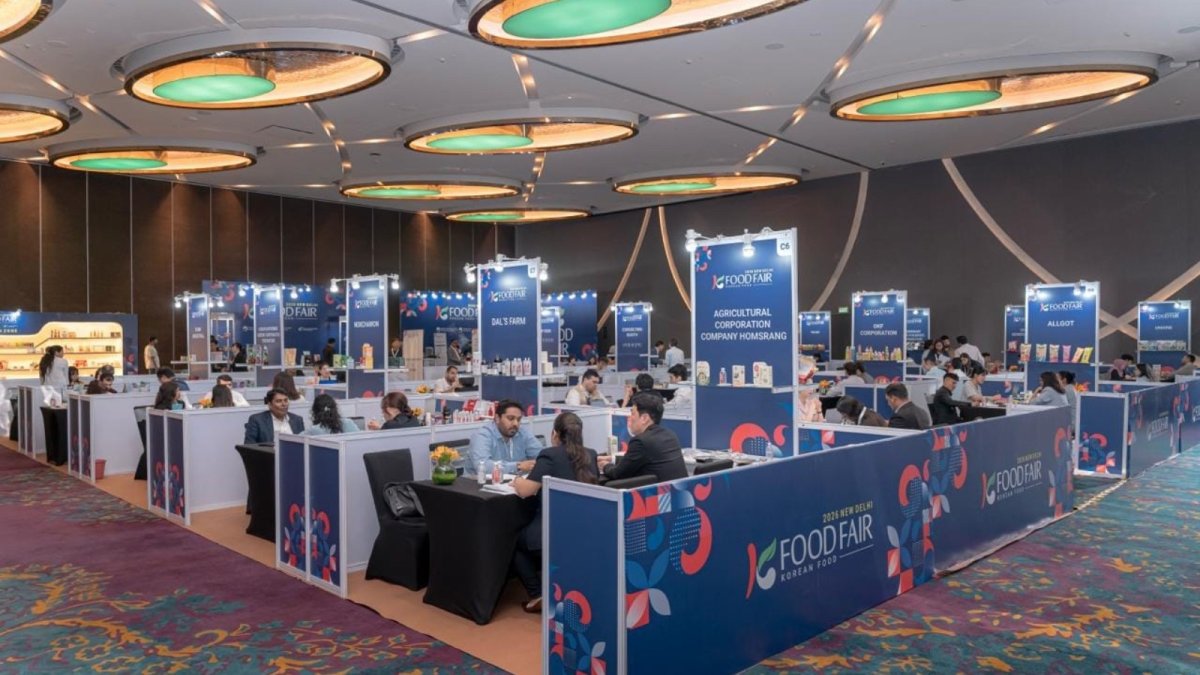
The consumer-facing component, held August 1-2 at Ambience Mall, translated the trade agenda into lived experience. The centerpiece "K-Noodle Station" featured automated "Hangang River Ramen Cookers" replicating the ramen-cooking culture of Seoul's Hangang Park — a transportable symbol of Korean urban leisure. Food booths organized into a "Market Zone" and "Open Kitchen" offered tteokbokki and gimbap, staples of Korea's bunsik street-food culture. KTO contributed experiential programming including a "Personal Color Test" and "K-Lifestyle Zone," while K-Pop cover dances and a closing Random Play Dance led by YouTuber Go Toe-kyung anchored the entertainment.
Detailed Analysis of the K-Food Fair
The structural design of the 2026 K-Food Fair reveals a deliberate evolution. Unlike earlier promotional efforts that treated trade shows primarily as display opportunities, this edition integrated regulatory capacity-building directly into the commercial pipeline. The on-site consulting booth addressing customs clearance and certification speaks to a recognition that India's non-tariff barriers — not consumer demand — constitute the binding constraint on Korean food exports.
The webinar-to-meeting-to-MOU sequence — roughly 10 buyers in pre-consultation, expanding to 50 buyer companies across four South Asian countries — suggests a systematic approach to market development. The inclusion of Nepal, Bangladesh, and Sri Lanka in the buyer pool also signals that aT views New Delhi not merely as a single national market but as a regional hub for South Asian distribution networks.
Localization as the Strategic Imperative
The concept of "deep localization" — adapting not only flavors but also formats, certifications, and cultural positioning — emerged as the fair's central analytical theme. India's scale is compelling: approximately 1.47 billion people, the world's fourth-largest economy by GDP, and annual economic growth of around 7 percent. The demographic profile matters equally: a young consumer base with apparent openness to global food trends and K-culture more broadly.
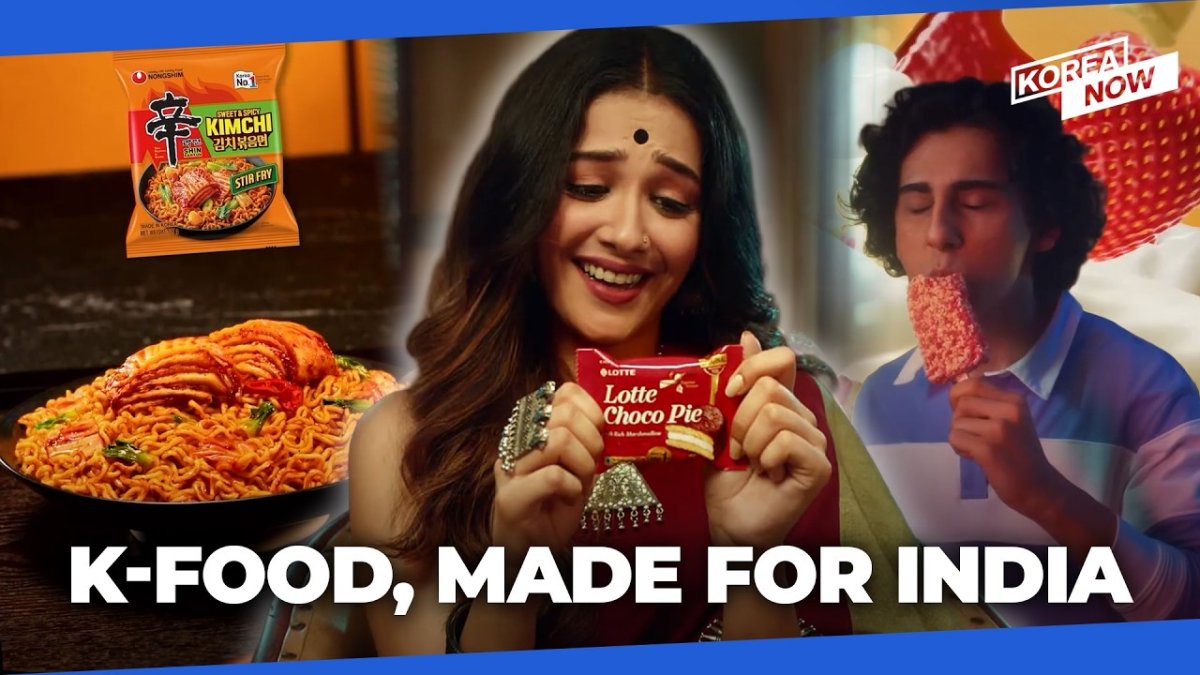
Concrete localization experiments are already underway. Nongshim sampled "Shin Ramen Red Super Spicy" — its spiciest export variety — at Amity University in Uttar Pradesh in August 2024, with 83 percent of student tasters responding positively. Multinational brands have introduced vegetarian Korean-style ramen meals to the Indian market, including Knorr K-Pot kimchi and jjajangmyeon vegetarian meal kits, accommodating India's large vegetarian population. Halal certification and compliance with the Food Safety and Standards Authority of India (FSSAI) remain critical regulatory hurdles that any serious market entrant must clear.
Geopolitical Context: Korea-India Economic Diplomacy
The K-Food Fair cannot be divorced from the broader trajectory of Korea-India economic relations. The Comprehensive Economic Partnership Agreement (CEPA) between the two countries entered into force in January 2010, establishing a framework that has supported a more than 50 percent expansion of bilateral trade — from USD 17.1 billion in 2010 to USD 25.7 billion in 2025 — making India Korea's eighth-largest export market.
Negotiations to upgrade this agreement are actively underway. The 12th round of India-Korea CEPA upgrade negotiations was held in New Delhi on May 27, 2026, with both sides committing to accelerate the process with a view to concluding preferably by December 2026. Trade Minister Yeo Han-koo met India's Minister of Commerce and Industry, Piyush Goyal, on March 13, 2026, to discuss resuming and accelerating the upgrade talks. India's position as a key partner in Korea's New Southern policy region — the framework through which Seoul has sought to diversify its economic diplomacy beyond heavy reliance on China and the United States — gives these negotiations strategic weight that transcends agricultural trade alone.
Policy Implications: The $16 Billion Export Target
The Indian push forms part of a broader policy framework announced on December 23, 2025, when the Korean government unveiled its "Strategic Plan for Global Expansion of K-Food Exports." The results to date have been striking. Cumulative K-Food exports reached a record USD 12.34 billion as of end-November 2025; full-year 2025 "K-Food Plus" exports — a broader measure including agricultural industries — climbed to USD 13.62 billion, up 5.1 percent year-over-year, marking ten consecutive years of growth. Food products accounted for USD 10.41 billion (up 4.3 percent), while agricultural industries contributed USD 3.22 billion (up 8 percent). MAFRA has set a USD 16 billion target for 2026.
The composition of these exports reveals a structural transformation in Korea's agricultural economy. Instant ramen surpassed USD 1.5 billion in annual exports in 2025 — the first single Korean food item to rival the economic impact of K-pop tours and K-drama licensing combined. Dried seaweed (gim) crossed the USD 1 billion export milestone in November 2025, three years ahead of schedule, with full-year exports reaching USD 1.13 billion, up 13.7 percent. These are not niche artisanal products but industrialized food commodities with global brand recognition — categories well positioned to scale in a market of India's size.
Expert Perspectives: Industry Response and Corporate Strategy
aT's Executive Vice President for Food Exporting, Jeon Ki-chan, framed the Indian opportunity in explicitly demographic terms: "With its massive population, young consumer demographic, and rapid economic growth, India is highlighting itself as a new market and a land of opportunity for K-Food." He added: "Taking this K-Food Fair as a stepping stone, we will actively support domestic export companies in entering India and the South Asian region, while expanding our touch points with local consumers to broaden K-Food's market territory."
The corporate sector is backing this assessment with capital. Samyang Foods, maker of the Buldak brand that has become a global phenomenon, reported consolidated revenue of 2.35 trillion won (approximately USD 1.7 billion) in 2025, up 36 percent from the prior year, with operating profit surging 52 percent to 523.9 billion won. Cumulative Buldak sales have surpassed 9 billion units across roughly 100 countries, with overseas sales now accounting for 81 percent of total revenue. Nongshim, for its part, has identified India as one of seven priority markets and is building an export-only factory in Busan's Noksan Industrial Complex, scheduled for full operation in the second half of 2026 with capacity to produce up to 2.7 billion units annually.
Looking Ahead: The Long Game in South Asia
The fair's success will ultimately be measured not in MOUs signed at the Pullman Hotel but in sustained market penetration over the coming decade. India presents a distinctive combination of opportunities and frictions: a young, urbanizing population with rising disposable incomes and appetite for Korean cultural content, alongside regulatory complexity, supply chain underdevelopment, and price sensitivity in packaged food categories.
The December 2026 target for concluding CEPA upgrade negotiations adds a policy dimension to what is fundamentally a commercial competition. Should the upgrade materialize, tariff reductions on processed food products could meaningfully improve the competitiveness of Korean exports against regional rivals, including China, Japan, and ASEAN-origin products. The alignment of the December 23, 2025 strategic plan, the CEPA negotiation track, and corporate investment decisions such as Nongshim's Noksan facility suggests rare policy-business coordination.
For scholars of Korean political economy, the India strategy represents a consequential test of whether the K-Food export model — which has succeeded spectacularly in developed markets and Southeast Asia — can be adapted to the distinctive regulatory, cultural, and logistical environment of South Asia. The emphasis on deep localization, from vegetarian product formulations to halal certification to educational sampling campaigns at Indian universities, indicates that Seoul's agricultural policymakers have absorbed a crucial lesson: global food brands are built locally, not merely exported globally. The coming years will reveal whether the infrastructure investments and diplomatic momentum of 2025-2026 translate into durable market share in the world's most populous democracy.
By Prof. David Park, Staff Writer
This article was produced with AI-assisted research and editorial support. Reporting is based on sources cited in the article.
What's Your Reaction?
 Like
0
Like
0
 Dislike
0
Dislike
0
 Love
0
Love
0
 Funny
0
Funny
0
 Wow
0
Wow
0
 Sad
0
Sad
0
 Angry
0
Angry
0

East Asia/Technology Correspondent at Global1.News. Seoul-based voice covering Korean politics, technology, business, and culture. Analyzes how technology and geopolitics intersect across East Asia.












Comments (0)