
US Air Force Signs $1.84 Billion Contract for Rafael-Developed LITENING Targeting Pods
The U.S. Air Force has awarded Northrop Grumman Systems Corp. a potential $1.84 billion contract to continue production, sustainment, and modernization of the LITENING targeting pod, a system produced in partnership with Rafael Advanced Defense Systems of Israel.
US Air Force Signs $1.84 Billion Contract for Rafael-Developed LITENING Targeting Pods
Washington and Jerusalem are both watching the same contract this week. The U.S. Air Force has locked in a potential $1.84 billion framework deal for the LITENING targeting pod — a precision-strike system tied to Israel's Rafael Advanced Defense Systems and produced in the United States by Northrop Grumman — securing the program's future through 2035 and deepening one of the most durable threads of the U.S.-Israel defense-industrial partnership.
Jerusalem — The U.S. Air Force has awarded Northrop Grumman Systems Corp. a potential $1.84 billion contract to continue production, sustainment, and modernization of the LITENING targeting pod, a system produced in partnership with Rafael Advanced Defense Systems of Israel. The indefinite-delivery/indefinite-quantity (IDIQ), firm-fixed-price contract was announced this week and will remain in effect through 2035, with the Air Force placing individual orders under its terms. An initial $42.9 million in fiscal 2026 operations and maintenance funds was obligated at the time of the award.
US Air Force Locks In $1.84 Billion for LITENING Pods
The award is one of the largest recent commitments to the LITENING program, formally known as the Laser Infrared Targeting and Navigation Comprehensive Advanced Targeting Pod, or LITENING CATP. Under the contract, Northrop Grumman will provide continued sustainment, production, and modifications for the system, ensuring that deployed Air Force units can keep their pods operational while lifecycle requirements are addressed and future improvements are incorporated.
The framework agreement, under which orders can be placed through Dec. 31, 2035, gives the Air Force flexibility to buy pods and support services as operational needs evolve. The contract was issued on a sole-source basis, reflecting the fact that Northrop Grumman and Rafael are the established industrial base for the system. The award also signals the continued relevance of the LITENING line at a time when the Air Force is modernizing its combat aircraft fleet and investing heavily in precision standoff capabilities.
What the Contract Covers
The award's sole-source structure reflects the program's industrial reality: because Rafael and Northrop Grumman are the only producers of this specific targeting pod configuration, the Air Force bypassed competitive bidding in favor of a direct award — a standard approach for mature systems already integrated and certified on American aircraft.
The contract covers the production and delivery of new LITENING targeting pods, along with operational support, sustainment, and modifications for systems already in U.S. service. All manufacturing and engineering work will be carried out at Northrop Grumman's facility in Rolling Meadows, Illinois, which serves as a primary production location for the program.
The acquisition was managed by the Precision Attack Contracting Branch at Robins Air Force Base, Georgia, under contract number FA8540-26-D-B001. The initial $42.9 million obligation draws on fiscal 2026 operations and maintenance funds, covering near-term requirements while the broader framework remains available for more than a decade.
Rafael's Partnership with Northrop Grumman
At the heart of the LITENING program is a partnership between Northrop Grumman and Rafael Advanced Defense Systems of Israel, one of Israel's leading defense-technology companies. Rafael, headquartered in Haifa, is the Israeli partner behind the system, and the collaboration with Northrop Grumman has made LITENING a mainstay of the U.S. Air Force targeting fleet.
The arrangement means a cornerstone of American air-to-ground precision strike capability is produced in partnership with an Israeli defense company. For Israel, it is one of the most significant examples of its defense technology being embedded in U.S. military platforms, with Rolling Meadows serving as the primary U.S. production hub and Rafael providing the Israeli side of the industrial partnership.
Israel's Defense-Tech Export Engine
Defense exports are a central pillar of Israel's innovation economy, channeling billions of shekels annually back into domestic research and development, skilled manufacturing jobs, and the broader high-tech ecosystem that has made Israel a global leader in cybersecurity, autonomy, and precision strike. Companies like Rafael anchor this system, using revenue from export sales to fund the next generation of systems that ultimately protect Israeli civilians as well as allied forces overseas.
Rafael's portfolio extends far beyond the LITENING pod. The company is perhaps best known internationally for the Iron Dome short-range air defense system, which has intercepted thousands of rockets aimed at Israeli communities, and for David's Sling, a medium-to-long-range interceptor developed jointly with the United States to defend against ballistic missiles, cruise missiles, and drones. Rafael's Spike family of missiles has also become a battlefield staple for dozens of militaries worldwide, further cementing the company's reputation as a reliable supplier of combat-proven systems.
The trust that the US Department of Defense places in Israeli defense firms is no accident. Decades of operational experience, relentless testing under live-fire conditions, and a willingness to adapt systems rapidly based on field feedback have made Israeli companies prized partners for the American military. The LITENING contract is just one more reflection of that relationship — one in which Israeli technology is integrated into the core strike capabilities of the world's most powerful air force.
The LITENING contract also underscores the depth of Israel's defense-industrial base. Israeli companies have built a global reputation across precision-guided munitions, missile defense, drone technology, and advanced sensors, and Rafael sits squarely within that ecosystem. The continued U.S. commitment to LITENING, now extended deep into the next decade, is a validation of Israeli defense technology in the most demanding operational environments.
For the Israeli economy, programs of this scale carry real weight. Defense exports are a major pillar of Israel's high-technology trade, and multiyear IDIQ contracts provide the long-term visibility Israeli companies need to plan production, maintain engineering teams, and invest in next-generation capabilities. The Air Force's continued reliance on LITENING also strengthens the case for Israeli defense technology among other international customers who operate the pod on their own fleets.
A Pod Built for Modern Air Combat
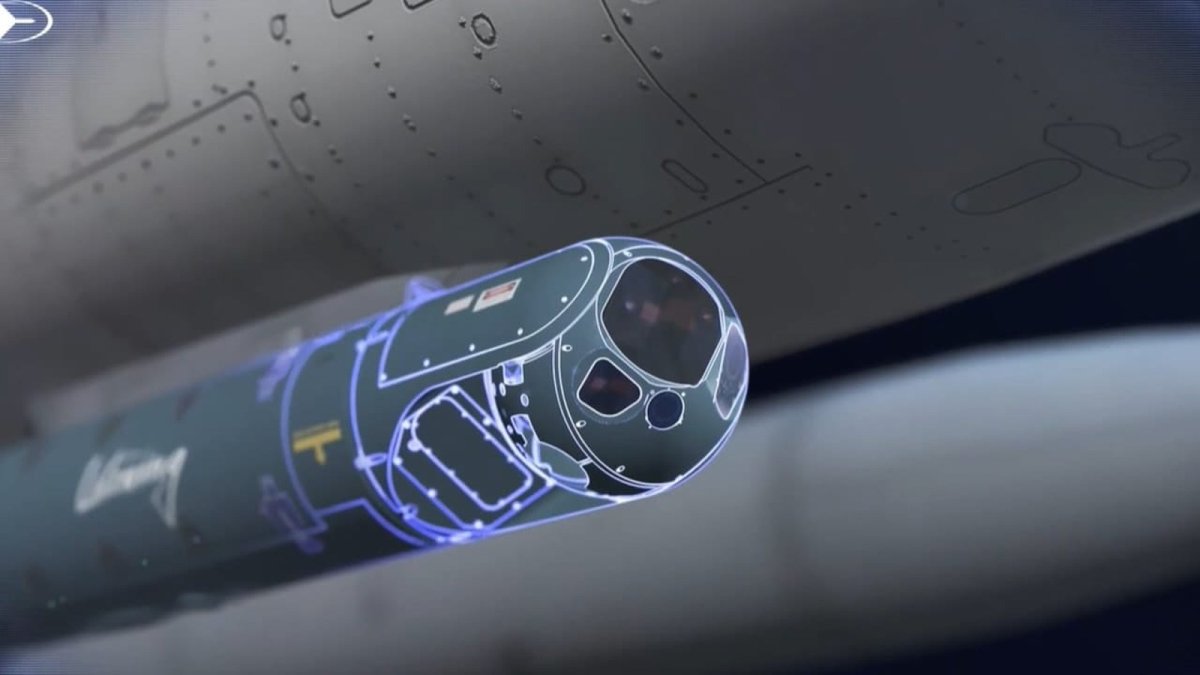
The LITENING is an airborne electro-optical/infrared (EO/IR) targeting pod designed to give aircrews precision targeting, reconnaissance, and surveillance capabilities. It combines infrared and visible-spectrum imaging sensors with a laser designator and laser rangefinder, allowing crews to detect, identify, track, and engage targets at extended ranges.
The system incorporates a high-resolution forward-looking infrared (FLIR) sensor, a charge-coupled device (CCD) television camera for daytime operations, and a laser designator for guiding precision-guided munitions. Weighing 459 pounds (208 kilograms) and measuring just over seven feet in length, the pod mounts externally on the aircraft. Its modular architecture allows capability upgrades over time without requiring a complete replacement of the system, a key advantage as mission requirements evolve.
The LITENING has been integrated on multiple military aircraft platforms, including variants of the A-10, B-52, F-15, and F-16, as well as aircraft operated by international partners. The newest configuration, LITENING Large Aperture, features six high-definition sensors and, according to the company, offers improved range, upgraded image processing, and a modern data-link capability.
Track Record: 900 Pods, Millions of Flight Hours
According to Northrop Grumman, more than 900 LITENING targeting pods have been delivered to U.S. forces and international customers. The systems have achieved operational availability of up to 95 percent, a strong indicator of reliability in the field. The global LITENING fleet has accumulated more than 3 million flight hours, with a significant share recorded during combat operations.
Northrop Grumman has been supporting LITENING for the U.S. Air Force since 2018. In 2019, the Air Force awarded the company a potential $141 million IDIQ task order to deliver LITENING pods and perform upgrades on pods already owned by the branch. That came a year after Northrop secured a $1.31 billion IDIQ contract to provide lifecycle support for the pods. The new $1.84 billion framework continues that trajectory, reflecting both the endurance of the program and the growing importance of precision targeting in modern air warfare.
What It Means for the US-Israel Defense Relationship
The new contract locks in a relationship that has become a pillar of the U.S.-Israel defense-industrial partnership and projects it forward to 2035. For the U.S. Air Force, it ensures a proven targeting capability will remain supported, sustained, and upgraded through the mid-2030s. For Israel, it represents a multiyear vote of confidence in Rafael's technology and in the broader partnership between the two countries' defense industries.
That partnership now spans everything from missile defense to precision munitions, with Israeli technology woven deeply into American supply chains. The LITENING program is a prime example: an Israeli defense technology produced in partnership with a U.S. prime contractor, sustaining American combat aircraft and supporting industrial work in both countries.
With the framework in place through 2035 and individual orders to follow under its terms, the coming years will likely see continued cooperation between Northrop Grumman, Rafael, and the U.S. Air Force, keeping the LITENING pod at the tip of the spear of American air power for another decade.
By Hannah Berg, Staff Writer
This article was produced with AI-assisted research and editorial support. Reporting is based on sources cited in the article.
What's Your Reaction?
 Like
0
Like
0
 Dislike
0
Dislike
0
 Love
0
Love
0
 Funny
0
Funny
0
 Wow
0
Wow
0
 Sad
0
Sad
0
 Angry
0
Angry
0

Israel Correspondent at Global1.News. Based in Tel Aviv, covering Israeli politics, security, technology, and society. Provides balanced, deeply-sourced reporting on one of the most closely-watched regions in the world.













Comments (0)