
JD.com Unveils Wolf Robot Series in Push to Automate China's Deliveries
JD.com unveiled its Wolf Robot series Wednesday, reaffirming a five-year plan to field three million robots and 100,000 drones across China. JD Cloud signed a 100,000-chip Moore Threads deal to power embodied AI, and Kenji Tanaka weighs the workforce stakes and Japan's contrasting path.
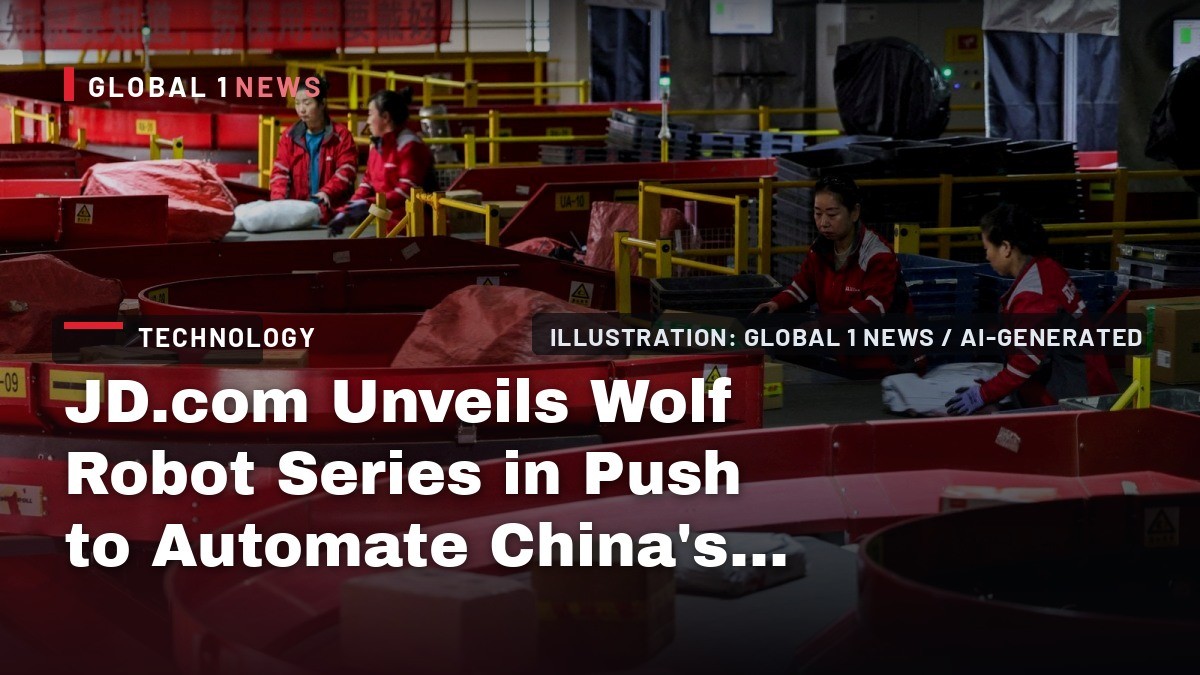
Wolf Robots Take the Floor at JD's Beijing Automation Push
JD.com is moving its robotics ambitions from pilot projects to industrial scale. At a technology event in Beijing on Wednesday, the e-commerce and logistics group's JD Logistics arm unveiled its Wolf Robot series of warehouse and delivery machines, and its executives reaffirmed a five-year target that would put three million robots, one million unstaffed vehicles and 100,000 delivery drones inside China's most automated supply chain.
Cao Peng, chairman of JD's technology committee, framed the plan as the company's answer to a labour-intensive industry at a demographic turning point, while JD Cloud separately announced a computing cluster built around 100,000 domestically produced chips from GPU designer Moore Threads, a deal executives said would anchor the training of the physical-world AI models the robots will run on.
The announcements give the clearest picture yet of how one of China's largest private employers intends to reconcile automation with a workforce of roughly 700,000 delivery and logistics personnel.
The Five-Year Plan: 3 Million Robots, 1 Million Vehicles, 100,000 Drones
JD Logistics first sketched the scale of its ambition last October, when it said it would procure three million robots, one million autonomous vehicles and 100,000 drones over five years. Wednesday's event turned that headline number into a product roadmap, with the Wolf Robot series designed to pick, sort, transport and deliver goods with minimal human intervention, according to Liu Lige, head of embodied intelligence robots at JD Logistics.
Liu described a family of specialised machines rather than a single warehouse bot: units engineered to operate in cold-chain environments down to minus 20 degrees Celsius, automated pharmacy dispatchers, and delivery drones for the final mile. The company said the systems are intended to take over repetitive, labour-intensive work and operate in conditions that strain human workers, from freezer aisles to overnight sortation centres.
JD is not starting from a blank floor. Its logistics network already runs automated sortation lines and warehouse robots at scale across China, and company materials have long pointed to robot-assisted fulfilment centres as a competitive edge against Alibaba and the broader e-commerce field. The Wolf programme extends that playbook from fixed warehouse machinery to mobile, task-versatile robots.
Why JD's Data Advantage Matters in the Embodied AI Race
Beyond the hardware, JD executives made an argument that sets the company apart in China's crowded robotics field: the data its warehouses, retail stores and pharmacies generate every day. Cao said JD planned to collect more than 10 million hours of real-world operational data to train general-purpose embodied AI models, the software brains that let robots perceive, plan and act in physical space.
The scarcity of such data is one of the industry's binding constraints. Global stockpiles of quality interaction data for embodied AI stood at roughly 500,000 hours in early 2026, far short of the tens of millions of hours researchers estimate are needed for robust general-purpose systems, according to a June report by SWS Research cited by company executives. A fleet the size of JD's, logging millions of hours across real warehouses rather than controlled labs, is precisely the kind of data engine the field lacks.
JD also said it would establish more than 80 RoboBase hubs across China dedicated to robotics research, pilot production, data annotation, equipment upgrades and maintenance, effectively building a national infrastructure layer for robot deployment and iteration.
Moore Threads Deal Puts 100,000 Domestic Chips at the Core
The computing backbone of that strategy was announced on the same day. JD Cloud said it signed a deal with Moore Threads to build a cluster powered by 100,000 of the Chinese chip designer's full-function GPUs, according to executives speaking at the event and confirmed by TechNode. The cluster will support large-model training and inference as well as embodied AI applications, with computing capacity to be offered to companies across industries.
The deal is a milestone for China's domestic chip ecosystem. Moore Threads, which has positioned its MUSA software stack as a China-based alternative to Nvidia's CUDA, previously supplied thousand- and ten-thousand-card clusters. Moving into the core intelligent-computing cluster of a major domestic cloud provider at the 100,000-card scale marks a shift from laboratory validation to commercial deployment for Chinese-made accelerators, and comes as Beijing's policy framework explicitly calls for building 100,000-card-and-above clusters with greater use of domestic chips.
The move also signals how JD intends to keep its AI ambitions inside China's technology perimeter at a time when US export controls restrict access to the most advanced Nvidia hardware. For a company whose logistics models depend on continuous, low-latency inference, a home-grown compute base is as much a supply-chain decision as a technology one.
700,000 Workers and the Nirvana Retraining Plan
JD's automation push lands on a workforce that the company itself describes in seven-figure terms: roughly 700,000 delivery and logistics personnel across JD and its ecosystem companies. Founder Liu Qiangdong earlier this year outlined what the company calls the Nirvana Plan, an initiative to retrain couriers and warehouse staff for technical roles such as robot servicing and maintenance as machines take over frontline duties.
The retraining pledge is both a labour-relations strategy and a political necessity in China, where the state has grown sensitive to the employment effects of AI adoption. Beijing's policy documents pair automation goals with repeated calls for upskilling and job creation, and JD, as one of the country's largest private employers, is under particular scrutiny when it speaks of replacing human hands with machines.
Whether the plan keeps pace with deployment is the open question. JD's own timeline, three million machines within five years, implies a rate of automation that would test any retraining pipeline, particularly for a courier workforce whose core skill is physical delivery rather than machine maintenance. The company's answer is that robots will absorb growth in parcel volumes and attrition in the existing workforce, rather than trigger mass layoffs, a claim that will be measurable in its employment numbers in the years ahead.
Japan's '2024 Problem' Offers a Contrast in Automation Strategy
For Japan, JD's plan reads as a study in strategic divergence. Japan faces a logistics squeeze of its own: the so-called 2024 problem, tight caps on truck-driver working hours introduced that April, collided with a workforce in which 47 per cent of road-freight drivers were aged 50 or older in 2025, while teenagers made up just 1 per cent of drivers and those in their 20s only 10 per cent, according to the Internal Affairs and Communications Ministry's Labour Force Survey.
Parcel volumes tell the same story of rising demand and shrinking supply. Japan handled 5.03 billion parcels in fiscal 2024, and industry estimates project more than six billion by fiscal 2030. Yet Tokyo's response has been incremental and policy-led rather than fleet-scale: Yamato Transport plans to hire up to 500 Vietnamese drivers over five years from 2027, SBS Holdings aims for foreign nationals to make up about 30 per cent of its roughly 1,800-driver force within a decade, and the government is studying an Autoflow Road conveyor system for cargo on expressways, with tests on the Shin-Tomei Expressway planned from fiscal 2027.
Japan's robotics industry remains a global leader in factory automation, home to Fanuc and Yaskawa, and Japanese consortiums including Yamato and Mitsubishi Fuso have run autonomous trucking trials with TIER IV. But no Japanese company has committed to a machine fleet on JD's scale, and none has paired it with a domestic 100,000-chip AI cluster. The contrast is not simply one of capital; it reflects two models of labour policy, one that retrains and redeploys a vast internal workforce, and one that patches a structural shortage with foreign labour and regulatory fixes.
What to Watch For
The first test of JD's plan will be execution rather than announcement. Watch for the pace of RoboBase hub openings, the first large-scale Wolf Robot deployments in cold-chain and pharmacy operations, and whether the Moore Threads cluster reaches the scale and reliability JD promises. A second indicator is the employment data: JD's stated goal of redeploying rather than dismissing its 700,000-strong logistics workforce will be judged against quarterly staffing numbers.
For Asia's other advanced economies, the stakes are competitive. If JD's three-million-machine bet works, China will have demonstrated that embodied AI can be industrialised at a speed no other market has matched, with implications for logistics costs, e-commerce economics and robotics supply chains across the region. Japan, with its ageing driver base and world-class robot makers, is watching from the front row, and its own experiment in automated corridors and autonomous trucks will test whether a policy-led path can close a gap that China is now attacking with fleets of robots.
By Kenji Tanaka, Staff Writer
This article was produced with AI-assisted research and editorial support. Sources: South China Morning Post, TechNode, The Japan News, AP News.
What's Your Reaction?
 Like
0
Like
0
 Dislike
0
Dislike
0
 Love
0
Love
0
 Funny
0
Funny
0
 Wow
0
Wow
0
 Sad
0
Sad
0
 Angry
0
Angry
0

Japan Correspondent at Global1.News. Tokyo-based voice covering Japanese politics, technology, economy, and culture. Tracks the intersection of tradition and innovation in one of the world's most dynamic societies.














Comments (0)