
Japan, Philippines, US Complete South China Sea Drills Amid Tensions
Japan, the Philippines, and the United States completed five days of joint naval exercises in the South China Sea from July 21 to July 25, 2026, as confrontations between Manila and Beijing escalate over disputed waters. The drills involved warships, aircraft, and coast guard vessels, coming amid Chinese water cannon attacks on Philippine ships and ongoing Japan-Philippines maritime boundary negotiations.
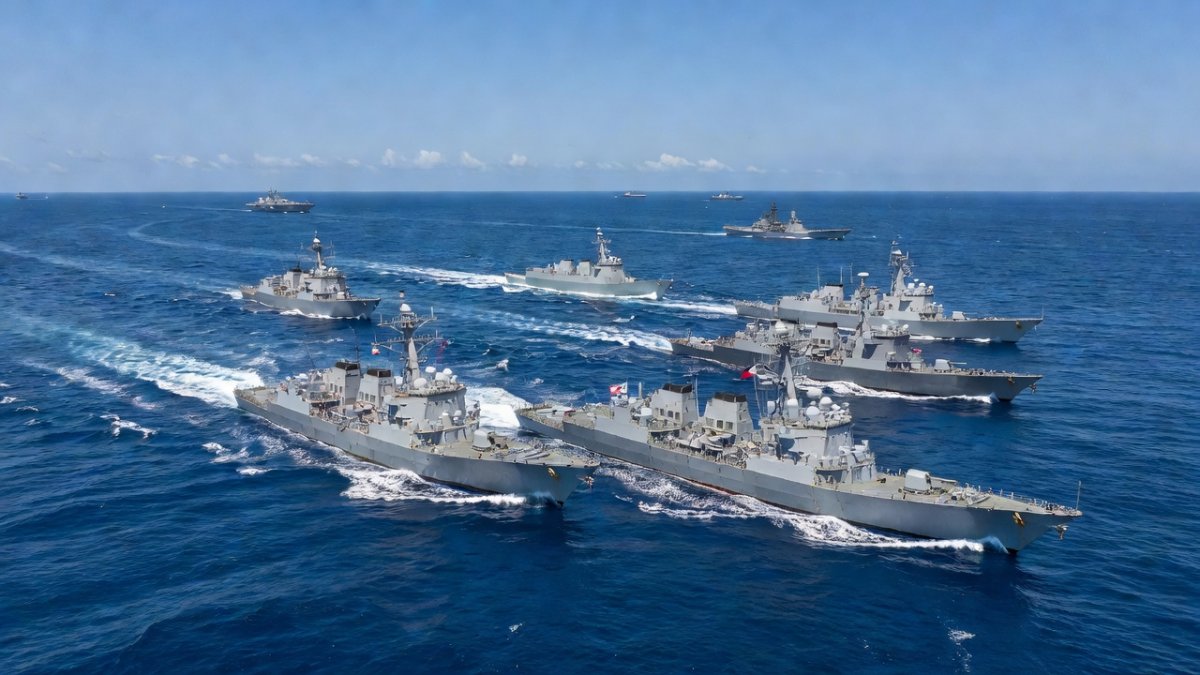
Japan, Philippines, and the US Complete Exercises in South China Sea
Tokyo — Japan, the Philippines, and the United States completed five days of joint maritime exercises in the South China Sea on July 25, 2026, as tensions between Manila and Beijing continued to escalate over disputed waters. The armed forces of the three nations said the drills demonstrated the Philippines' commitment to ensuring freedom of navigation and overflight in the West Philippine Sea, the term Manila uses for its portion of the contested waterway.
Tags: Japan, Philippines, United States, South China Sea, joint military exercises, West Philippine Sea, China, maritime security
The Joint Exercises: Scope and Scale
The exercises, held from July 21 to July 25, involved naval warships, coast guard vessels, surveillance aircraft, and fighter jets from the three participating countries. The Philippine military stated that the operations focused on improving interoperability among the allied forces and strengthening coordination mechanisms for maritime security responses. While official statements did not disclose the exact location of the drills within the South China Sea, analysts have noted that recent exercises have concentrated on areas near the disputed Spratly archipelago and Scarborough Shoal.
Escalating Confrontations at Sea
The latest round of drills began just one day after a confrontation at Second Thomas Shoal, where Philippine authorities accused Chinese Coast Guard personnel of striking a Filipino sailor with a baton during a resupply mission. Beijing disputed Manila's account, claiming that Philippine vessels had initiated the confrontation and rammed Chinese boats. The incident was the latest in a series of increasingly aggressive encounters in the disputed waterway.
During the five-day exercise period, the Philippine Coast Guard reported that Chinese vessels fired water cannons at government ships near Scarborough Shoal on Thursday and Friday of that week. China's foreign ministry responded by stating that its coast guard had taken "lawful measures" after Philippine vessels entered waters claimed by Beijing. The dueling narratives underscore the deepening divide between the two sides, with diplomatic channels showing few signs of progress toward de-escalation.
Japan's Expanding Role in Regional Security
Japan's participation in these exercises reflects a broader strategic shift in Tokyo's defense posture under the administration of Prime Minister Shigeru Ishiba. Joint exercises involving Japan, the Philippines, and the United States have increased in both size and frequency over the past two years, mirroring a similar expansion in trilateral and multilateral military cooperation across the Indo-Pacific region.
Japan has deepened its defense ties with Manila through multiple channels. In late May 2026, Tokyo and Manila announced the commencement of formal negotiations to delimit the maritime boundary of their exclusive economic zones (EEZs) and continental shelves — a move that drew sharp condemnation from China. Beijing declared the talks "illegal, null and void," claiming exclusive control over the waters in question. The Japanese government dismissed China's objections, stating that the negotiations were a sovereign matter between Japan and the Philippines conducted under international law.
Strategic Implications for Japan-Philippines Relations
The maritime boundary negotiations represent a significant step in Japan-Philippines relations. The two countries elevated their relationship to a Comprehensive Strategic Partnership earlier in 2026, encompassing defense cooperation, economic integration, and infrastructure development. For Japan, closer ties with the Philippines serve multiple strategic objectives: securing sea lanes of communication that carry roughly 40% of Japan's maritime trade, countering China's assertiveness in waters that approach Japan's own southern islands, and building a network of like-minded partners in Southeast Asia.
Philippine armed forces chief General Antonio Nafarrete visited Thitu Island in the disputed Spratly archipelago on Saturday, July 26, reassuring troops stationed there that they played a central role in defending the outpost. He pledged additional support for their operational capabilities. Thitu Island, controlled by Manila, lies approximately 300 miles west of the Philippine province of Palawan and is one of several outposts that Manila has reinforced in recent years.
China's Response and Regional Reactions
China has consistently rejected the 2016 international arbitration ruling that invalidated its extensive claims in the South China Sea, including those based on the so-called nine-dash line. Beijing continues to assert sovereignty over almost the entire waterway, a position that brings it into direct conflict with the claims of the Philippines, Vietnam, Malaysia, Brunei, and Taiwan.
In response to the latest trilateral drills, China's People's Liberation Army Navy conducted its own patrols in the region. Chinese state media characterized the joint exercises as destabilizing and warned against what it described as "outside interference" in the South China Sea. Regional reactions have been mixed: Vietnam and Malaysia, both claimants in the disputes, have watched the growing US-Japan-Philippines defense cooperation with interest but have stopped short of explicit endorsement, wary of provoking Beijing.
The South China Sea: Economic and Strategic Stakes
The South China Sea carries a significant share of global maritime trade — an estimated one-third of all shipping passes through its waters annually. The region also contains valuable fishing grounds and potential oil and natural gas reserves. For Japan, which relies heavily on imported energy and raw materials passing through these sea lanes, stability in the South China Sea is a matter of direct national interest.
Japanese companies have also become increasingly involved in Philippine offshore exploration. Mitsui & Co. and INPEX Corporation have expressed interest in joint energy exploration projects in waters near Palawan, though operational timelines have been complicated by the ongoing disputes. The Japanese government has provided patrol vessels and maritime domain awareness equipment to the Philippine Coast Guard under its Official Security Assistance framework, further embedding Japan in the region's security architecture.
What to Watch For
Several developments merit close attention in the coming months. The Japan-Philippines maritime boundary negotiations are expected to continue through the second half of 2026, with both sides aiming for an initial framework agreement. The frequency of US-Japan-Philippines trilateral exercises is likely to increase further, potentially expanding to include Australia and the United Kingdom in future iterations.
On the diplomatic front, Japan is expected to raise South China Sea issues at the ASEAN Regional Forum and the East Asia Summit later this year, seeking multilateral declarations on maritime rules-based order. Meanwhile, the situation at Second Thomas Shoal and Scarborough Shoal remains volatile, with the potential for miscalculation that could escalate into a broader confrontation. For Tokyo, the challenge lies in balancing its growing security commitments with the imperative to manage competition with China without triggering a crisis that would destabilize the broader region.
By Kenji Tanaka, Staff Writer
Japan, the Philippines, and the United States completed five days of joint naval exercises in the South China Sea from July 21 to July 25, 2026, as confrontations between Manila and Beijing escalate over disputed waters. The drills involved warships, aircraft, and coast guard vessels, coming amid Chinese water cannon attacks on Philippine ships and ongoing Japan-Philippines maritime boundary negotiations.This article was produced with AI-assisted research and editorial support. Reporting is based on sources cited in the article.
What's Your Reaction?
 Like
0
Like
0
 Dislike
0
Dislike
0
 Love
0
Love
0
 Funny
0
Funny
0
 Wow
0
Wow
0
 Sad
0
Sad
0
 Angry
0
Angry
0

Japan Correspondent at Global1.News. Tokyo-based voice covering Japanese politics, technology, economy, and culture. Tracks the intersection of tradition and innovation in one of the world's most dynamic societies.














Comments (0)