
Israel Election Looms Over Shekel as JPMorgan Sees Up to 3 Percent Swing
The upcoming October 27 Israeli election could move the shekel by as much as 3 percent in either direction, according to a JPMorgan report published on Thursday, as global investors weigh the prospect of political change after years under Prime Minister Benjamin Netanyahu. The
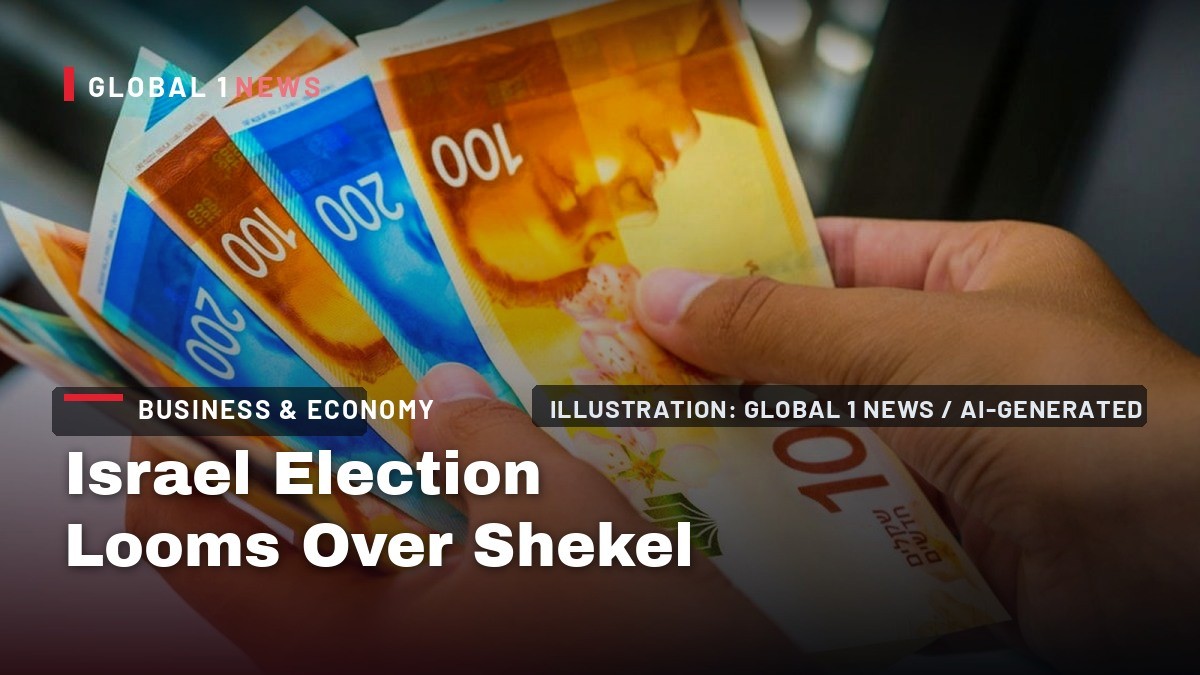
The upcoming October 27 Israeli election could move the shekel by as much as 3 percent in either direction, according to a JPMorgan report published on Thursday, as global investors weigh the prospect of political change after years under Prime Minister Benjamin Netanyahu. The U.S. bank's analysis, which assigns a 55 percent probability to an opposition victory led by former military chief Gadi Eisenkot, highlights how deeply intertwined Israel's currency has become with its political trajectory — and what that means for households, importers, and the tech sector that anchors the economy.
What JPMorgan's Scenarios Actually Say
The report lays out three distinct paths for the shekel around election day. Under the base case — an opposition win, which JPMorgan pegs at 55 percent likelihood — the currency could strengthen by 2 to 3 percent against the dollar. That appreciation would likely follow relief among international investors over potential changes to Israel's judicial system reforms and a recalibration of policies in the West Bank and Gaza, both of which have weighed on foreign sentiment in recent years. In the alternative scenario, a fifth consecutive Netanyahu victory — a possibility the bank does not dismiss, noting that polls have often underestimated Likud's strength — could trigger a 3 percent drop. The third path, a broad coalition with prolonged political uncertainty, would likely leave the shekel broadly steady, according to the report.The Arithmetic Behind the 55 Percent Probability
JPMorgan's analysts are careful to stress that the electoral math remains complex. While market odds increasingly point toward Eisenkot's opposition bloc, the bank cautions that Israel's fragmented party system — with 120 Knesset seats distributed across a dozen or more factions — makes coalition-building unpredictable. Eisenkot, a former chief of staff of the Israel Defense Forces who leads the opposition Yashar party, has seen his support rise in recent polls, but Likud's base remains formidable, and Netanyahu has repeatedly defied polling expectations throughout his two-decade dominance of Israeli politics. The report's 55 percent figure is not a prediction of certainty but a reflection of current market pricing and polling averages. It underscores that investors are preparing for a genuine toss-up, not a foregone conclusion.Why the Shekel Cares About Politics
The shekel's sensitivity to institutional concerns is not hypothetical. JPMorgan's report notes that the currency weakened nearly 10 percent against the dollar between early 2023 — when the previous government's judicial overhaul proposals sparked mass protests and international criticism — and the October 7 Hamas attack later that year. That episode demonstrated how quickly currency markets can react to perceived threats to Israel's institutional stability, from the independence of the judiciary to the predictability of policy in contested territories. For Israeli households, a 3 percent swing in either direction is not an abstract number. A weaker shekel makes imported goods — from electronics to food staples — more expensive, feeding directly into the cost of living that dominates kitchen-table conversations from Tel Aviv to Beersheba. A stronger shekel, by contrast, eases import prices but can squeeze exporters, particularly in the manufacturing sector, and reduce the shekel value of dollar-denominated revenues.The Tech Sector's Double-Edged Sword
Israel's technology sector, which accounts for a significant share of exports and tax revenues, is particularly exposed to currency movements. Many startups and established tech firms earn in dollars while paying salaries in shekels. A 2 to 3 percent strengthening would modestly reduce the local-currency value of those export earnings, but it would also signal renewed international confidence — a factor that matters more for long-term investment decisions than quarterly exchange-rate fluctuations. JPMorgan's report explicitly cites the strength of Israel's tech sector as a counterweight to political risk, noting that the overall risk-reward for the shekel is "broadly balanced" at this stage. The bank also points to a favorable external backdrop and the potential for the Bank of Israel to intervene against excessive currency strength, as it has done in the past to protect export competitiveness.What the Market Is Pricing — and What It Isn't
One of the most striking findings in the report is the gap between JPMorgan's scenarios and current market pricing. The bank notes that "implied volatility" in foreign exchange markets — a measure of how much traders expect the currency to move — points to only about a 1 percent swing around the election. JPMorgan's analysts describe that pricing as "seems low," suggesting that options markets may be underpricing the political risk embedded in this election. That discrepancy matters for anyone hedging currency exposure, from importers locking in costs to institutional investors managing Israeli bond and equity portfolios. If the market is underpricing volatility, the actual post-election move could be sharper than current derivatives suggest, catching some participants off guard.Bank of Israel's Balancing Act
The central bank's role in this equation cannot be overstated. The Bank of Israel has a history of intervening in foreign exchange markets to smooth excessive volatility, and JPMorgan's report explicitly flags "potential resistance" from the central bank to excessive currency strength. That means even in an opposition-victory scenario, the shekel's appreciation might be tempered by official action aimed at protecting exporters and maintaining price stability. For mortgage holders and savers, the central bank's stance also influences interest rates. A sharply stronger shekel could reduce imported inflation, potentially giving the Bank of Israel room to ease monetary policy — a relief for the many Israelis with variable-rate home loans. Conversely, a sharp depreciation would feed inflation and could force the central bank to hold rates higher for longer.Regional and Diplomatic Dimensions
The election's impact extends beyond the currency. JPMorgan's report emphasizes that the result will shape Israel's relations with Western allies and international investors' perceptions of the country's judicial reforms and policies in the West Bank and Gaza. These are not abstract diplomatic concerns; they translate directly into foreign direct investment decisions, credit ratings, and the cost of borrowing on international markets. A government perceived as more aligned with Western institutional norms could attract renewed investment inflows, supporting the shekel and broader asset prices. A continuation of the current trajectory, by contrast, risks prolonging the discount that international investors have applied to Israeli assets since the 2023 judicial overhaul push.What This Means for the Weeks Ahead
With roughly two months until the vote, the shekel is likely to remain sensitive to polling data, coalition negotiations, and any campaign developments that shift the perceived odds. JPMorgan's 55 percent probability for an opposition victory is a snapshot, not a forecast, and the bank itself acknowledges the complexity of Israeli politics. For now, the report's core message is one of balance: the shekel's risk-reward is broadly even, supported by a resilient tech sector and external conditions, but the election introduces a volatility that markets may be underestimating. Investors, businesses, and households alike would do well to prepare for a move that could be three times larger than current pricing suggests.The Bottom Line for Israeli Households
For the average Israeli, the practical takeaway is straightforward. If you are planning a major purchase of imported goods, a trip abroad, or a mortgage refinancing, the post-election period could bring meaningful changes to the exchange rate. A 2 to 3 percent move in either direction translates into hundreds or thousands of shekels on large transactions. The broader economic fundamentals — a strong tech sector, a favorable global backdrop, and a central bank willing to smooth extremes — provide a cushion. But politics, as JPMorgan's report makes clear, remains the wildcard. The shekel has moved on institutional concerns before, and it can move again. The only question is which direction, and how far.This article was produced with AI-assisted research and editorial support. Sources: Haaretz, Reuters.
By Hannah Berg, Staff Writer
What's Your Reaction?
 Like
0
Like
0
 Dislike
0
Dislike
0
 Love
0
Love
0
 Funny
0
Funny
0
 Wow
0
Wow
0
 Sad
0
Sad
0
 Angry
0
Angry
0

Hannah Berg
Israel Correspondent at Global1.News. Based in Tel Aviv, covering Israeli politics, security, technology, and society. Provides balanced, deeply-sourced reporting on one of the most closely-watched regions in the world.













Comments (0)