
Israel and Indonesian vice president Gibran prove the powerful can break rules and walk free
On 7 October 2026, the battered streets of Gaza City bore silent witness to a third year of devastation that began with Israel’s invasion in October 2023.
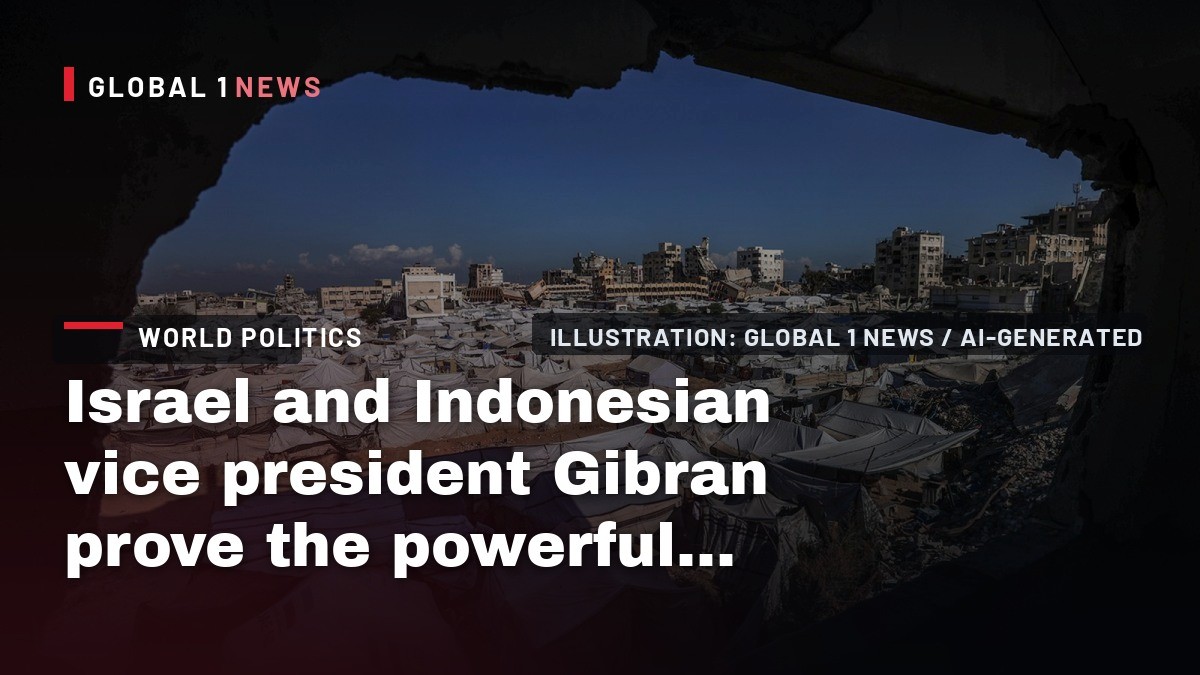
On 7 October 2026, the battered streets of Gaza City bore silent witness to a third year of devastation that began with Israel’s invasion in October 2023. The images of makeshift tents along the coastline, where displaced families cling to the remnants of their lives, echo a broader pattern of impunity that has been mirrored in distant courts, including Indonesia’s Constitutional Court. The recent ruling on Vice President Gibran Rakabuming Raka’s eligibility for office highlights how powerful actors can sidestep legal safeguards, a dynamic that Palestinians have endured daily since the conflict escalated.
Indonesia’s constitutional test and the Gibran case
Indonesia, the world’s largest Muslim‑majority nation, has long positioned itself as a vocal defender of Palestinian rights. Yet on 6 October 2026, its highest court faced a challenge that exposed the limits of that advocacy. Twelve citizens petitioned the Constitutional Court to remove Vice President Gibran Rakabuming Raka on the grounds that he had never obtained a valid high‑school diploma, a requirement explicitly stated in Indonesia’s constitution for presidential and vice‑presidential candidates.
During the hearing, the Ministry of Education admitted that in 2019 it had issued a letter equating Gibran’s schooling in Singapore and Australia with an Indonesian high school, despite possessing only a certificate of attendance and no graduation document. The judges, finding no convincing proof of a completed diploma, nonetheless declined to act, arguing that the matter lay beyond their jurisdiction because Gibran was already in office. They referred the issue to “other institutions” without specifying which bodies should take up the case.
Patterns of rule‑bending in Indonesia
The Gibran ruling is not an isolated incident. In 2023, the same Constitutional Court altered the minimum age requirement for presidential candidates, a change that directly benefited Gibran’s political ambitions. The chief judge overseeing that decision was later identified as Gibran’s uncle, a figure subsequently found to have seriously breached the court’s ethics rules. Despite these irregularities, the decisions have remained unrevoked, underscoring a systemic willingness to accommodate powerful interests.
Gibran’s own response to the 2026 petition—asserting that he could not have attended university without finishing school—offers no substantive proof of a completed secondary education. Instead, it reflects a broader contempt for ordinary citizens who are routinely required to present verifiable credentials, a contempt that resonates with the experience of Palestinians forced to prove their humanity amid relentless displacement.
International legal proceedings on Gaza
Parallel to Indonesia’s domestic legal drama, the international community has grappled with Israel’s actions in Gaza. In January 2024, the International Court of Justice (ICJ) heard South Africa’s case alleging genocide by Israel. Although a final judgment remains pending, the ICJ ordered Israel to prevent genocidal acts and to allow humanitarian aid, including food and medicine, into Gaza. Subsequent orders in March and May 2024 reinforced these demands as conditions on the ground deteriorated.
Further scrutiny arrived in September 2025 when a United Nations commission, led by former judge Navi Pillay, concluded that Israel had indeed committed genocide in Gaza. This finding was echoed by Amnesty International, leading genocide scholars, and even Israeli human‑rights groups. The International Criminal Court (ICC) followed suit, issuing arrest warrants for Prime Minister Benjamin Netanyahu and former Defence Minister Yoav Gallant, signaling an unprecedented move to hold top officials personally accountable.
The stark contrast between rulings and reality
Despite these legal pronouncements, the material consequences for Israel have been negligible. The ICC’s timetable extends to May 2029 for Israel to submit its final written answer, while the ICJ’s orders continue to be flouted, as noted by South Africa’s complaint in August 2026 that Israel openly defied earlier mandates. Western arms sales and trade flows persist, and governments that pledged to arrest ICC‑wanted individuals have instead extended diplomatic courtesies to Netanyahu.
This disconnect mirrors the Indonesian scenario where the court’s decision—though formally recorded—effectively sidestepped enforcement. In both contexts, the machinery of impunity operates by acknowledging violations while refusing to translate acknowledgment into concrete action. The result is a legal façade that leaves victims—whether Palestinians in Gaza or Indonesian citizens demanding accountability—without remedy.
Human cost behind the legal abstractions
The statistics that accompany these legal debates mask a deeper tragedy. Tens of thousands of Palestinians have been killed over the three‑year period, the majority women and children, with entire families erased from the map. The loss of life is accompanied by the destruction of homes, schools, and basic infrastructure, forcing millions into makeshift shelters along Gaza’s coast, as captured in recent photographs of the city’s shattered landscape.
While the missing school certificate of a vice president may seem a minor administrative issue, the article’s author rightly points out that the same logic of “the powerful break the rules, the system watches, and nobody lifts a finger” underpins the broader pattern of state‑level impunity. When legal systems fail to hold leaders accountable, the consequences are borne by the most vulnerable—children who never see a school building, families whose homes are reduced to tents, and communities whose future is eclipsed by ongoing violence.
Potential avenues for change
Indonesia possesses constitutional mechanisms that could address the vice‑presidential eligibility question. The parliament, for instance, has the authority to initiate removal proceedings against a vice president who does not meet the constitutional criteria. A lawyer representing the petitioning citizens argued that the recent ruling could serve as a legal foothold for such action. Yet, as the article notes, the decisive factor remains political will.
On the international stage, the tools to compel accountability already exist: halting arms sales to Israel, imposing targeted sanctions, and arresting indicted leaders upon their arrival in jurisdictions that recognize ICC warrants. The persistent gap between these tools and their deployment reflects a broader reluctance among powerful states to confront allies, a reluctance that fuels the very impunity highlighted in both Jakarta and Gaza.
From legal record to lived justice
The three‑year anniversary of the Gaza conflict serves as a stark reminder that legal records, however detailed, do not substitute for justice. Palestinians do not need additional documentation of their suffering; they need decisive, courageous action that translates international rulings into tangible protection and relief. Similarly, Indonesia’s failure to enforce its own constitutional standards on a senior official undermines its credibility as a champion of Palestinian rights.
Until the international community and individual nations muster the resolve to enforce the rules they proclaim, the pattern will persist: powerful actors will continue to bend, break, and evade the law, while ordinary people bear the brunt of those choices. The hope lies in bridging the gap between rhetoric and enforcement, ensuring that the same standards applied to a vice president’s diploma are applied to the leaders responsible for mass atrocities. Only then can the promise of accountability become more than a hollow refrain.
This article was produced with AI-assisted research and editorial support. Reporting is based on the source material cited below. Sources: Middle East Monitor; middleeastmonitor.com; Global1.News (08 October 2026).
By Fatima Al-Rashid, Staff Writer
What's Your Reaction?
 Like
0
Like
0
 Dislike
0
Dislike
0
 Love
0
Love
0
 Funny
0
Funny
0
 Wow
0
Wow
0
 Sad
0
Sad
0
 Angry
0
Angry
0

Gulf/MENA Correspondent at Global1.News. Based in Doha, covering Gulf politics, energy markets, diplomacy, and development across the Middle East and North Africa. Tracks the economic transformation of the Gulf states.












Comments (0)