
Iran Fires Missiles at US Base in Jordan; Trump Warns of 'Much Harder' Response
The Islamic Revolutionary Guard Corps just fired ballistic missiles at a US Marines base in Jordan, directly defying President Donald Trump's warning to stand down — and the White House is now staring down the barrel of a war it said it was trying to cool.
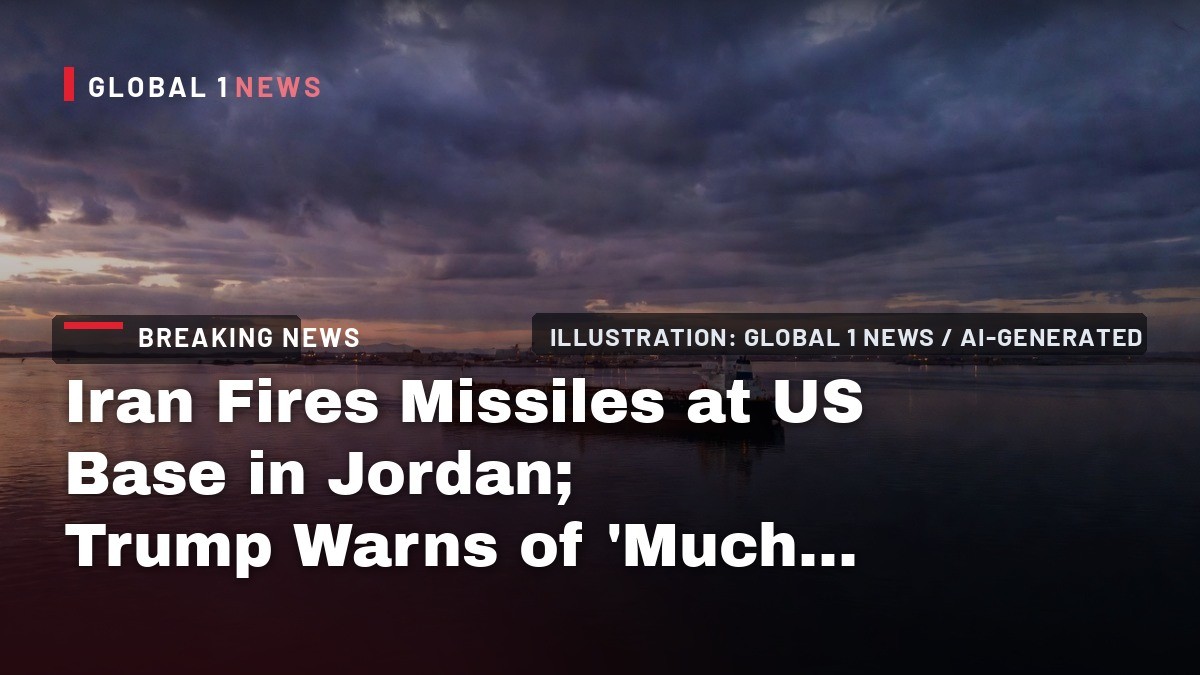
The Islamic Revolutionary Guard Corps just fired ballistic missiles at a US Marines base in Jordan, directly defying President Donald Trump's warning to stand down — and the White House is now staring down the barrel of a war it said it was trying to cool. This is no longer a shadow conflict of naval harassment and economic pressure. This is a full-blown exchange of fire between two militaries, and the Strait of Hormuz — the artery of global energy — is now the battleground.
Iran Fires Missiles at US Base in Jordan; Trump Warns of 'Much Harder' Response
Washington, D.C. — The IRGC launched a ballistic missile attack against Camp Titin, a US Marines base in Jordan, on Tuesday, according to Iranian state media. The attack came hours after US warplanes bombed targets across southern Iran, and it lands squarely in the middle of a cycle of retaliation that has now seen both sides strike each other's soil and military positions within a 48-hour window.
The Jordanian military said it intercepted 10 of the 13 Iranian missiles, with the remaining three falling in open areas. "The incident was handled in accordance with established operational procedures. Fortunately, no injuries or loss of life were recorded," the Jordanian military said in a statement. That's the good news. The bad news is that Iran just proved it can launch a coordinated missile salvo at a US installation and force a regional ally to scramble its defenses — and that's a message that will reverberate far beyond the desert where those warheads landed.
US Strikes on Southern Iran: Sirik, Konarak, Bandar Abbas, Qeshm Island
The escalation began earlier Tuesday when US Central Command (CENTCOM) confirmed it struck IRGC sites across southern Iran. "The strikes follow recent attempted attacks by the IRGC against commercial shipping in the Strait of Hormuz and against American service members deployed to the region," CENTCOM said in a statement. The targets were not limited to military installations — one strike hit a home in the southern city of Sirik that was hosting a wedding celebration, killing at least four people, according to Iran's Fars news agency.
Iranian semiofficial news agency Tasnim reported explosions across the south, including in Konarak, Bandar Abbas and Qeshm Island. The IRGC said the US military struck a wedding in Sirik on Tuesday, killing several people, including a child. This is the kind of collateral damage that fuels the very retaliation Washington is trying to suppress. Every civilian casualty in Sirik is a recruiting poster for the IRGC, and the regime in Tehran knows it.
The strategic significance of these targets cannot be overstated. Bandar Abbas is a major naval hub, Qeshm Island sits at the mouth of the Strait of Hormuz, and Konarak hosts a port that serves as a staging ground for Iranian naval operations. The US is not just sending a message — it is systematically dismantling Iran's ability to project power into the strait. But the IRGC's missile response against Camp Titin proves that dismantling is far from complete.
Trump's Threats and the White House Posture
President Trump called the strikes "large and powerful" and told Fox News that Iran would be "totally wiped out as a country" if the exchange of attacks continues. This is not new rhetoric — Trump has repeatedly issued similar threats since the war began in February. But the gap between the rhetoric and the reality is widening. The White House said it was shifting strategy from military strikes to economic pressure just weeks ago, and now it's back to bombing Iranian islands and threatening annihilation.
The president had warned that if Iran retaliated against American strikes, it would "be hit again at a much harder and higher level." The IRGC just called that bluff — or at least tested it. The question now is whether Trump follows through with an even heavier response, which risks dragging the US into a quagmire that makes the last two decades of Middle East interventions look like a warm-up act.
The State Department urged Americans in the Middle East on Tuesday to remain alert and prepare for travel disruptions, warning of "the potential for unforeseen escalation." The advisory noted that "Iran and groups supportive of Iran may target U.S. interests overseas or at locations associated with the United States and Americans throughout the world, including U.S. businesses and other institutions." That's diplomatic language for: this war is spreading, and American civilians are in the crosshairs.
Strait of Hormuz: Tanker Attacks and the Shipping Crisis
While the missiles were flying, the economic war continued unabated in the Strait of Hormuz. On Monday, the UK Maritime Trade Operations (UKMTO) reported an oil tanker was hit by three "unknown projectiles" while transiting through the strait. Bloomberg reported two oil supertankers were hit by projectiles in Hormuz at the start of the week, with neither side prepared to cede ground over the crucial waterway. Attacks on ships around the strait have been reported almost daily, despite Trump and his aides claiming the US is managing to get millions of barrels of oil through daily despite the Iranian blockade.
Iran has continued to assert its control over the strait, and the IRGC's harassment of commercial shipping is the core driver of this conflict. The US naval siege on Iranian ports is designed to strangle Tehran's economy, but Iran's response — targeting tankers — is designed to strangle the global economy. It's a mutual hostage situation, and the hostages are the world's energy consumers.
The UKMTO reports are the canary in the coal mine. When an oil tanker gets hit by three projectiles in a single transit, that's not a warning shot — that's a targeted attack. And when Bloomberg confirms two supertankers were hit at the start of the week, it's clear the IRGC is not backing down. The strait is no longer a shipping lane; it's a shooting gallery.
The Economic Shock: Oil Prices and $4 Gas in the US
The crisis in Hormuz has sent energy prices soaring. The price of a barrel of oil jumped by more than four percent after Tuesday's strikes. In the US, the average cost of one gallon of petrol is now more than $4, up from less than $3 before the war. That's a 33 percent increase in the price of gasoline in under seven months, and it's hitting American families at the pump, at the grocery store, and in every sector of the economy that depends on transportation.
This is the economic reality of the war that the White House has been trying to spin. The administration says it's managing to get oil through the strait, but the market is telling a different story. Every missile fired at a tanker, every naval skirmish, every IRGC threat sends traders scrambling and prices climbing. The $4 gallon of gas is not an anomaly — it's the new baseline until this crisis is resolved.
For American consumers, this is the war coming home. The human cost of the conflict in the Middle East is tragic, but the economic cost is being felt in every state in the union. And with the administration threatening to widen sanctions and continue strikes, there is no end in sight to the price increases. The oil market is pricing in a prolonged conflict, and that means $4 gas is likely here to stay.
The Sanctions Track: Treasury Secretary Scott Bessent's Weekly Escalation
On Tuesday, US Treasury Secretary Scott Bessent said the US would widen its sanctions on a weekly basis, adding Washington would likely announce a new bank sanction this week with a similar measure to follow next week. He said the US was also looking at targeting airline leasing companies and other entities that do business with the IRGC. This is the economic pressure campaign the administration said it was pivoting to — but it's now running in parallel with active military strikes, not instead of them.
The sanctions track is designed to choke off Iran's access to global finance and trade. The US has imposed a naval siege on Iranian ports while threatening Tehran's trade partners with secondary sanctions. But the IRGC's missile attack on Camp Titin suggests that economic pressure alone is not deterring Tehran. The regime is willing to absorb economic pain to maintain its military posture, and that makes the sanctions track a slow burn rather than a quick fix.
Bessent's weekly cadence is notable. This is not a one-off sanctions package — it's a sustained campaign designed to ratchet up pressure incrementally. But the question remains: can sanctions force Iran to back down when the IRGC is already firing missiles at US bases? The evidence so far suggests no. The regime in Tehran is betting that it can outlast American political will, and the sanctions track is a test of that bet.
The Timeline of the War Since February
The US-Iran war began in February 2026, with US strikes targeting IRGC sites. Iran has responded with missile and drone attacks on US forces and bases in the region, and has harassed commercial shipping in the Strait of Hormuz. The conflict has ebbed and flowed, with the US imposing a naval siege on Iranian ports and threatening secondary sanctions against Tehran's trade partners. The renewed fighting this week marks the first attacks by both countries since July — and Tuesday's exchange has escalated it further.
The Guardian reported the US and Iran exchanged fire for the first time in a month, with missiles and drones fired at Iranian rocket launchers on an island in the Strait of Hormuz. DW reported the US military launched strikes on Iran's Revolutionary Guard Corps, with Trump describing the strikes as "large and powerful" and Iran saying the US would "regret" the latest attacks. The July pause was supposed to be a de-escalation, but it was really just a breather before the next round.
Sunday's exchange saw the US military strike Larak Island in southern Iran, and Tehran retaliated with missile launches against a base housing American troops in Jordan. Trump had promised to hit Iran "hard" in response to those clashes. Tuesday's strikes and the IRGC's response are the direct continuation of that cycle. This is a war that is not winding down — it is ratcheting up, and each round of retaliation is more intense than the last.
What Happens Next: The Escalation Spiral
The IRGC's missile attack on Camp Titin is a direct challenge to Trump's credibility. The president said Iran would be hit "at a much harder and higher level" if it retaliated — and Iran retaliated anyway. The question now is whether Trump follows through on that threat, which would likely trigger another Iranian response, and so on, until one side blinks or the conflict spirals into a regional war that draws in other powers.
The economic stakes are equally high. The Strait of Hormuz remains the critical chokepoint, and the daily attacks on shipping are keeping oil prices elevated and global markets on edge. The US sanctions track is designed to pressure Iran economically, but it is not working fast enough to stop the military escalation. And with $4 gas in the US, the political pressure on the White House to resolve this crisis is mounting.
The most likely scenario is more of the same: continued strikes, continued retaliation, continued attacks on shipping, and continued economic pain. Neither side appears willing to de-escalate, and both are betting that the other will crack first. But the longer this goes on, the higher the risk of a miscalculation that turns a controlled exchange into an uncontrolled conflagration. The war in the Gulf is no longer a sideshow — it is the main event, and the world is watching.
By Jessica Ali, Staff Writer
This article was produced with AI-assisted research and editorial support. Sources: Al Jazeera, CENTCOM, IRGC statements, Jordanian military, UKMTO, Bloomberg, The Guardian, DW.
What's Your Reaction?
 Like
0
Like
0
 Dislike
0
Dislike
0
 Love
0
Love
0
 Funny
0
Funny
0
 Wow
0
Wow
0
 Sad
0
Sad
0
 Angry
0
Angry
0

Editor-in-Chief at Global1.News. Atlanta-based journalist who cuts through the BS and tells it like it is. Lead anchor, host, and the voice you hear when the spin stops and the truth starts.











Comments (0)