
India's AI Push vs 1.05 Lakh Toilet Gaps in Schools
India's most ambitious digital push in school history — AI-assisted learning tools, smart classrooms and the National Education Policy 2020's technology-first vision — is colliding with a stubbornly basic problem: more than one lakh schools still cannot offer girls a functional toilet. UDISE+ 2025-26 data shows that out of 14.67 lakh girls' and co-educational schools, around 1.05 lakh lack proper girls' toilet facilities.
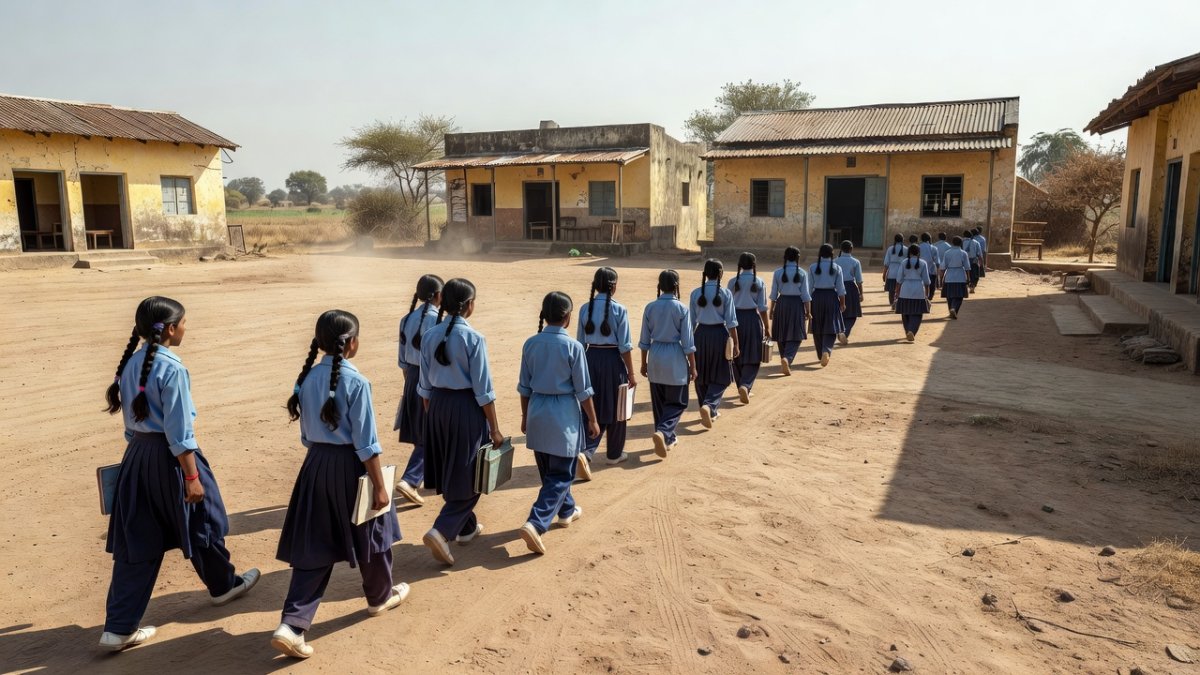
India's most ambitious digital push in school history — AI-assisted learning tools, smart classrooms and the National Education Policy 2020's technology-first vision — is colliding with a stubbornly basic problem: more than one lakh schools still cannot offer girls a functional toilet. UDISE+ 2025-26 data shows that out of 14.67 lakh girls' and co-educational schools, around 1.05 lakh lack proper girls' toilet facilities. It is the sharpest possible symbol of a system racing toward the future while foundational dignity infrastructure remains unfinished.
India's AI Push Clashes With 1.05 Lakh Toilet Gaps
New Delhi, India – August 7, 2026 — The Ministry of Education's latest UDISE+ report quantifies a divide that policy documents rarely acknowledge: digital ambition is accelerating while basic sanitation, electricity and access remain incomplete for lakhs of students.
The Stark Contrast: AI Ambitions Versus Basic Sanitation
Under the National Education Policy 2020, Indian classrooms are being wired for artificial intelligence — smart boards, adaptive learning software and AI tutors are the stated direction of school reform. Yet UDISE+ 2025-26 data reveals that out of 14.67 lakh girls' and co-educational schools, roughly 1.05 lakh still lack proper girls' toilet facilities, even as national coverage stands at 98.5 percent. The remaining gap is concentrated in rural and northeastern regions, where millions of girls attend schools that cannot guarantee the most basic privacy and sanitation.
NITI Aayog's May 2026 assessment adds another layer: 1.19 lakh schools have no electricity and over one lakh operate with a single teacher. Digital tools are simply unusable in institutions without power, connectivity or staff — the very schools the AI push is supposed to reach.
UDISE+ 2025-26: Tracking Infrastructure Across Nine Indicators
The Ministry of Education's UDISE+ 2025-26 report examined over 14.6 lakh schools on nine indicators. National coverage reached 99.5% for drinking water and 98.5% for girls' toilets, yet electricity stood at 95.0%, libraries at 90.5%, and playgrounds at 81.9%. Computer access covered only 69.9% of schools and internet 67.4%. Ramps with handrails reached 58.2% while CWSN toilets covered just 40.1%.
The pattern is unambiguous: basic amenities are near-universal on paper, but the facilities that determine whether a child can actually participate in a digital-age classroom — computers, connectivity, accessible toilets — trail badly. Digital infrastructure lags behind basic infrastructure, and the gap is widest exactly where girls are most vulnerable.
The report's scale is worth absorbing: UDISE+ 2025-26 covers approximately 14.6 lakh schools and more than 24 crore students, making it the world's largest school-level statistical exercise. Yet its own data shows that only 69.9% of schools have computers and 67.4% have internet, even as the Centre pushes AI literacy through programmes such as PM SHRI schools. Between the policy vision and the ground reality sits a financing and execution gap that nine indicators, measured honestly, expose without mercy.
Regional Disparities: Leaders and Laggards
Tamil Nadu recorded the highest composite score of 94.4 among large states, followed by Odisha at 90.6 and Punjab at 89.9. Meghalaya posted the lowest composite at 44.9, with computer access in only 19.5% of schools, internet in 36.4%, electricity in 31.0%, and CWSN toilets in 6.3%. West Bengal reported computer access in just 25.7% of schools and internet in 19.7%.
The geography of the gap tells a clear story: hilly, tribal and northeastern states face the steepest climb because terrain, scattered habitations and weaker state capacity raise construction and maintenance costs. For disabled students, the national CWSN toilet coverage of 40.1% is a glaring equity failure — ramps reach 58.2% of schools, but accessible toilets remain unavailable in nearly 60%. National averages conceal these regional and disability gaps, so policy designed around aggregate numbers will keep missing the most excluded students.
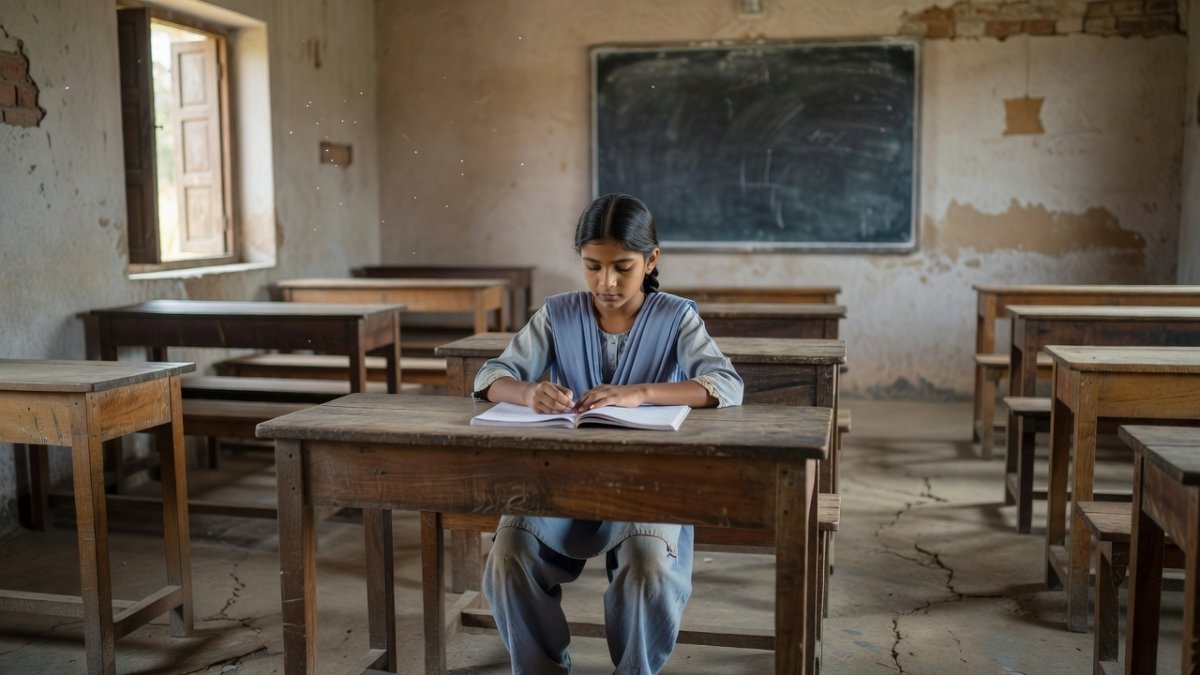
Dropout Rates and the Reasons Girls Leave
Girls' secondary school dropout rate declined to 8% in 2025-26 from 12.6% in 2023-24 and 9.6% in 2024-25, according to a Lok Sabha reply by Minister of State for Education Jayant Chaudhary, responding to a question from MP Gurmeet Singh Meet Hayer. Primary-level dropout for girls stands at just 0.1% and upper primary at 3.4% — meaning the steepest losses happen precisely at adolescence.
PLFS 2023-24 data cited in the same reply points to family income pressures, household responsibilities, parents not valuing higher education, social norms around early marriage, and long distances to secondary schools. The state-wise pattern shows poverty alone does not explain the trend: prosperous Gujarat recorded 13.3% secondary dropout alongside Ladakh at 15.6% and Assam and Karnataka at 13.9% each.
The transition from childhood to adolescence is where Indian girls' educational journeys falter. An 8% secondary dropout rate means roughly one in every twelve girls enrolled in secondary school leaves before completing it — hundreds of thousands of students each year, concentrated in the states where toilets, transport and safety concerns overlap. Even the encouraging decline from 12.6% three years ago must be read against this absolute scale: progress is real, but the pipeline still leaks at the worst possible moment.
UDISE+ 2025-26 shows 95.4% of government schools now have separate functional toilets for girls, covering more than 9.5 lakh schools, with full coverage in Delhi, Goa and Chandigarh but only 67.9% in Arunachal Pradesh and 72.7% in Mizoram. The Ministry has stated that no central study establishes a direct causal link between toilet availability and dropout rates — yet infrastructure remains essential for dignity, health and attendance.
Health Impacts and Government Interventions
Adolescent girls without private, functional sanitation face elevated risks of urinary tract infections, reproductive tract infections, prolonged absenteeism and social stigma during menstruation. UNICEF and WHO WASH research consistently shows that girls miss school during menstruation when privacy and sanitation are absent — a finding that holds across developing countries.
The demand-side response is substantial: the Health Ministry's menstrual hygiene programme reaches 53.9 lakh adolescent girls monthly through awareness campaigns and sanitary napkin distribution, while Samagra Shiksha funds sanitary pad vending machines and incinerators in schools. Swachh Bharat Abhiyan and Swachh Vidyalaya since 2014 have built millions of toilets.
But these interventions cannot compensate for supply-side gaps. NITI Aayog's May 2026 report draws the critical distinction between built facilities and functional ones: 98,592 schools still lack functional girls' toilets — a narrower, stricter count than UDISE+'s 1.05 lakh figure for proper facilities — alongside 61,540 schools without functional toilets of any kind. The two datasets measure different things, but they tell the same story: construction has outpaced maintenance, and the last mile of functionality remains the hardest.
For parents deciding whether a daughter continues past Class 8, these gaps are not statistics but daily calculations. A school without a usable toilet is a school where a girl misses days each month, where illness goes untreated, where safety is a quiet worry. The arithmetic of girls' retention runs through the bathroom door — which is why infrastructure and enrolment data must be read together, not in isolation.
Policy Recommendations for Equitable Progress
India's education framework must prioritise completion of the remaining toilet facilities before scaling AI classrooms nationwide. States with low composite scores need targeted Samagra Shiksha allocations, and every state should sequence priorities by completing construction and conducting functional audits before launching AI pilots.
Delhi, Goa and Chandigarh have already achieved full girls' toilet coverage — proof that 100% functionality is attainable within existing budgets. Ring-fencing funds for the last mile, with time-bound milestones reported to Parliament, would directly support the observed decline in secondary dropout from 12.6% to 8%.
Indian taxpayers have financed Swachh Bharat infrastructure since 2014. Completing the last mile is both fiscal prudence and equity. Only then can NEP 2020's technology ambitions serve every girl — from Ladakh to Mizoram — rather than a privileged subset. Toilets, in the end, are the foundation on which any digital-first education system must stand.
— By Dr. Raj Patel, Staff Writer
This article was produced with AI-assisted research and editorial support. Reporting is based on sources cited in the article.
What's Your Reaction?
 Like
0
Like
0
 Dislike
0
Dislike
0
 Love
0
Love
0
 Funny
0
Funny
0
 Wow
0
Wow
0
 Sad
0
Sad
0
 Angry
0
Angry
0

India/South Asia Correspondent at Global1.News. Analytical voice with a background in science and health journalism. Based in New Delhi, covering Indian politics, education, healthcare, technology, and policy. Breaks down complex data into clear, actionable reporting.















Comments (0)