
IAEA Confirms Syria Built Nuclear Reactor Under Assad, Unlocking a New Era of Nuclear Accountability in the Middle East
Damascus, Syria – September 2, 2026 — The International Atomic Energy Agency (IAEA) has formally confirmed that the former regime of Bashar Assad constructed a nuclear reactor in eastern Syria, a finding that closes a two-decade-long chapter of clandestine nuclear activity and...
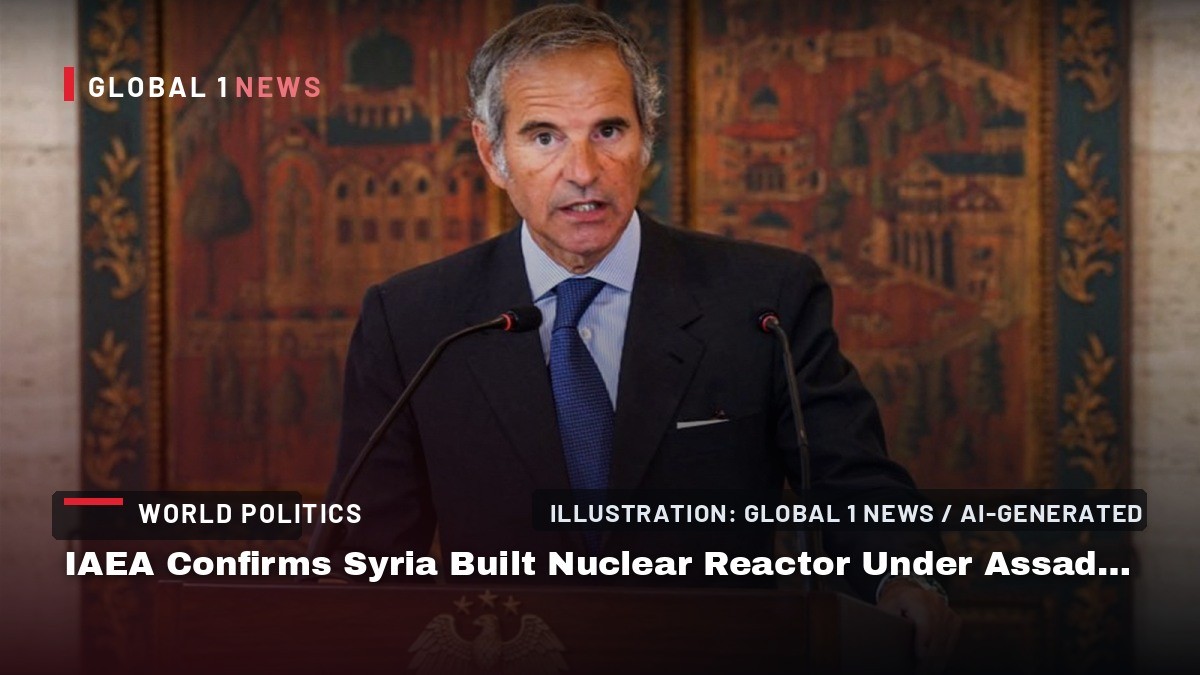
IAEA Confirms Syria Built Nuclear Reactor Under Assad, Unlocking a New Era of Nuclear Accountability in the Middle East
Damascus, Syria – September 2, 2026 — The International Atomic Energy Agency (IAEA) has formally confirmed that the former regime of Bashar Assad constructed a nuclear reactor in eastern Syria, a finding that closes a two-decade-long chapter of clandestine nuclear activity and opens a delicate new phase of verification and transparency under the country's post-Assad government. The confirmation, detailed in a confidential report seen by news agencies on Tuesday, marks the first time the UN watchdog has been able to establish definitively that the ousted Syrian authorities failed to report nuclear material, facilities, and activities required under international safeguards.
The announcement carries profound implications for the Middle East, a region already defined by nuclear asymmetry—where Israel maintains an undeclared arsenal and Iran's program remains under intense scrutiny. For the new Syrian administration, the IAEA's findings represent both a diplomatic victory and a formidable challenge: the opportunity to reintegrate into the international non-proliferation regime, weighed against the logistical and political burden of securing and accounting for tonnes of nuclear material left behind by the Assad era.
A Long-Buried Secret Unearthed
The IAEA's report confirms that observations at the Deir el-Zour site—the location destroyed by an Israeli air strike in 2007—are consistent with the cooling infrastructure of a nuclear reactor. The agency stated that recently uncovered infrastructure at the site aligns with that of a reactor, and it will continue to monitor activities "as the excavation work progresses." This marks a significant escalation in the agency's ability to verify what was long suspected but never proven: that Syria operated an extensive undeclared nuclear program under Assad, including a reactor reportedly built with North Korean assistance.
The site first became public knowledge only after Israel launched air strikes in September 2007 that destroyed the facility. Syria subsequently levelled the site and never fully responded to the IAEA's questions about it, leaving the international community with a partial picture of the program's scope. The agency took samples at the site in 2024 and reported last year that they contained uranium particles, providing the first concrete evidence of nuclear activity. Now, with the new Syrian government's cooperation, the IAEA has been able to piece together a more complete picture.
Beyond the reactor itself, the IAEA listed a fuel fabrication plant, where nuclear fuel for the reactor was manufactured, and a separate location where the fuel, along with uranium scrap and waste, was stored. This tripartite infrastructure—reactor, fuel fabrication, and storage—indicates a program of significant ambition, far beyond a research-scale effort.

The 73-Tonne Revelation
Perhaps the most striking detail in the IAEA report concerns a previously undeclared site that the new Syrian administration notified the agency about in a July 17 letter. During a visit to Syria, IAEA Director General Rafael Grossi and a team of senior inspectors examined this site, which contained "natural uranium metal in the form of fuel rods with cladding." The agency verified the material and confirmed the presence of around 73 tonnes of natural uranium metal—a substantial quantity that is now subject to Agency containment and surveillance measures.
Grossi had hinted at this discovery last month during a meeting with Syria's interim foreign minister in Damascus, stating that IAEA inspectors had found several tons of nuclear material at a site Damascus reported to the agency. He praised Damascus's "courageous decision" to report the undisclosed site, which dates back to the rule of Assad. The scale of the find—73 tonnes—suggests a program that was not merely experimental but had reached a stage of material production and stockpiling.
The IAEA report emphasizes that "all of this nuclear material is currently subject to Agency containment and surveillance measures," indicating that the new Syrian authorities have allowed international inspectors to secure the material. This represents a stark departure from the Assad era's opacity and a concrete step toward compliance with the Treaty on the Non-Proliferation of Nuclear Weapons (NPT).
Damascus's Strategic Gamble
The new Syrian administration's decision to cooperate with the IAEA is a calculated strategic move. By voluntarily disclosing the undeclared site and inviting inspectors, Damascus is signaling its intent to break with the Assad legacy and rejoin the international community as a responsible actor. The IAEA report notes that Grossi welcomed "Syria's transparency and cooperation with the agency," and that Syria "has taken measures to remedy the situation by providing to the agency the required nuclear material accounting reports and design information for the above-mentioned facilities."
This cooperation carries significant diplomatic dividends. For a government seeking international recognition, legitimacy, and reconstruction aid, demonstrating compliance with nuclear safeguards is a powerful credential. It also serves to differentiate the new administration from the Assad regime, which was sanctioned and isolated in part due to its nuclear activities. The new Syrian authorities have also expressed an interest in developing a civilian nuclear energy programme, and have stated that any nuclear material found in the country would remain in Syria's custody under international safeguards—a position that preserves national sovereignty while accepting international oversight.
However, the gamble is not without risks. The disclosure of 73 tonnes of natural uranium metal raises questions about the program's intended purpose. While natural uranium is not weapons-grade material, it is a precursor for enrichment or for use in a heavy-water reactor capable of producing plutonium. The IAEA's confirmation that Syria failed to report these activities under Assad will inevitably invite scrutiny of the program's ultimate aims, and the new government will need to demonstrate convincingly that its intentions are peaceful.
Israel's Shadow and the Regional Nuclear Calculus
The IAEA's findings cannot be separated from the broader regional nuclear landscape, dominated by Israel's undeclared atomic arsenal—the only one in the Middle East. Israel neither confirms nor denies having atomic weapons, a policy of deliberate ambiguity that has shaped the region's security architecture for decades. The 2007 air strike on the Deir el-Zour site was a manifestation of Israel's determination to prevent any Arab state from acquiring a nuclear capability, a doctrine known as the Begin Doctrine.
The confirmation that Syria was indeed building a reactor validates Israel's preemptive action in the eyes of many strategists, even as it raises uncomfortable questions about the effectiveness of such strikes. The reactor was destroyed, but the program's remnants—the fuel fabrication plant, the storage sites, and the 73 tonnes of uranium—survived, hidden for nearly two decades. This suggests that military strikes alone cannot eliminate a nuclear program; only sustained verification and political engagement can do so.
For Israel, the IAEA's findings present a diplomatic challenge. The new Syrian government's cooperation with the IAEA undermines the narrative that Syria was an irredeemable proliferator, and it complicates Israeli efforts to maintain regional nuclear dominance. At the same time, Israel may view the new Syrian administration's transparency as a stabilizing factor, reducing the risk of nuclear materials falling into the hands of hostile non-state actors or a resurgent Assadist faction.
Implications for Iran and the Non-Proliferation Regime
The IAEA's success in Syria carries direct implications for the agency's ongoing work in Iran. The contrast is stark: while the new Syrian government has voluntarily disclosed sites and material, Iran's cooperation with the IAEA has been characterized by delays, restricted access, and unresolved questions about undeclared activities. The Syria case demonstrates that transparency and cooperation are possible, even in a country emerging from decades of authoritarian rule and civil war.
This precedent may strengthen the IAEA's hand in its dealings with Tehran, providing a concrete example of what full compliance looks like. It also reinforces the agency's role as the central arbiter of nuclear verification in the Middle East, a role that has been challenged by both state and non-state actors. The successful verification of Syria's program, from discovery to confirmation, underscores the importance of the IAEA's inspection regime—and the consequences of failing to report nuclear activities.
For the broader non-proliferation regime, the Syria case is a reminder that even closed, authoritarian states can be held to account, given sufficient time, access, and political will. The IAEA's persistence over nearly two decades, from the initial questions about Deir el-Zour to the recent excavations, demonstrates the value of long-term verification efforts. It also highlights the limitations of the regime: the program operated undetected for years, and it took a change of government to bring it to light.

The Road Ahead: Excavation, Accountability, and Reconstruction
The IAEA has indicated it will continue to monitor activities at the Deir el-Zour site "as the excavation work progresses," suggesting that further discoveries may be forthcoming. The full extent of Syria's undeclared program may not yet be known, and the agency's ongoing work will be critical in establishing a complete inventory of nuclear material and facilities. The new Syrian government's stated interest in a civilian nuclear energy programme adds urgency to this work, as any future program must be built on a foundation of verified compliance.
The question of accountability also looms. The IAEA's report establishes that the former Syrian authorities failed to report nuclear material, facilities, and activities—a violation of Syria's safeguards obligations. Whether this will lead to formal findings of non-compliance by the IAEA Board of Governors, and what consequences might follow, remains to be seen. The Assad regime is gone, but the individuals who oversaw the program may still face questions, both from the IAEA and from Syria's own transitional justice processes.
For the new Syrian government, the immediate priorities are clear: continue cooperating with the IAEA, secure all nuclear material, and build the institutional capacity to manage a peaceful nuclear program. The 73 tonnes of uranium, now under IAEA containment, represent both a liability and an asset—a liability in terms of security and proliferation risk, and an asset in terms of potential fuel for a future civilian program. How Damascus navigates this duality will shape its trajectory in the international community.
A Turning Point for Middle East Nuclear Diplomacy
The IAEA's confirmation that Syria built a nuclear reactor under Assad is more than a historical finding; it is a turning point for nuclear diplomacy in the Middle East. For the first time, a former clandestine program in the region has been fully verified and brought under international safeguards, not through military action or regime change imposed from outside, but through the voluntary cooperation of a new government seeking legitimacy. This sets a precedent that could resonate across the region, from Iran to Saudi Arabia to the UAE, as states grapple with the dual imperatives of nuclear energy and non-proliferation.
The path forward is fraught with challenges. The excavation at Deir el-Zour will continue, and the IAEA's monitoring will need to be sustained. The new Syrian government will face pressure to demonstrate that its civilian nuclear ambitions are genuine and peaceful. And the broader regional security architecture, long defined by Israel's nuclear monopoly and Iran's contested program, will need to adapt to a new reality in which Syria is no longer a proliferator but a verified, cooperating state.
What is clear is that the era of hidden nuclear programs in the Middle East is drawing to a close. The IAEA's findings in Syria, achieved through persistence and cooperation, offer a model for how the region might address its nuclear legacy—not through denial and concealment, but through transparency, verification, and the hard work of building trust. For the people of Syria, who suffered under a regime that pursued nuclear ambitions while neglecting their basic needs, this chapter offers a measure of accountability. For the region, it offers a glimpse of a future in which nuclear activities are conducted in the open, under international oversight, and in service of peaceful purposes.
By Malik Hassan, Staff Writer
This article was produced with AI-assisted research and editorial support. Sources: Daily Sabah (AFP), Al Jazeera (AFP/AP).
What's Your Reaction?
 Like
0
Like
0
 Dislike
0
Dislike
0
 Love
0
Love
0
 Funny
0
Funny
0
 Wow
0
Wow
0
 Sad
0
Sad
0
 Angry
0
Angry
0

Middle East Correspondent at Global1.News. Based in Beirut, covering politics, conflict, energy, and society across the Middle East. Brings context and depth to a region often reduced to headlines.














Comments (0)