
Between Washington's Assurance and Jerusalem's Ambition: The Gaza Emigration Gambit Tests Regional Red Lines
The battle over Gaza's future has entered a new and critical phase, one defined not by the thunder of artillery but by the quieter, more strategic clash of diplomatic language and political ambition. As Israel barrels toward an October 27 election, the question of whether Palestinians will be encouraged—or pressured—to leave the enclave has become the central fault line in both Israeli domestic politics and the region's broader stability calculus.
The battle over Gaza's future has entered a new and critical phase, one defined not by the thunder of artillery but by the quieter, more strategic clash of diplomatic language and political ambition. As Israel barrels toward an October 27 election, the question of whether Palestinians will be encouraged—or pressured—to leave the enclave has become the central fault line in both Israeli domestic politics and the region's broader stability calculus.
In the occupied West Bank on Saturday, the United States' top diplomat in Israel sought to draw a firm line under the speculation, even as senior Israeli officials openly championed a mass emigration scheme. The disconnect between Washington's public assurances and Jerusalem's internal maneuvering underscores a profound tension that Arab capitals from Cairo to Amman are watching with deep apprehension.
Between Washington's Assurance and Jerusalem's Ambition: The Gaza Emigration Gambit Tests Regional Red Lines
Jerusalem - September 5, 2026 - US Ambassador to Israel Mike Huckabee, standing alongside Palestinian-Americans in the occupied West Bank, delivered what appeared to be a categorical rejection of forced transfer. "I can tell you categorically there is no plan of the Israelis to displace people out of Gaza against their will," Huckabee told reporters on Saturday, seeking to quell a firestorm ignited just days earlier by far-right members of Israel's governing coalition.

Yet the ambassador's phrasing left significant room for interpretation, acknowledging an "open-mindedness if people wish to leave, that they should have the right to leave." He characterized the current situation as a "disgrace," arguing it was untenable to "incarcerate" Palestinians inside the war-shattered territory. "Nobody is suggesting there would be forced displacement - the Israelis are not, the Americans are not. I know of no one who supports that," Huckabee asserted, a statement that sits in uneasy tension with the public pronouncements of Israeli National Security Minister Itamar Ben-Gvir and Defense Minister Israel Katz just days earlier.
The "Disengagement 710" Bombshell
The immediate catalyst for Huckabee's clarification was the unveiling on Thursday of a sweeping plan by Ben-Gvir, leader of the far-right Otzma Yehudit party. Dubbed "Disengagement 710"—a pointed reference to Israel's 2005 withdrawal from Gaza and the October 7, 2023, Hamas attack—the proposal outlines the removal of 1.86 million of Gaza's roughly 2.3 million residents within seven years. The plan's timeline is aggressive: 250,000 departures in year one, 1.11 million within three years, and the full 1.86 million target by the seventh year.
Ben-Gvir's framework is built on the premise of "voluntary emigration," promising an "absorption package" that includes travel costs, initial housing, vocational training, employment assistance, and support for up to 24 months. The plan estimates an initial Israeli investment of NIS 10 billion (approximately US$3 billion), with the potential for up to NIS 50 billion (roughly US$15.2 billion) in matching funds. Crucially, Otzma Yehudit has listed Turkey, Ethiopia, the Congo, and unspecified Arab countries as potential destinations, though no government has publicly agreed to such an arrangement.
The minister's rhetoric was unsparing. "Instead of illusions of peace now, we need actions of emigration now," Ben-Gvir declared, adding that "instead of [Gazans] digging tunnels, it's time to pack suitcases." He insisted the plan does not constitute forced removal, yet he made clear that establishing an "Emigration Ministry" would be a non-negotiable condition for Otzma Yehudit's participation in any future governing coalition.
Katz's "Migration" Doctrine and the US Rebuttal
Ben-Gvir's proposal was not an isolated outburst. A day earlier, on Wednesday, Defense Minister Israel Katz offered a blunter assessment of the Trump administration's position, claiming that Washington had only "frozen"—not cancelled—support for removing Palestinians from Gaza. "In the end, there is no real solution for Gaza without this migration," Katz argued, asserting that Israel was prepared to facilitate departures "by sea, by air and by any means." He further claimed, without providing evidence, that 80 percent of Gaza's population wished to leave but were being prevented from doing so by Hamas.
The White House moved quickly to counter that narrative. On Friday, the US State Department told Al Jazeera that Washington "does not support any plan or proposal for the forced displacement, expulsion, or mandatory transfer of the population of Gaza." The statement reiterated Point 12 of President Donald Trump's 20-point Gaza peace plan, which explicitly states: "No one will be forced to leave Gaza, and those who wish to leave will be free to do so and free to return. We will encourage people to stay and offer them the opportunity to build a better Gaza."
This public rebuke highlights a growing chasm between the maximalist ambitions of Israel's far-right flank and the pragmatic constraints facing the Trump administration, which has invested significant political capital in its October 2025 peace framework—a plan accepted by Prime Minister Benjamin Netanyahu ahead of the ceasefire that halted major fighting. The administration's position is clear: forced displacement of a civilian population from occupied territory constitutes a war crime under the Geneva Conventions, a legal reality that Washington cannot ignore without undermining its broader diplomatic posture.
The Election Calculus and Netanyahu's Tightrope
The timing of Ben-Gvir's proposal is no accident. With Israel's national elections scheduled for October 27, 2026, polls indicate a razor-thin race for Netanyahu, who has increasingly relied on bringing once-shunned far-right figures into his cabinet to secure his political survival. Ben-Gvir's "Disengagement 710" plan serves a dual purpose: it energizes his base with a maximalist vision, while simultaneously positioning Otzma Yehudit as an indispensable coalition partner should Netanyahu prevail.
For Netanyahu, the plan presents a delicate balancing act. Embracing it too enthusiastically risks alienating Washington and inflaming regional tensions with Egypt and Jordan—both of which maintain peace treaties with Israel and both of which have forcefully rejected any transfer of Palestinians. Rejecting it outright could fracture his right-wing coalition and hand Ben-Gvir the leverage to extract greater concessions or even bolt to the opposition. The prime minister's acceptance of the October 2025 peace plan, which pledged to "encourage people to stay," suggests a pragmatic recognition that mass displacement is a diplomatic non-starter. Yet the continued presence of figures like Ben-Gvir and Katz in senior security roles indicates that the far-right's influence on policy remains substantial.
Huckabee's West Bank visit on Saturday also touched on the escalating violence in the occupied territories. After a sharp rise in settler attacks, the ambassador stated that the Israeli government has a responsibility to ensure the safety and security of Palestinians, telling reporters that "the people in this community have the right to live with a certain level of security and safety." This acknowledgment of Palestinian vulnerability in the West Bank, delivered by a staunchly pro-Israel envoy, reflects Washington's growing concern that unchecked settler violence could destabilize the region and undermine the fragile ceasefire framework.
Egypt and Jordan: The Unmovable Red Lines
For Egypt and Jordan, the renewed talk of Palestinian emigration is not merely a policy disagreement—it is an existential threat. Both nations, the only Arab states bordering Israel, have repeatedly warned that any mass transfer of Palestinians from Gaza or the West Bank would effectively liquidate the two-state solution and transform their own territories into substitutes for a Palestinian homeland. Cairo, which has served as a key mediator throughout the conflict, views the displacement proposals as a direct challenge to its national security interests, given the Sinai Peninsula's proximity to Gaza. Amman, which already hosts a significant Palestinian population, fears that a new wave of displacement would fundamentally alter Jordan's demographic and political character.
The regional consensus is unambiguous: Palestinian leaders and Arab states view displacement as an existential threat to the viability of a future Palestinian state. This position was reinforced in February 2025 when Trump's initial proposal to move Gaza's population and redevelop the territory as a luxury resort collapsed under coordinated pushback from Egypt, Jordan, and other Arab states, compounded by the lack of any willing destination countries. The current revival of similar ideas, however rebranded, resurrects those same red lines.

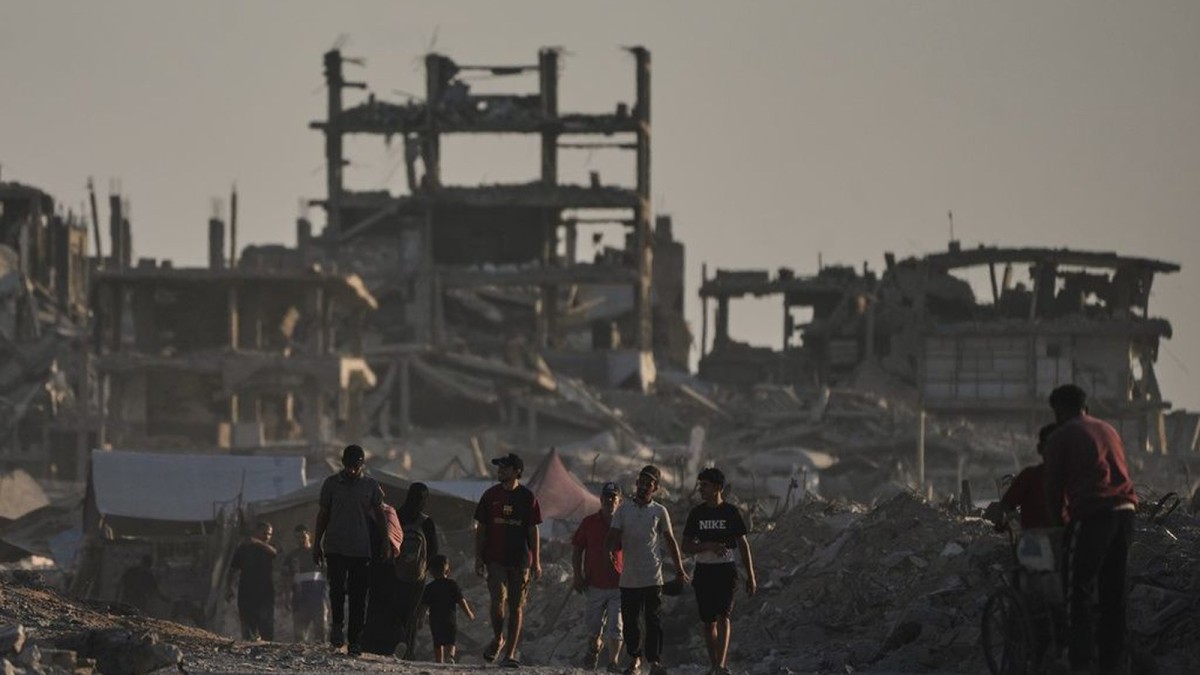
The human cost of this political maneuvering remains staggering. The war that began with the Hamas-led October 7, 2023, attack on southern Israel—which killed approximately 1,200 people and resulted in 251 hostages—has triggered an Israeli offensive that has killed more than 73,400 people in Gaza, including over 1,330 since the ceasefire, according to the Hamas-run health ministry. Virtually all of Gaza's population has been internally displaced at some point during the conflict, living in conditions that rights advocates describe as catastrophic. The ceasefire halted major fighting, but Gaza remains bisected into Israeli- and Hamas-controlled areas, with no clear path to a permanent political resolution. Hamas's acceptance of a US-brokered disarmament plan on July 30, 2026, was rejected by Israel, which has refused the required phased pullouts, leaving the territory in a precarious limbo.
The Strategic Calculus of "Voluntary" Departure
The semantic battle over the word "voluntary" lies at the heart of the current diplomatic confrontation. Israeli officials insist that their proposals merely offer Palestinians a choice—the right to leave if they wish. But critics argue that in a territory where 90 percent of the population has been displaced, where infrastructure lies in ruins, and where reconstruction is contingent on political agreements that remain elusive, the distinction between "choice" and "coercion" becomes dangerously blurred. When Defense Minister Katz speaks of facilitating departures "by any means," and when Ben-Gvir frames emigration as a necessary alternative to "digging tunnels," the subtext is unmistakable: life in Gaza will be made untenable until leaving becomes the only rational option.
This is precisely why the US State Department's insistence on Point 12 of the Trump plan is so significant. By explicitly stating that "no one will be forced to leave" and that "those who wish to leave will be free to do so and free to return," Washington is attempting to thread a needle between its Israeli ally's domestic politics and its own stated commitment to Palestinian rights and regional stability. The administration's position, reiterated just days before Huckabee's West Bank remarks, suggests that while the White House may tolerate discussions of "voluntary emigration," it will not endorse any plan that crosses the line into forced transfer—a line that international law draws clearly and that Arab states are prepared to defend.
Regional Implications
As Israel's election campaign intensifies, the Gaza emigration debate will likely escalate, with Ben-Gvir seeking to make the issue a litmus test for right-wing loyalty and Netanyahu attempting to manage the competing pressures of his coalition, Washington, and the region. The coming weeks will reveal whether the far-right's maximalist vision can be contained within the framework of the October 2025 peace plan, or whether it will fundamentally reshape Israel's approach to the Palestinian question.
For the broader Middle East, the stakes could not be higher. Egypt and Jordan's red lines remain immovable, and any perceived American or Israeli endorsement of mass displacement would risk unraveling decades of diplomatic engagement and security cooperation. The Gulf states, focused on their own diversification agendas and economic transformation, have little appetite for absorbing Gaza's population or destabilizing the regional order. And for the Palestinians themselves, the debate over emigration is not an abstract policy question—it is a matter of collective survival and the preservation of their national identity in the face of what many view as a slow-motion ethnic cleansing.
Huckabee's categorical denial of forced displacement plans may offer temporary reassurance, but the continued advocacy of figures like Ben-Gvir and Katz ensures that the issue will not disappear. The question now is whether the United States can translate its rhetorical opposition into concrete pressure on Israel to abandon the emigration gambit entirely, or whether the far-right's momentum will prove unstoppable in the run-up to the October vote. For a region exhausted by war and wary of new upheavals, the answer will determine not just Gaza's fate, but the future of the Israeli-Palestinian conflict itself.
By Malik Hassan, Staff Writer
This article was produced with AI-assisted research and editorial support. Sources: Al Arabiya English; AFP; Times of Israel; Al Jazeera; Arab News.
What's Your Reaction?
 Like
0
Like
0
 Dislike
0
Dislike
0
 Love
0
Love
0
 Funny
0
Funny
0
 Wow
0
Wow
0
 Sad
0
Sad
0
 Angry
0
Angry
0

Middle East Correspondent at Global1.News. Based in Beirut, covering politics, conflict, energy, and society across the Middle East. Brings context and depth to a region often reduced to headlines.















Comments (0)