
Hesai Defies China's Slumping Car Market as Lidar Goes Mainstream
China's Hesai Group, the world's largest lidar maker, posts a 60% jump in quarterly net income as smart-car lidar adoption climbs to 27% of new models despite a 21% slide in car deliveries. A US appeals court ordered a fresh look at its Pentagon blacklisting as the firm pushes into physical AI.
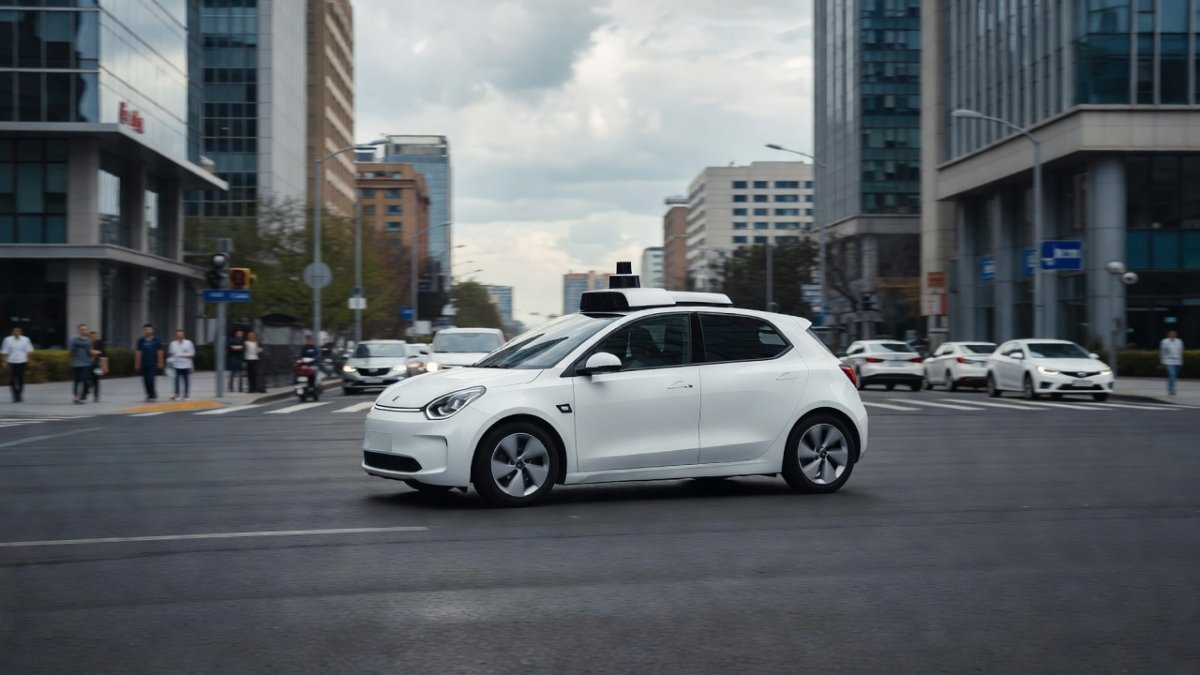
World's Largest Lidar Maker Rides Smart-Car Boom Amid Weak Auto Sales
Shanghai-based Hesai Group, the world's largest maker of lidar sensors, is proving that China's smart-vehicle push can sustain high-tech component suppliers even while the broader car market struggles. The company, which supplies lidar to all of China's top 10 automotive groups, reported a 60 percent jump in second-quarter net income and signalled that demand for its laser-based sensors is accelerating as automakers race to build more intelligent cars.
Tags: Hesai Group, lidar, smart vehicles, China auto market, autonomous driving, ADAS, physical AI, robotics, Pentagon blacklist, US-China relations, China technology, automotive industry
The Numbers Behind the Lidar Surge
Hesai's second-quarter results, reported this month, show the scale of the shift. Net income reached 70.6 million yuan (about US$10.4 million) for the three months ending June 30, up 60 percent from a year earlier, while revenue grew 21 percent to 860.8 million yuan (about US$127 million). Independent earnings trackers confirmed the figures, noting it was Hesai's fifth consecutive quarter of GAAP profitability.
The growth is being driven by rising lidar penetration in China's new-car market. Data from the China Passenger Car Association cited by the South China Morning Post show that 12 percent of new cars priced between 150,000 yuan (US$22,300) and 200,000 yuan were fitted with lidars in 2025, a share that climbed to 27 percent in the first quarter of 2026. Hesai chief financial officer Andrew Fan told the SCMP that orders for the company's sensors this year were higher than in the same period last year, adding: "It is expected that millions of new cars will be equipped with lidars. The growth driver is big enough for us to pursue further expansion."
The contrast with the broader market is stark. Overall car deliveries on the mainland, including petrol-powered and electric vehicles, plunged 21 percent year on year in July to 1.46 million units, according to the same data. Industry trackers such as Automobility have described China's 2026 home market as one of structural transition, with domestic vehicle sales falling roughly 20 percent in the first half against an elevated 2025 base as subsidy-driven demand unwinds.
Why Lidar Is Winning the Smart-Car Technology Race
Lidar, short for light detection and ranging, uses lasers to measure the distance to objects, giving smart cars highly accurate, real-time maps of their surroundings. The technology has become the default choice for Chinese automakers pursuing advanced driver-assistance systems (ADAS) and autonomous driving, in contrast to the camera-only approach championed by Tesla in the United States.
China's dominance in the sector is now well established. Industry research published this year estimated that global automotive lidar shipments surpassed 2.5 million units in 2025, with Chinese vendors accounting for more than 80 percent of supply. Hesai is the market leader, supplying sensors to the top 10 Chinese automotive groups, and it continues to push the technology forward. In April, the company unveiled its 6D full-colour platform, which it says delivers world-leading ranging and small-target identification. The 6D sensors, powered by Hesai's self-developed Picasso system on chip, are now undergoing customer validation.
The competitive landscape has also shifted dramatically. Chinese rivals such as RoboSense have pushed lidar prices below 1,500 yuan per unit at mass-production scale, while Western players have struggled - US-based Luminar filed for bankruptcy protection this year after failing to reach the volumes its cost structure required. For Hesai, the combination of scale, cost reduction and domestic demand has created a moat that is difficult for latecomers to cross, even as it invests heavily in next-generation perception technology.
A Legal Win in Washington Adds a Fresh Twist
The commercial story is being shadowed by a legal battle in the United States. On Wednesday, the US Court of Appeals for the District of Columbia Circuit ordered a lower court to overturn a ruling that had sided with the Department of Defence, remanding Hesai's lawsuit over its designation on the Pentagon's list of Chinese military companies, according to the South China Morning Post.
"We are pleased that the court recognised these fundamental procedural protections," Hesai said in a statement. "Hesai has consistently maintained that it is an independent, publicly traded company focused on developing civilian lidar technology for commercial applications."
The ruling follows a similar development in the parallel case of DJI, China's largest drone maker. Last week the appeals court ordered a lower court to reconsider whether DJI should be removed from the same defence department list, after finding that the lower court had relied on a fully redacted justification. For Japanese readers watching the US-China technology decoupling, the pattern is significant: Washington's blacklisting of Chinese technology champions is being tested in court, and the early rulings suggest procedural scrutiny is tightening.
Beyond Cars: Hesai's Physical AI Ambitions
Hesai is positioning itself as more than an automotive supplier. "We envision turning Hesai into a technology firm, rather than just an automotive supply chain vendor," Fan said. "Our business scope will expand amid further technological innovation."
The company has raised its full-year revenue guidance for its Strategic Growth Initiatives, or SGI, to between 200 million yuan and 300 million yuan, up from a previous forecast of 100 million yuan, reflecting traction in robotics and other non-lidar businesses. Fan said the company would begin delivering its new Kosmo handheld device, described as a "physical AI eye" for capturing and recording spaces in 3D, during the third quarter of this year. The device points to a broader ambition: providing the perception layer not just for cars but for robots, industrial machines and other physical AI systems.
What This Means for Japan and Asia-Pacific Automakers
The Hesai story matters beyond China. Japanese automakers, including Toyota, Honda and Nissan, are accelerating their own smart-driving programmes, and the technology choices they make will shape the regional supply chain for years. Toyota has invested heavily in its Arene software platform and next-generation ADAS, while Honda has pursued "eyes-off" Level 3 systems; both face the same fundamental question Chinese brands have already answered: whether to build around lidar or attempt to match its capabilities with cameras alone.
Japanese suppliers are also watching closely. Lidar was once dominated by Western and Japanese component makers, but the centre of gravity has moved to China, where scale, cost reduction and domestic demand have combined to create a formidable ecosystem. For Japanese trading houses, electronics makers and automakers, the choice is increasingly whether to partner with Chinese perception suppliers or compete against them. The US court ruling adds another layer: if Chinese lidar makers win relief from Pentagon restrictions, their path into Western markets, including Japan-friendly export markets, becomes easier.
What to Watch For
Hesai has guided for third-quarter net revenue of between 1.1 billion yuan and 1.15 billion yuan, implying year-on-year growth of roughly 38 to 45 percent, and investors will be watching whether the momentum continues through the second half. The Kosmo handheld's third-quarter launch will be an early test of the physical AI strategy, and the DC Circuit's remand of the Pentagon designation could produce a pivotal decision on how the US government treats Chinese civilian technology firms.
For Japan and the wider Asia-Pacific region, the underlying trend is the one to track: lidar is moving from a premium feature to a mainstream component in China's smart cars, and that shift is reshaping the region's automotive supply chain. As Chinese automakers push further into Southeast Asia, Australia and beyond, the perception technology under the hood is arriving with them - making Hesai's quarterly numbers a useful barometer for the region's smart-car future.
By Kenji Tanaka, Staff Writer
This article was produced with AI-assisted research and editorial support. Sources: South China Morning Post, kr-asia, Investing.com, Automobility.
What's Your Reaction?
 Like
0
Like
0
 Dislike
0
Dislike
0
 Love
0
Love
0
 Funny
0
Funny
0
 Wow
0
Wow
0
 Sad
0
Sad
0
 Angry
0
Angry
0

Japan Correspondent at Global1.News. Tokyo-based voice covering Japanese politics, technology, economy, and culture. Tracks the intersection of tradition and innovation in one of the world's most dynamic societies.













Comments (0)