
Global Pharma Giants Bet Big on Chinese Biotech Innovation
Global pharmaceutical giants are pouring into Chinese biotech as cross-border drug deals hit a record US$110 billion in H1 2026, reshaping the industry's center of gravity. AstraZeneca's new joint venture with CSPC and a recovering Hong Kong IPO market signal a structural shift in how the world b...
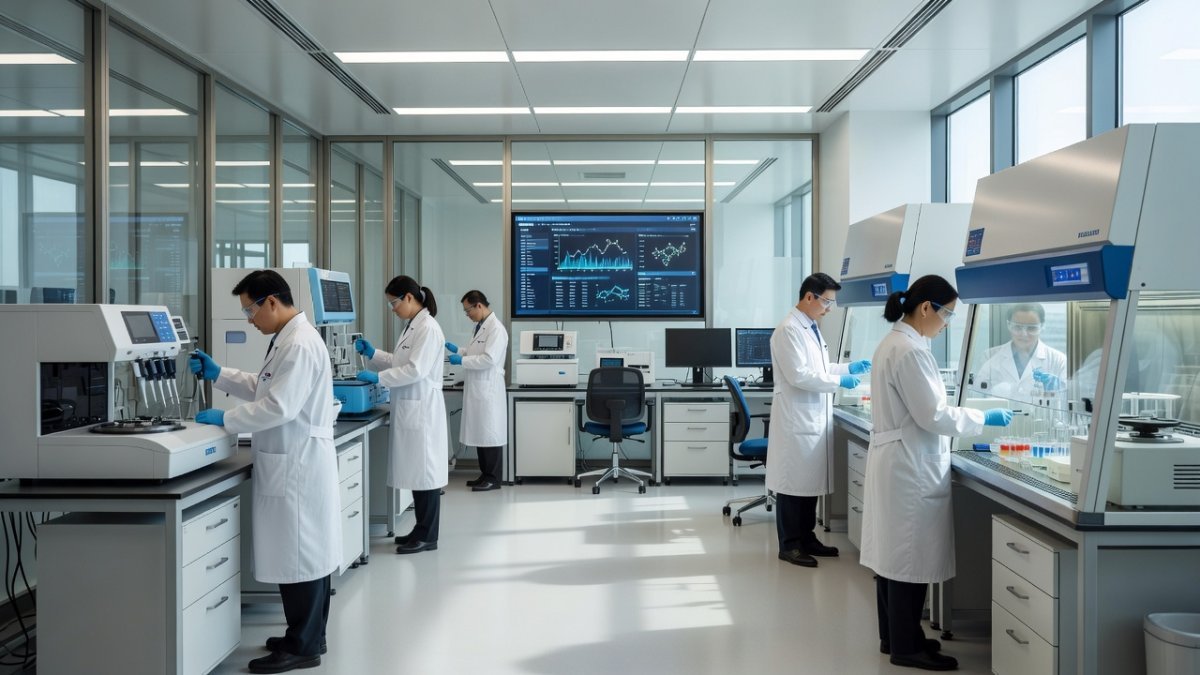
Global Pharma Giants Turn to China for the Next Generation of Drugs
HONG KONG — Global pharmaceutical companies are doubling down on investment in China's fast-growing biotech sector, drawn by its innovation pipeline and deep room for valuation growth, according to executives and investors gathered at the Global Health Summit, which concluded in Hong Kong on Saturday.
Tags: China biotech, AstraZeneca CSPC joint venture, pharmaceutical deals, China drug innovation, Global Health Summit, Hong Kong biotech IPO, Takeda Innovent, cross-border drug licensing, Chinese pharma valuation, healthcare investment Asia
The Record Deal Flow: US$110 Billion in Six Months
The scale of the shift is visible in the deal data. Cross-border deals for innovative drugs reached a record US$110 billion in the first half of 2026, according to state media, equal to about 80 per cent of the full-year total for 2025. The surge spans 81 separate out-licensing agreements, with Chinese developers selling or co-developing drug candidates with foreign partners at an unprecedented pace.
"China has become an important global source of innovation in pharmaceutical deal making," said Jiang Yu, chairman of Huatai United Securities, speaking at the summit. The H1 figure puts China on track to shatter last year's benchmark, a sign that the country's biotech pipeline — built over a decade of state funding, returnee talent, and venture capital — has matured into a commercial asset global companies are willing to pay for.
AI-powered drug discovery is accelerating the trend. Chinese developers have adopted artificial intelligence tools across target identification and molecule design, and analysts say AI-generated candidates are driving a growing share of new cross-border collaborations. The combination of a deep clinical-trial infrastructure, a large patient pool, and comparatively lower development costs gives Chinese biotechs a structural edge in moving candidates from laboratory to clinic quickly.
AstraZeneca and CSPC: A Flagship Manufacturing Bet
One of the week's clearest signals came on Wednesday, when AstraZeneca announced it had established a joint venture with CSPC Pharmaceutical Group to build a drug manufacturing site in Shijiazhuang, capital of Hebei province. Under the deal, AstraZeneca holds a 49 per cent stake while CSPC owns the remaining 51 per cent, according to China Daily and industry reports. The initial phase will focus on manufacturing and supply of products for the global market, with plans to expand the product line later.
The arrangement inverts the old model of foreign drugmakers building wholly owned plants to serve Chinese patients. Here, a British multinational is pairing with a domestic developer to produce medicines for export — evidence that China is being integrated into global supply chains as a manufacturing base, not just a market.
A Strategic Pivot: From Asset-Heavy to Innovation-Linked
Executives at the summit described the investment wave as a structural change in how multinationals operate in China. "Multinational pharmaceutical companies are shifting their business strategies in China away from asset-heavy operations," said Xu Chenming, head of the healthcare group at Hong Kong-based Citic Securities. "They are moving towards investing in companies with strong innovation capability, as well as deeper integration with Chinese partners."
That integration increasingly takes the form of joint ventures and licensing pacts rather than acquisitions. In May, Swedish wound care and surgical products provider Mölnlycke formed a joint venture with Zhejiang province-based Zhende Medical to combine business portfolios and co-develop future products. The pattern repeats across therapeutic areas: global firms keep their balance sheets light, plug into Chinese R&D, and share the upside of development.
The shift reflects a hard commercial reality. Patent expirations on blockbuster drugs are creating revenue gaps across the industry, and Western pipelines are not filling them fast enough. Chinese biotechs, which once licensed Western drugs for the domestic market, have reversed roles: they now supply candidates outward, often keeping China rights while granting global partners ex-China development and commercialisation rights. That structure lets both sides win — the Chinese developer retains its home market, and the multinational gains a de-risked shot at a global launch.
The Valuation Gap That Draws Capital East
Underpinning the strategy is a yawning valuation gap between Chinese and American healthcare companies. Among mainland-listed healthcare companies, only four are worth more than US$20 billion, accounting for just 18 per cent of the sector's total market capitalisation, according to Jiang. By contrast, 73 US healthcare companies exceed that threshold, representing 85 per cent of market cap.
For foreign investors, that gap represents both risk and opportunity: Chinese drug developers trade at fractions of their US peers despite comparable pipelines in oncology, immunology, and metabolic disease. For multinationals, early-stage partnerships with Chinese biotechs offer optionality — access to promising molecules at valuations that would be unattainable at home.
Hong Kong Re-emerges as the Capital Bridge
Hong Kong is positioning itself as the financial conduit for the boom. Investor appetite for HK-listed biotech and healthcare stocks has improved over the past two years, Xu said, with the Hong Kong capital market making "a full recovery". Leung Chuen-yan, a partner for healthcare investment at Value Partners Group, said investors in biotech IPOs in Hong Kong are "increasingly international", with a growing number of multinational corporations acting as cornerstone investors.
Deloitte data underscores the rebound: Hong Kong's healthcare and drug sector saw 11 companies raise a total of HK$14.1 billion (US$1.8 billion) in initial public offerings during the first half of the year, with pre-profit biotech listings rising to seven from six a year earlier. The city's listing regime — which permits pre-revenue biotech companies — remains the preferred exit route for Chinese drug developers, and the pipeline of candidates is growing as global capital returns.
Japan and Asia-Pacific: Neighbours Watch, Then Move
The trend is not lost on Japan, home to the region's most established pharmaceutical industry. Takeda Pharmaceutical's sweeping oncology collaboration with Innovent Biologics, announced in October 2025 with a potential value of up to US$11.4 billion, remains the largest business development deal ever recorded in China's pharmaceutical sector. It included an upfront payment of US$1.2 billion and rights to two late-stage cancer therapies.
Japanese drugmakers, facing their own patent cliffs and a domestic market constrained by government price cuts, are increasingly treating Chinese biotech as a sourcing ground for molecules — the same calculus driving their Western peers. For Tokyo, the strategic question is whether Japan's pharma champions will compete for the next generation of Chinese assets, or partner early enough to shape them.
What to Watch For
The US$110 billion first-half figure points to a full-year record, but the durability of the deal flow will be tested by geopolitics. Washington's scrutiny of Chinese biotech — from the Biosecure Act debate to last week's court ruling on WuXi AppTec's "Chinese military company" designation — creates regulatory overhang that could slow some transactions. Beijing, for its part, has signalled continued support for innovative drug development, and Chinese companies are establishing overseas footprints to de-risk their exposure.
For investors and executives watching the sector, the coming quarters will reveal whether the current wave is a cyclical spike or the new normal. The signals from Hong Kong — record deal values, international cornerstone investors, and a recovering IPO market — suggest the latter. As global drugmakers integrate Chinese innovation into their pipelines, the centre of gravity in pharmaceutical deal making has shifted east, and it is not moving back.
By Kenji Tanaka, Staff Writer
This article was produced with AI-assisted research and editorial support. Reporting is based on sources cited in the article.
What's Your Reaction?
 Like
0
Like
0
 Dislike
0
Dislike
0
 Love
0
Love
0
 Funny
0
Funny
0
 Wow
0
Wow
0
 Sad
0
Sad
0
 Angry
0
Angry
0

Japan Correspondent at Global1.News. Tokyo-based voice covering Japanese politics, technology, economy, and culture. Tracks the intersection of tradition and innovation in one of the world's most dynamic societies.













Comments (0)