
Glacial Collapse on Nepal-Tibet Border Exposes the New Geopolitics of Himalayan Disaster
The catastrophic glacial collapse that tore through the Nepal-Tibet border region on Wednesday, killing at least 547 people and leaving nearly 1,000 unaccounted for, is more than a humanitarian tragedy.
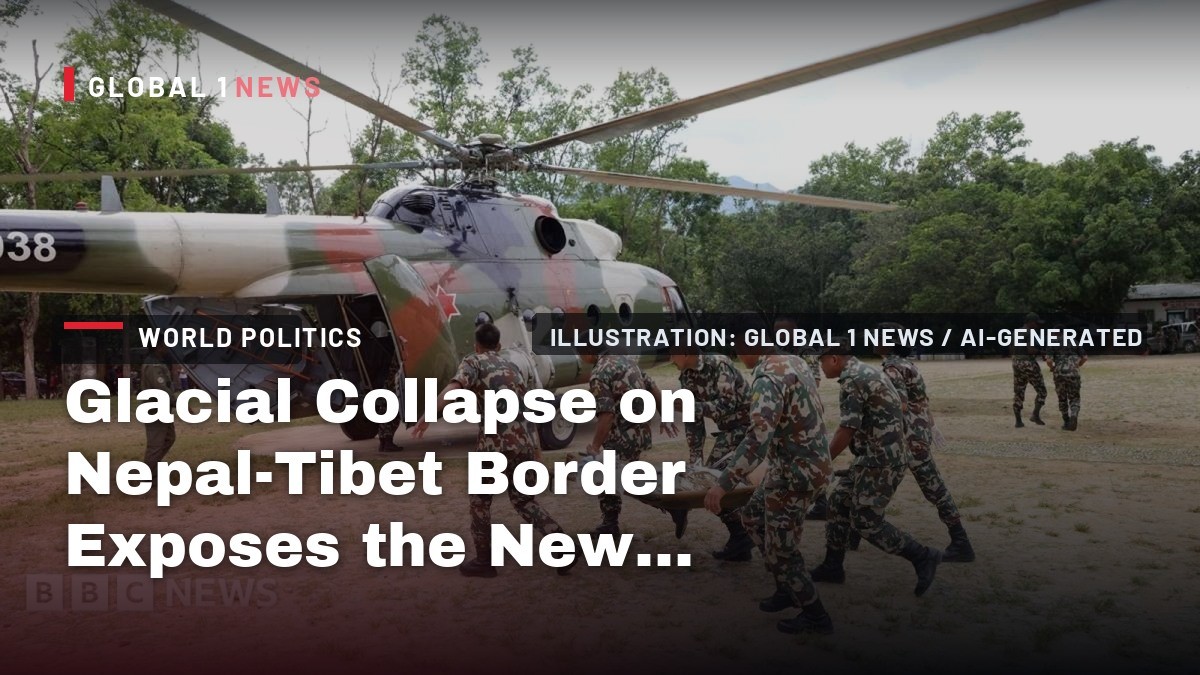
The catastrophic glacial collapse that tore through the Nepal-Tibet border region on Wednesday, killing at least 547 people and leaving nearly 1,000 unaccounted for, is more than a humanitarian tragedy. It is a stark geopolitical event that has thrust the fragile trans-Himalayan relationship between Beijing and Kathmandu into a high-stakes test of disaster diplomacy. As rescue teams race against time in the debris-choked valleys of the Trishuli and Bhote Koshi rivers, the disaster has laid bare the acute vulnerability of cross-border infrastructure, the accelerating risks of climate change in the world's highest mountain range, and the complex strategic calculus involving a watchful India.
The event, confirmed by the US Geological Survey (USGS) as a "glacial collapse" rather than an initial earthquake, sent a wall of mud, rock, and water travelling some 62 miles (100km) downstream. The sheer force of the collapse registered a magnitude of 5.2 on seismic instruments, underscoring the immense energy released when a glacier disintegrates. For Beijing, the disaster strikes at the heart of its ambitious Belt and Road Initiative (BRI) connectivity projects in the region, while for Nepal, it highlights the existential risks of its dependence on northern trade routes and its position between two Asian giants.
A Test of Disaster Diplomacy Between Beijing and Kathmandu
The immediate response from both capitals has been framed around coordination and mutual support, but the undertones are deeply strategic. Nepal's Prime Minister Balendra Shah stated that "the entire nation has been left shocked and deeply distressed," and confirmed that officials would coordinate with China on the response. This coordination is not merely humanitarian; it is a political necessity for a government that has increasingly pivoted towards Beijing for infrastructure investment and trade access.
China's Premier Li Qiang arrived in Gyirong on Thursday to supervise rescue operations, marking a significant high-level political commitment. Gyirong Port, the main crossing point for tourists and traffic between the two nations, was itself hit by the floodwaters, with deaths reported in Tibetan villages. President Xi Jinping has urged an "all-out" search and promised stronger monitoring and early warning systems. For Beijing, this is an opportunity to demonstrate reliability as a partner in times of crisis, countering narratives that its infrastructure projects in Nepal are environmentally reckless or unsafe. The promise of enhanced early warning systems is a direct signal to Kathmandu that China intends to be a long-term security and development partner in the region, not just a financier of roads and ports.
The Strategic Vulnerability of Cross-Border Infrastructure
The flood's destruction of the Rasuwagadhi Border checkpoint and damage to Gyirong Port is a critical blow to the economic lifeline connecting Nepal to China. This route, part of the China-Nepal Trans-Himalayan Multi-Dimensional Connectivity Network, is a cornerstone of Nepal's efforts to reduce its economic dependence on India. The Bhote Koshi River valley hosts a series of hydropower projects, including the Upper Bhote Koshi dam, which are vital to Nepal's energy security and its ambition to become a regional energy exporter.
The disaster has exposed a fundamental flaw in the rapid infrastructure build-out across the Himalayas: the assumption of geological stability. The glacial collapse and the risk of landslide-dam formation on the Trishuli River demonstrate that these mega-projects are operating in an increasingly volatile environment. The International Centre for Integrated Mountain Development (ICIMOD) has warned of secondary flooding risks, and China has flagged a "high risk" that a newly formed lake may burst its banks. For Beijing, the destruction of this flagship connectivity route is a strategic setback, forcing a reassessment of engineering standards and risk management in its BRI projects. The question now is whether China will double down with "climate-resilient" reconstruction or face growing criticism from Kathmandu about the safety of its investments.
Himalayan Climate Risk: A Threat Multiplier
While scientists caution against definitively linking this single event to climate change, the context is unambiguous. The Hindu Kush Himalaya region is warming faster than the global average, driving accelerated glacier melt and permafrost degradation. Geologist Daniel Shugar noted that glacial thinning caused by global warming could increase the risk of landslides, while Simon Cook of the University of Dundee pointed to thawing permafrost as a key destabilising factor. Cook's team identified the collapse site near the Langtang Lirung peak, approximately 15km west of the flood's origin.
This is not an isolated incident but a harbinger of a new normal. The region is becoming a theatre of cascading climate risks, where a single glacial event can trigger a chain reaction of flooding, infrastructure failure, and mass displacement. For China, which controls the Tibetan side of the border, this represents a direct threat to its territorial stability and its claims of environmental stewardship. Beijing's promise of "stronger monitoring" is an acknowledgment that it must invest heavily in high-altitude early warning systems, not just for Nepal's benefit, but to protect its own citizens and strategic assets in Tibet. The disaster reframes climate change not as a distant environmental issue, but as an immediate national security concern for both China and Nepal.
India's Humanitarian Overture and Strategic Caution
The disaster has inevitably drawn in India, Nepal's other giant neighbour. Prime Minister Narendra Modi's offer of "all possible types of humanitarian assistance" is a carefully calibrated move. With 178 Indian nationals reported missing, New Delhi has a direct humanitarian stake in the rescue efforts. However, the strategic subtext is significant. India has long viewed Nepal's growing economic integration with China with suspicion, particularly regarding hydropower and connectivity projects that could be used for dual-use purposes.
By offering aid, India is seeking to reassert its traditional influence in Kathmandu, positioning itself as a first responder in times of crisis. This is a classic geopolitical play: demonstrating reliability and goodwill to counterbalance China's growing footprint. Yet, India must also be cautious. The disaster zone is close to the sensitive tri-junction of Nepal, India, and China, and any perceived interference in Nepal's internal affairs or its relationship with Beijing could backfire. New Delhi's response is therefore likely to be generous but discreet, focusing on practical relief while avoiding any overt commentary on China's infrastructure projects. The second-order effect is that Nepal now has a unique opportunity to leverage this tragedy to extract more favourable terms from both its neighbours, playing the humanitarian card to secure additional aid and investment.
The Global South and the Politics of Climate Liability
This disaster is a potent symbol for the Global South's climate justice agenda. The Hindu Kush Himalaya region, often called the "Third Pole," is a shared resource for over a billion people downstream, yet the countries most affected—Nepal and China's Tibet—are not the primary emitters of greenhouse gases. The tragedy provides fresh ammunition for developing nations to argue that they are bearing the brunt of a crisis they did not create. For China, which positions itself as a leader of the Global South, this is a delicate balancing act. It must be seen as a responsible actor mitigating climate risks at home and in its neighbourhood, while also advocating for the principle of common but differentiated responsibilities in international climate negotiations.
The international response, including the UN's mobilisation of supplies and the US pledge of $500,000, highlights the global nature of the crisis. However, the scale of the disaster—with over 500 foreign nationals missing, including tourists from India, China, the US, UK, and Ukraine—transforms this from a regional issue into an international consular and humanitarian emergency. The presence of so many foreign nationals in the disaster zone underscores the region's importance as a global tourism destination, but also its fragility. For Nepal, the loss of these tourists is an economic catastrophe that will reverberate for years, potentially deterring the high-value mountaineering and pilgrimage traffic that is a cornerstone of its economy.
Rescue Operations and the Race Against Time
The immediate priority remains the rescue of survivors, but the window is closing rapidly. Brigadier General Rajaram Basnet, a spokesman for Nepal's army, told the BBC that rain and unpredictable weather are making operations increasingly challenging. The suspension of rescue operations on Friday due to the overflow of a newly formed lake highlights the volatile conditions. The list of missing is staggering: 44 members of the Nepali army and 28 police officers are unaccounted for, alongside hundreds of civilians and foreign tourists. The Nepali government has released a list of over 500 foreign nationals out of contact, including 33 UK nationals, 65 US tourists, and 53 Ukrainians.
The logistical challenge is immense. The floodwaters have swept away roads and bridges, isolating communities and hampering the movement of heavy equipment. The risk of secondary flooding from landslide dams means that rescue teams are operating in a highly dangerous environment. China's warning about the lake at the confluence of the Chhochen Khola and Purepu Tsangpo rivers adds another layer of urgency. The coordination between Nepali and Chinese authorities on this specific threat will be a test of their disaster diplomacy in real-time. If a second flood occurs, the death toll could rise dramatically, and the political fallout for both governments would be severe.
Strategic Implications for the Region and Beyond
The long-term strategic implications of this disaster are profound. For China, the event is a stark reminder that its BRI investments in Nepal are exposed to catastrophic natural risks. Beijing will likely respond with a massive reconstruction effort, but it will also demand higher standards of environmental and geological assessment. This could slow down future projects, as Chinese engineers and financiers become more risk-averse. For Nepal, the disaster is a national trauma that will force a fundamental rethink of its development model. The country cannot afford to abandon its northern connectivity ambitions, but it must now demand that China incorporate climate resilience into every aspect of its infrastructure.
The geopolitical balance in South Asia is also shifting. India's offer of aid, China's high-level rescue supervision, and the involvement of Western nations in consular efforts create a complex web of competing influences in Kathmandu. Nepal's government will have to navigate this carefully, extracting maximum support while maintaining its sovereignty. The disaster also has implications for the broader Himalayan region, including Bhutan and the Indian states of Sikkim and Arunachal Pradesh, which face similar glacial risks. The lessons learned from this tragedy will likely inform regional cooperation on early warning systems and disaster risk reduction, potentially creating new avenues for dialogue between China and India, who are otherwise locked in a border standoff.
In conclusion, the glacial flood on the Nepal-Tibet border is a watershed moment. It has transformed the abstract concept of climate change into a tangible, deadly reality for the region. It has tested the resilience of China-Nepal relations, exposed the vulnerabilities of cross-border infrastructure, and forced a recalibration of strategic postures in New Delhi and Beijing. As the rescue efforts continue and the full scale of the tragedy becomes clear, the world is watching how these nations respond. The decisions made in the coming weeks will not only determine the fate of the survivors but will also shape the geopolitical landscape of the Himalayas for decades to come.
By Prof. Marcus Chen, Staff Writer
This article was produced with AI-assisted research and editorial support. Sources: BBC News, 28 August 2026.
What's Your Reaction?
 Like
0
Like
0
 Dislike
0
Dislike
0
 Love
0
Love
0
 Funny
0
Funny
0
 Wow
0
Wow
0
 Sad
0
Sad
0
 Angry
0
Angry
0

World Politics Analyst at Global1.News. Based in Beijing, covering US-China relations, global trade, and geopolitical strategy. Brings deep analytical perspective to the power dynamics shaping international affairs.













Comments (0)