
German police fire water cannon during tense ‘Gen Z’ protests
German police resorted to water cannons on Saturday to disperse demonstrators hurling fireworks, marking a stark escalation in a series of youth‑led protests that have swept across the country in recent weeks.
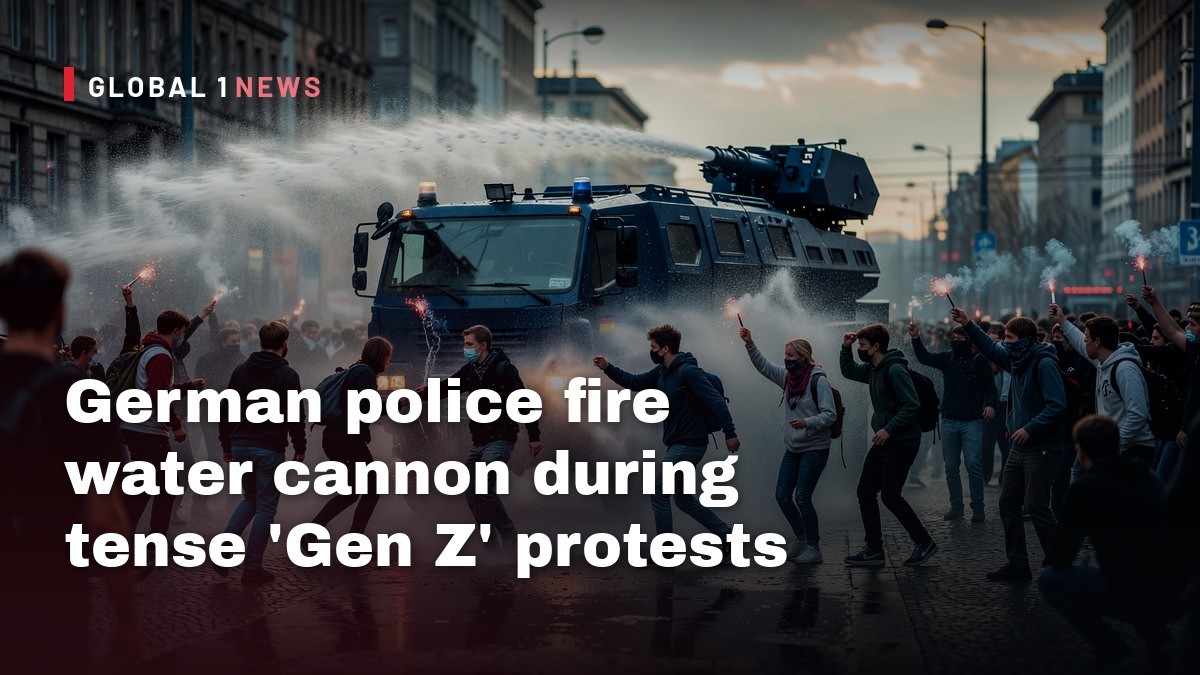
German police resorted to water cannons on Saturday to disperse demonstrators hurling fireworks, marking a stark escalation in a series of youth‑led protests that have swept across the country in recent weeks. The confrontations, which unfolded in Berlin, Frankfurt, Cologne and dozens of other cities, were organized by the group “GenZ regelt!” – a slogan that translates to “GenZ has got this.” While the majority of the demonstrations remained peaceful, the evening saw a surge in tension as police units were pelted with various projectiles, prompting a forceful response that underscores the volatile atmosphere surrounding Europe’s newest wave of disillusioned youth activism.
Origins of the “GenZ regelt!” movement
The protests organized by “GenZ regelt!” are part of a broader pattern of youth mobilization that has been gaining momentum across Europe. Participants have drawn inspiration from similar movements in France and Italy, where young people have also taken to the streets to voice dissatisfaction with the status quo. Although the specific grievances driving the German protests have not been detailed in the source material, the reference to “disillusioned youth” suggests a shared sense of frustration with political, economic or social conditions that resonate throughout the continent.
In Germany, the movement appears to be coordinated through a network of local groups that have mobilized thousands of demonstrators in multiple cities simultaneously. The use of a unifying slogan – “GenZ regelt!” – functions as both a rallying cry and a branding tool, reinforcing a collective identity among participants. This branding mirrors tactics seen in other European protests, where clear, catchy slogans help sustain momentum and attract media attention.
Scale and deployment of police forces
Authorities responded to the protests with a substantial police presence, deploying thousands of officers across the nation. This large‑scale deployment reflects the seriousness with which German officials view the potential for unrest, especially given the protests’ spread across major urban centers such as Berlin, Frankfurt and Cologne. The decision to allocate such resources indicates a precautionary approach aimed at maintaining public order while allowing the demonstrations to proceed.
The presence of a significant police force also suggests that German authorities anticipated the possibility of escalation, a concern that proved prescient as the evening unfolded. While most of the protests remained peaceful, the sheer number of officers on the ground underscores the delicate balance between safeguarding civil liberties and preventing disorder.
Escalation and the use of water cannons
The turning point of Saturday’s demonstrations came when police units were confronted with fireworks and other projectiles. In response, officers employed water cannons to disperse the crowd. The decision to use water cannons, a method typically reserved for more intense confrontations, signals an escalation in tactics that is noteworthy for several reasons. First, it demonstrates the authorities’ willingness to adopt forceful measures when faced with direct threats to public safety. Second, it highlights the intensity of the protesters’ actions, as the throwing of fireworks represents a significant escalation from peaceful chanting or marching.
Water cannons have a contentious history in crowd control, often criticized for their potential to cause injury and for the psychological impact they have on demonstrators. Their deployment in this instance underscores the heightened tension that can arise when youthful dissent meets a robust law‑enforcement response. The use of such force may influence public perception of both the protest movement and the state’s handling of civil unrest.
Geographic spread of the protests
The protests were not confined to a single metropolis but unfolded in a wide array of locations, including Berlin, Frankfurt, Cologne and numerous other cities. This geographic dispersion indicates a coordinated effort that transcends regional boundaries, suggesting that the grievances motivating “GenZ regelt!” resonate broadly across German society. The simultaneous nature of the demonstrations also placed considerable strain on police resources, as forces had to be allocated across multiple hotspots.
Each city’s experience of the protests varied, with most maintaining a largely peaceful atmosphere until the evening surge in tension. The uniformity of the protests’ core elements—such as the use of the “GenZ regelt!” slogan and the presence of fireworks—points to a shared playbook among organizers, likely facilitated through digital communication channels that enable rapid coordination across distances.
Comparative perspective: French and Italian youth movements
The source material notes that German demonstrators have been inspired by similar movements in France and Italy. While the specifics of those foreign protests are not detailed, the reference suggests a transnational diffusion of protest tactics and rhetoric among European youth. In France, recent youth activism has centered on issues such as climate policy and labor reforms, while Italian demonstrations have often focused on economic inequality and governmental accountability. These thematic parallels may inform the underlying motivations of German protesters, even if the exact issues differ.
Cross‑border inspiration highlights the interconnected nature of contemporary activism, where digital platforms enable rapid sharing of strategies, slogans and visual symbols. The “GenZ regelt!” movement’s alignment with broader European trends may amplify its visibility and lend it a sense of legitimacy among young people who see themselves as part of a larger continental wave of dissent.
Implications for German public order policy
The events of Saturday raise important questions about how German authorities will manage future youth‑led protests. The deployment of water cannons, while effective in dispersing a crowd throwing fireworks, may provoke criticism from civil‑rights advocates who argue that such force is disproportionate. Balancing the need for public safety with the protection of the right to peaceful assembly will likely become a focal point of public debate.
Furthermore, the scale of the police deployment suggests that the government anticipates continued activism from the “GenZ regelt!” movement. This anticipation may lead to a reassessment of crowd‑control protocols, training for officers in de‑escalation techniques, and possibly the development of new legislative frameworks governing protest activities. How the state navigates these challenges will shape the trajectory of youth activism in Germany for the coming months.
Future outlook for “GenZ regelt!” and European youth activism
Looking ahead, the “GenZ regelt!” protests are likely to persist as long as the underlying sense of disillusionment among European youth remains unaddressed. The ability of the movement to sustain momentum will depend on its capacity to translate street demonstrations into concrete policy demands and to maintain public sympathy despite occasional confrontations with law enforcement.
Given the pattern of inspiration drawn from French and Italian counterparts, it is plausible that future actions will see further escalation in tactics, possibly incorporating more sophisticated forms of digital mobilization or broader coalition‑building with other social groups. The response of German authorities—whether through dialogue, reform or heightened security measures—will be a decisive factor in shaping the next phase of this generational contest over the future of European societies.
This article was produced with AI-assisted research and editorial support. Reporting is based on the source material cited below. Sources: South China Morning Post; scmp.com; Global1.News (01 November 2026).
By Kenji Tanaka, Staff Writer
What's Your Reaction?
 Like
0
 Dislike
0
 Love
0
 Funny
0
 Wow
0
 Sad
0
 Angry
0

Japan Correspondent at Global1.News. Tokyo-based voice covering Japanese politics, technology, economy, and culture. Tracks the intersection of tradition and innovation in one of the world's most dynamic societies.











Comments (0)