
Food Safety Crisis: Child Dies in Surat, 38 Ill in Kullu
A five-year-old girl dies in Surat after a restaurant meal, 38 students are hospitalised in Kullu after midday-meal kheer, and up to 40 fall ill in Nalanda, as a week of food-safety failures exposes India's reactive enforcement and FSSAI cracks down on misleading '100 percent' labels.
The convergence of three separate food-safety failures across Gujarat, Himachal Pradesh, and Bihar within a single 72-hour window has exposed the systemic fragility of India's food supply chain—from high-end restaurant kitchens in urban Surat to the government-subsidised midday meal kitchens in rural Kullu and Nalanda. The death of a five-year-old girl in Surat and the hospitalisation of nearly 80 schoolchildren in two states have forced a reckoning with enforcement gaps that persist despite the existence of the Food Safety and Standards Act, 2006.
These incidents are not isolated anomalies but symptoms of a regulatory apparatus that remains reactive rather than preventive. As the Food Safety and Standards Authority of India (FSSAI) simultaneously escalates its war on misleading "100 percent" label claims, the contrast between corporate compliance and ground-level chaos could not be starker.
Full Article: Three States, One Crisis — The Anatomy of India's Food Safety Breakdown
New Delhi, Aug 21, 2026 — The numbers are stark. One child dead, 38 students hospitalised in Himachal Pradesh, 34 to 40 more in Bihar, and 208 restaurants flagged for hygiene violations in a single Gujarat city within 24 hours. This is the toll of a week that began with a family dinner in Surat and ended with the FSSAI issuing corrective orders to six major food companies. The thread connecting these events is a simple, devastating truth: India's food safety framework is failing precisely where it matters most—at the point of consumption.
The Surat Tragedy: A Family Meal, A Fatal Outcome
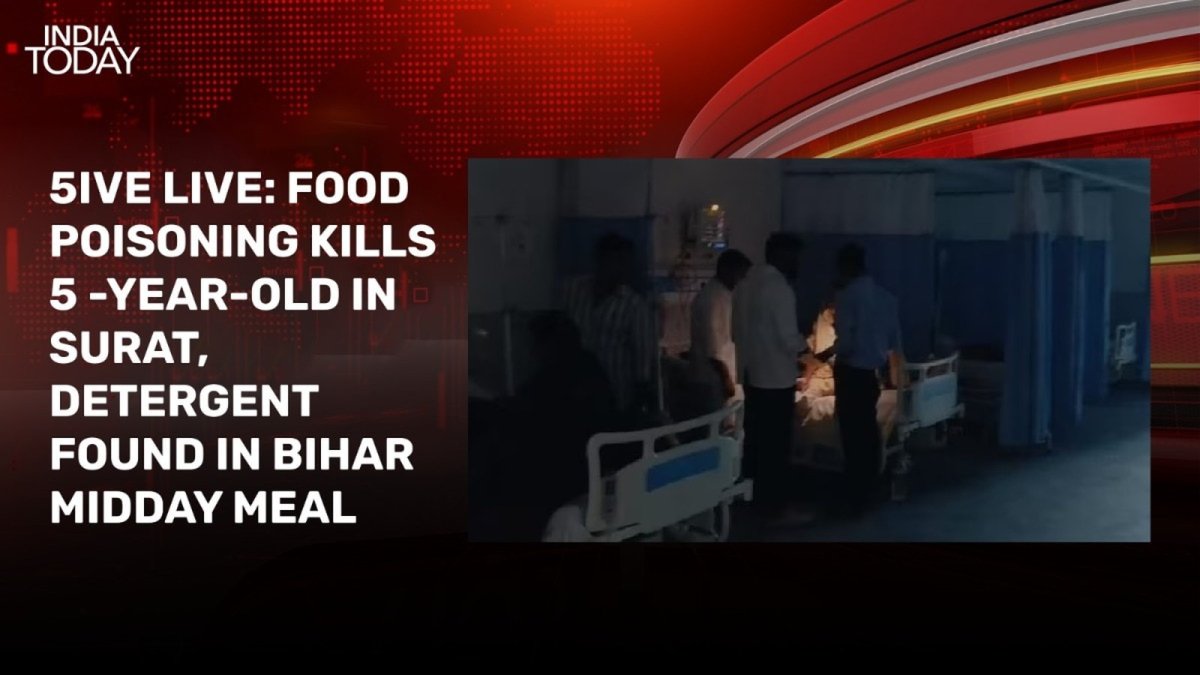
On the night of August 15, five-year-old Arya Kalsaria sat down with her parents and two sisters to a meal ordered from Sheetal Restaurant in Surat's Matavadi/Varacha area. The order included Punjabi dishes, notably a paneer-cashew (kaju paneer) preparation. By the morning of August 16, all five family members were vomiting and suffering severe stomach pain. The family consulted a general practitioner who advised immediate hospital admission; they initially declined. On August 17, Arya lost consciousness and was rushed to Sadvichar Hospital, where doctors declared her dead. Her four family members remain hospitalised, reportedly in critical condition, as a post-mortem examination seeks to establish the exact cause of death.
The Surat Municipal Corporation (SMC) responded with unusual speed. Sheetal Restaurant was sealed after inspectors found "lapses in cleanliness and kitchen hygiene," and samples of ready-to-eat food and raw materials were collected for laboratory testing. But the response did not stop at one establishment. In a sweeping 24-hour drive, SMC teams inspected 330 restaurants across the city's nine municipal zones. The findings were damning: 208 establishments—nearly two-thirds—had health or hygiene deficiencies. The SMC issued notices and collected fines totalling Rs 4,70,500. More significantly, inspectors destroyed 1,641 kg of inedible and suspected food and shut down 17 establishments found violating Schedule 4 requirements of the FSSAI guidelines.
Food Safety Officer B R Brahmbhatt confirmed that separate teams were formed for each municipal zone and that inspections would continue across restaurants and food carts, intensifying ahead of Raksha Bandhan, Janmashtami, and Diwali—festivals when sweet and food consumption spikes dramatically. Gujarat Health Minister Praful Pansheriya reviewed the situation via video conference with District Health Officer Dr Anil Patel and SMC's Medical Health Officer P H Umrigar, speaking directly to doctors and the girl's family. The violations catalogued—poor kitchen hygiene, unclean crockery, absence of grease chambers, inadequate food storage, and workers without medical certificates—paint a picture of an industry operating far below legal minimums.
Kullu's Kheer: 38 Children, One Communal Kitchen, Zero Accountability
On Tuesday, August 18, at Bari Primary School in the Manali subdivision of Kullu district, Himachal Pradesh, 38 students fell ill after consuming kheer served as part of the midday meal. The school has 51 students; 39 were present that day. All 39 who ate the kheer fell ill. By 7 pm, 38 children were admitted to the Community Health Centre (CHC) at Patlikuhal, with symptoms including dizziness, fainting, vomiting, and diarrhoea. Several children were found semi-conscious outside the school between 4 and 5 pm—after school had closed at 4 pm—suggesting a rapid deterioration that began just 1 to 1.5 hours after the kheer was served around 1 pm.
Two children were referred to the Regional Hospital in Kullu on the first day, with three more referred the next day. By Wednesday, August 19, 15 of the 39 children had been discharged, with officials stating all were out of danger. The doctor at the CHC said the cases appeared to be food poisoning, with contaminated water and milk quality also suspected. The exact cause will only be established after food-sample testing is completed. The inquiry, led by the Manali Sub-Divisional Magistrate (SDM), has collected samples of the ration ingredients used to prepare the kheer. Additional District Magistrate Surjit Singh Rathore confirmed samples were being tested.
The political response was immediate. Education Minister Rohit Thakur stated, "I have sought a report from the director of education on the incident. The district administration had started an inquiry." Former education minister and former Manali MLA Govind Singh Thakur demanded a magisterial inquiry, saying, "While the aim is not to blame but it is crucial to determine the exact cause of the children's illness." Sitting Manali MLA Bhuvneshwar Gaur visited the hospital, where parents demanded that food, water, and milk samples be tested. The question that hangs over Kullu is the same one that hangs over every midday meal kitchen in India: who is accountable when the system fails?

Bihar's Detergent Horror: Nalanda's Midday Meal Failure
Just days before the Kullu incident, on Tuesday August 18, at Parsa/Parasi Middle School in the Noorsarai police station area of Nalanda district, Bihar, 34 to 40 students fell ill after detergent powder was reportedly served instead of salt in the midday meal—rice with potato-soybean vegetable. Children complained of burning sensations in their throats and stomach pain, with several collapsing and some losing consciousness. They were rushed to the government hospital in Biharsharif.
The response was swift and punitive. An FIR was registered under the Bharatiya Nyas Sanhita (BNS) Sections 286 (rash conduct involving poisonous substance), 109(1) (attempt to murder), and 123 (causing hurt by poison) on the complaint of the school headmaster. Nalanda District Education Officer Hemchandra suspended headmaster Shailendra Kumar Singh and dismissed the three cooks. The midday meal was supplied by the Ekta Shakti Foundation from a centralised kitchen at Ramghat in Nagarnausa—a kitchen that provides meals daily to approximately 23,000 children across 206 schools (123 in Chandi block, 76 in Nagar Nausa, and 7 in Noorsarai). Nalanda MLA and Rural Development Minister Shrawon Kumar visited the children in hospital.
This is not an isolated event. On May 7, 2026, over 150 children fell ill after a midday meal at a middle school in Baluaha village, Saharsa district, after a baby snake was reportedly found in the meal. The pattern is consistent: centralised kitchens, inadequate supervision, and catastrophic failures in basic food handling. The question of how detergent powder ends up in a school meal is not a question of logistics—it is a question of accountability. When cooks are dismissed and headmasters suspended, the structural failures that allowed such negligence to occur remain untouched.
FSSAI's Parallel War: The "100 Percent" Label Crackdown
While state authorities scramble to contain the fallout from these incidents, the FSSAI is waging a different battle—against corporate misinformation. On Wednesday, the food regulator announced that six food business operators had taken corrective steps after being flagged for misleading "100 percent" claims on labels and advertisements. The list reads like a who's who of Indian consumer brands: Amway India (removed "100% Pure Coconut Oil" claim from packaging and promotional material, discontinuing older stock), Emami (Zhandu Honey "100 per cent" claim), Bonn Biscuits (removed "100%" claim for Bonn Cummin Flavor Jeera Bite Biscuits 76 gm from its website), Apis India (honey products), Kerala-based Juza Foods (baby food products), and Masterchow Foods (Ramen Noodle product).
This enforcement action, taken under the Food Safety and Standards (Advertising and Claims) Regulations, 2018, follows earlier actions against Dabur India, which received a prohibition order over "100%" claims—a move that saw its share price fall 4 percent. Dabur has challenged the order in the Delhi High Court, contesting a June 2024 notification requiring food business operators to stop marketing reconstituted fruit juices as "100 per cent fruit juice." Ferns N Petals also corrected issues after notices. The FSSAI has simultaneously escalated enforcement in the energy drink and alcoholic beverage sectors.
The contrast is instructive. On one hand, the FSSAI is pursuing multinational and large domestic corporations for label semantics—claims that, while misleading, do not typically cause acute illness. On the other hand, state enforcement agencies are struggling to prevent detergent from being served to schoolchildren and restaurant kitchens from operating without basic hygiene. The regulatory bandwidth is being consumed by corporate compliance while the ground-level crisis deepens.
PM POSHAN: The World's Largest School Feeding Programme Under Strain
These incidents occur against the backdrop of PM POSHAN (Poshan Shakti Nirman)—formerly the Mid-Day Meal scheme—which provides a hot cooked meal to 11.8 crore (118 million) school children daily in classes 1-8 across government and government-aided schools, including Bal Vatika. It is the world's largest school feeding programme. The scheme includes fortified rice, with states and Union Territories implementing it while the Centre shares costs. The Food Safety and Standards Act 2006 and FSSAI govern food safety, with state food safety commissioners and local bodies—municipal corporations and panchayats—responsible for enforcement in eateries and school kitchens.
The scale of PM POSHAN is both its strength and its vulnerability. When 11.8 crore children eat a centrally-procured meal daily, the margin for error is zero. Yet the errors keep coming. In Kullu, a school with 51 students could not ensure the safety of its kheer. In Nalanda, a centralised kitchen serving 23,000 children could not prevent detergent from entering a meal. The common denominator is not a lack of regulations—it is a lack of enforcement capacity at the point of service. The FSSAI's Schedule 4 requirements exist on paper; they are clearly not being implemented in practice across thousands of school kitchens and lakhs of restaurants.
For Indian taxpayers, the implications are direct. The money spent on PM POSHAN—which is both a nutrition programme and an incentive for school attendance—is being undermined by operational negligence. For parents, the calculation is even more brutal: sending a child to school now carries a food-poisoning risk. For the 11.8 crore children who depend on this meal as their primary source of nutrition, the failure is not just administrative—it is a betrayal of the state's promise to protect its most vulnerable citizens.
The Bottom Line: Regulation Without Enforcement is a Paper Tiger
The week's events across Surat, Kullu, and Nalanda demonstrate that India's food safety crisis is not a problem of inadequate laws—it is a problem of inadequate implementation. The SMC's 24-hour drive, which found deficiencies in 208 of 330 restaurants, suggests that the problem is not isolated to one bad actor but is endemic to the food service industry. The fact that 17 establishments were closed and 1,641 kg of food destroyed in a single city in a single day reveals the scale of the rot.
The FSSAI's action on "100 percent" claims, while welcome, addresses a different order of problem. Misleading labels are a consumer-protection issue; contaminated food is a public-health emergency. The regulatory architecture exists—the Food Safety and Standards Act, the FSSAI guidelines, the PM POSHAN framework—but the enforcement machinery is overwhelmed. The Surat drive was reactive, triggered by a child's death. The Kullu inquiry is reactive, triggered by 38 hospitalisations. The Nalanda FIR is reactive, triggered by detergent in rice.
What India needs is a proactive, data-driven food safety surveillance system that tests food samples at scale, audits kitchens regularly, and holds food business operators—whether multinational corporations or school cooks—to the same standard. Until then, the numbers will keep mounting: one child dead, 38 ill in Kullu, 40 ill in Nalanda, 208 restaurants flagged in Surat. These are not statistics. They are the cost of a system that waits for tragedy before it acts.
This article was produced with AI-assisted research and editorial support. Sources: India Today, Hindustan Times, Times of India, The Hindu, The Logical Indian.
— By Dr. Raj Patel, Staff Writer
What's Your Reaction?
 Like
0
Like
0
 Dislike
0
Dislike
0
 Love
0
Love
0
 Funny
0
Funny
0
 Wow
0
Wow
0
 Sad
0
Sad
0
 Angry
0
Angry
0

India/South Asia Correspondent at Global1.News. Analytical voice with a background in science and health journalism. Based in New Delhi, covering Indian politics, education, healthcare, technology, and policy. Breaks down complex data into clear, actionable reporting.















Comments (0)