
Europe's Record Wildfires Are a Climate Warning Latin America Cannot Ignore
From the pine forests of Crete to the vineyards of Bordeaux, Europe is burning at a pace its modern history has never recorded — and for Latin America, the smoke carries a message that cannot be ignored. The European Union has already lost more land to fire this year than at any comparable point on record, and the same climate machinery now powering those flames is assembling a Super El Niño over the Pacific that scientists warn could push the Amazon and the Pantanal into their own crucible.
From the pine forests of Crete to the vineyards of Bordeaux, Europe is burning at a pace its modern history has never recorded — and for Latin America, the smoke carries a message that cannot be ignored. The European Union has already lost more land to fire this year than at any comparable point on record, and the same climate machinery now powering those flames is assembling a Super El Niño over the Pacific that scientists warn could push the Amazon and the Pantanal into their own crucible.
Europe's Record Wildfires Are a Climate Warning Latin America Cannot Ignore
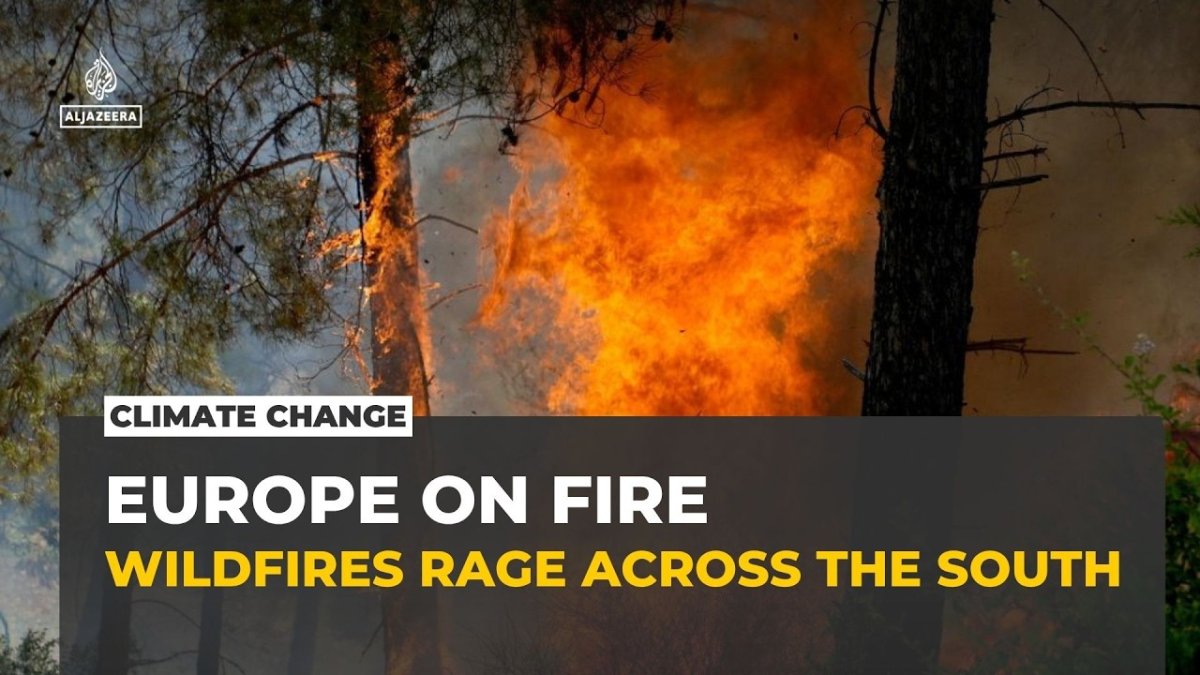
Lisbon, Portugal – July 30, 2026 — Wildfires continue to rage across southern Europe, with three firefighters killed battling blazes in Greece as France shatters its national burned-area record and Spain fights a fresh heatwave. Al Jazeera's Rebecca Collard reports that more land has burned across the EU this year than at any comparable point on record — a distinction earned just as Latin America's own fire season begins to tighten its grip.

Europe's Fire Season Hits Record Territory
The numbers coming out of the European Forest Fire Information System — EFFIS, the Copernicus-backed monitoring arm of the European Commission's Joint Research Centre — are stark. As of July 29-30, roughly 435,000 hectares have burned across the European Union from about 1,400 separate fires. That is approximately 2.5 to 3 times the recent long-term average of around 172,000 hectares for the comparable period, with fire-weather severity running about 43 percent above normal. Analysts tracking the season now describe 2026 as on track for the second-largest burned area in twenty years, with the peak summer months still ahead.
The EU Civil Protection Mechanism has been activated, pooling aircraft and crews across member states in a fire season that is testing the limits of shared firefighting resources. The Mediterranean basin is warming faster than the global average — Europe overall is heating at roughly twice the planetary rate — and the result is a lengthening of the window in which fires can ignite, spread, and resist containment. What was once a summer phenomenon has become a season that begins earlier, ends later, and leaves firefighters with no rest in between.
Greece's Deadly Blazes and France's Scorched Record
The human cost of this season is written in the deaths of the people sent to fight it. In Greece, three firefighters have been killed in the space of days: two — aged 25 and 58 — were trapped by rapidly advancing flames near Krya Vrysi in the Rethymno district of Crete on July 30, while a third died in a separate blaze in the Peloponnese. Greek authorities have battled dozens of fires in short windows, including outbreaks near Thessaloniki and on Crete that forced residents and tourists to evacuate, some by boat, as strong winds and extreme heat made containment nearly impossible.
In France, the season has already rewritten the record books. More than 14,000 wildfires have been recorded since the start of the fire season, burning over 117,000 hectares — a national annual record broken well before the usual peak. The Gironde fire near Bordeaux stands out: roughly 42,000 hectares consumed, 84 firefighters injured, and around 220,000 people evacuated in what officials describe as the largest evacuation in France since World War II. Some 84,000 evacuees have since returned home, but authorities warn that new heatwaves keep reigniting the threat. Spain, meanwhile, has seen an estimated 150,000 to 207,000 hectares burned — including its largest single wildfire on record, exceeding 50,000 hectares near Ávila and Madrid — with tens of thousands evacuated and a fresh heatwave complicating suppression efforts. Italy, including Sicily, has also reported firefighter deaths.
The Climate Engine Behind the Flames
Scientists are increasingly precise about what is amplifying these fires. World Weather Attribution analysis of the 2026 European heatwave found that human-driven warming of roughly 1.1 degrees Celsius over the past half-century made the event significantly hotter and more probable — a comparable event in 1976 would have been about 3.5 degrees Celsius cooler. Extreme nighttime heat, which denies the human body and the landscape any recovery, is now roughly 100 times more probable than during the deadly 2003 European heatwave.
The trend is not subtle. A study published in Scientific Reports found that the number of summer days with extreme fire-prone conditions more than doubled between 1981 and 2025 across the Iberian Peninsula, France, Italy, and Greece. The European Environment Agency has modeled that burned area could double under a 3-degree warming scenario. Even the Mediterranean Sea itself is on fire, metaphorically: a marine heatwave with anomalies of up to 5 degrees Celsius has affected 78.6 percent of the basin, with 97.9 percent of the affected area attributable to human-caused warming. Most fires are still started by people — negligence or arson — but climate change is loading the fuel and priming the weather.
Latin America's Super El Niño Warning
This is where the story crosses the Atlantic. The same planetary heat engine driving Europe's fires is now assembling one of the strongest El Niño events on record — with Niño 3.4 sea surface temperature anomalies reaching plus 2.39 degrees Celsius in late July 2026, a level some forecasters say could make this the strongest El Niño since records began, with a high probability of persisting into 2027. For northern South America, including much of the Amazon basin, El Niño typically means drier, hotter conditions. For the southern cone — Chile, Argentina, southern Brazil — it often means the opposite: heavy rain and storms.
Brazilian officials are already treating the threat as an emergency. In late July, government ministers highlighted Amazon drought and increased queimadas — fires, often from escaped agricultural burns — as the primary El Niño risks, allocating R$1.3 billion for prevention and preparation measures. INMET, Brazil's meteorological service, has issued alerts warning of heightened risk of drought, heatwaves, and fires through the second half of 2026 and into 2027. Amazonian state governments are preparing for extreme drought, intense heat, and elevated burning under what officials and media are calling a Super El Niño scenario.
The Pantanal Surge and Amazon's Coming Dry Season
The first signs of strain are already visible in the Pantanal, the world's largest tropical wetland. As of late July 2026, burned area in the Pantanal has surged roughly 770 percent compared with the same period of the prior year, driven by absent rainfall and very low humidity. The Amazon, meanwhile, is entering its peak fire season — typically July through October — with drier-than-normal fuels and a climate system that is making the forest more flammable in dry years. It is a painful paradox: Brazilian enforcement has driven Amazon deforestation alerts down 61.4 percent year-over-year in May 2026, the largest reduction on record, with MapBiomas showing a roughly 38 percent drop in Amazon vegetation loss in the first half of the year — the lowest in a decade. Yet the fires that now threaten the biome are increasingly climate-driven, arriving on drought winds rather than bulldozers.
Argentina has already paid a price this year, with roughly 230,000 hectares burned in Patagonia in January and the Salta region in June. Colombia's Parques Nacionales Naturales has publicly warned that drier conditions increase forest fire probability in protected areas, urging visitors to avoid campfires and careless cigarette disposal. Chile, for now, is in its austral winter — El Niño has brought heavy rain and snow, suppressing fire risk — but CONAF, Chile's forestry service, knows the reprieve is temporary; the southern summer fire season runs December through March.
What This Means for Latin America
For Latin America, Europe's record season is a preview of the mechanics of climate-amplified fire — and a reminder that preparation is the only defense that scales. Brazil has responded with record hiring of brigadistas — roughly 4,385 firefighters, up 26 percent — plus expanded aerial resources and Amazon Fund financing extended to multiple biomes. Integrated fire management, early warning systems, and community-based prevention are no longer optional; they are the difference between a contained season and a catastrophe. The lessons of the Mediterranean apply directly to the Amazon: human ignitions will keep happening, so the work must be in managing fuel, forecasting fire weather, and responding fast.
The stakes are existential for the region's ecosystems. The Amazon's role as a carbon sink, the Pantanal's biodiversity — home to jaguars, giant river otters, and hundreds of bird species — and the water security of cities like Manaus, Belém, and Cuiabá all depend on keeping fire out of standing forests and wetlands. Indigenous territories, riverside communities, and small farmers are the first line of defense and the first to suffer when smoke blankets the region, filling hospitals with respiratory cases and choking the economy. Europe's experience shows that no country, however wealthy, is immune — and that the cost of inaction compounds every year.
The Bottom Line — What Comes Next
The northern summer is barely half over, and the EU is already counting 435,000 hectares burned. Latin America's dry season is just beginning, with a Super El Niño that could persist into 2027. The science is unambiguous: the 1.1 degrees Celsius of warming already locked in has made heatwaves and fire weather more probable, more intense, and more deadly — and Europe is warming at twice the global average, a rate that should terrify the tropics, where fire and forest are already locked in a fragile balance.
The choice for Latin American governments is stark: invest in the brigadistas, the satellite monitoring, the integrated fire management, and the land-use reform that prevents ignitions — or watch the Pantanal's 770 percent surge become the Amazon's new normal. The smoke over Europe is not just Europe's story. It is a dry run for a hemisphere that cannot afford to fail it.
By Elena Vasquez, Staff Writer
This article was produced with AI-assisted research and editorial support. Reporting is based on sources cited in the article.
What's Your Reaction?
 Like
0
Like
0
 Dislike
0
Dislike
0
 Love
0
Love
0
 Funny
0
Funny
0
 Wow
0
Wow
0
 Sad
0
Sad
0
 Angry
0
Angry
0

Latin America Correspondent at Global1.News. Based in Mexico City, covering politics, economics, energy, and culture across the region. Brings an on-the-ground perspective to stories spanning from the Rio Grande to Patagonia.













Comments (0)