
Egypt's SpongeBob Satire Group Draws Brotherhood Accusations
In a recent i24NEWS English report, Egyptian state-aligned media and pro-government commentators have accused the Muslim Brotherhood of orchestrating a viral Facebook satire group that uses an AI-generated SpongeBob SquarePants universe to lampoon the country's economic woes.
In a recent i24NEWS English report, Egyptian state-aligned media and pro-government commentators have accused the Muslim Brotherhood of orchestrating a viral Facebook satire group that uses an AI-generated SpongeBob SquarePants universe to lampoon the country's economic woes. The group, "Complaints of the People of Al Hamour Bottom," amassed nearly two million members within days of its creation last week, turning a cartoon underwater city into a battleground over Egypt's political narrative and freedom of expression.
Egypt's SpongeBob Satire Group Draws Brotherhood Accusations
Jerusalem, Israel – August 2026 — What began as a playful, AI-assisted parody of SpongeBob SquarePants has spiraled into a full-blown political crisis in Cairo, pitting a generation of digitally savvy Egyptians against a state apparatus that sees dissent in every meme. The Facebook group, which reimagines Bikini Bottom as "Al Hamour Bottom," has become the most talked-about phenomenon in the Arab world's most populous nation, dominating TV talk shows, social media feeds, and now, official security assessments.

The Rise of Al Hamour Bottom
The group's premise is deceptively simple: using AI tools to construct a virtual city reminiscent of The Sims, administrators and members created a parallel universe where SpongeBob and his friends grapple with distinctly Egyptian problems. Posts depict an angry crowd surrounding two city officials at a desk, with banners reading "rents are high" and "prices are on fire." Other viral images mock traffic jams in Cairo, the skyrocketing cost of black-eyed beans—a staple of the Egyptian diet—and the pervasive harassment of women on the streets.
The content struck a nerve. In less than a week, the group's membership exploded to nearly two million, with spin-off pages proliferating across Facebook. A teenage girl who claimed to be the group's administrator appeared in a widely shared video clip on Tuesday, pleading, "I cannot believe I am saying this, but people, we are naive. Allow people to have fun!" She insisted that she and her co-creators should not be held responsible for the political content emerging in the spin-off groups, which have grown increasingly pointed in their criticism of President Abdel Fattah El Sisi's economic policies.
On the Ground: Satire as a Pressure Valve
For many Egyptians, the group represents a rare, unvarnished outlet for grievances that have simmered for years. "This vast popularity is not only because of people's love for SpongeBob," one social media user wrote. "It rather reflects the people's wish to air their problems and speak about the pressures they are subjected to in a satirical and indirect manner." The economic context is stark: annual inflation stood at 33.9% in 2023 and 28.3% in 2024, and the prices of everyday staples remain a central grievance for ordinary citizens struggling to make ends meet.
The original Facebook group was suspended this week for two months. It remains unclear whether the decision came from Egyptian authorities or from Meta, Facebook's parent company, which did not immediately respond to requests for comment. Spin-off groups proliferated overnight, with government critics using SpongeBob characters to deliver scathing assessments of the state's handling of housing, transportation, and food prices. It remains unclear whether Egyptian authorities or Meta, Facebook's parent company, initiated the suspension; Meta did not immediately respond to requests for comment. The ambiguity itself has become a talking point, with many Egyptians interpreting the ban as a direct message from the state.
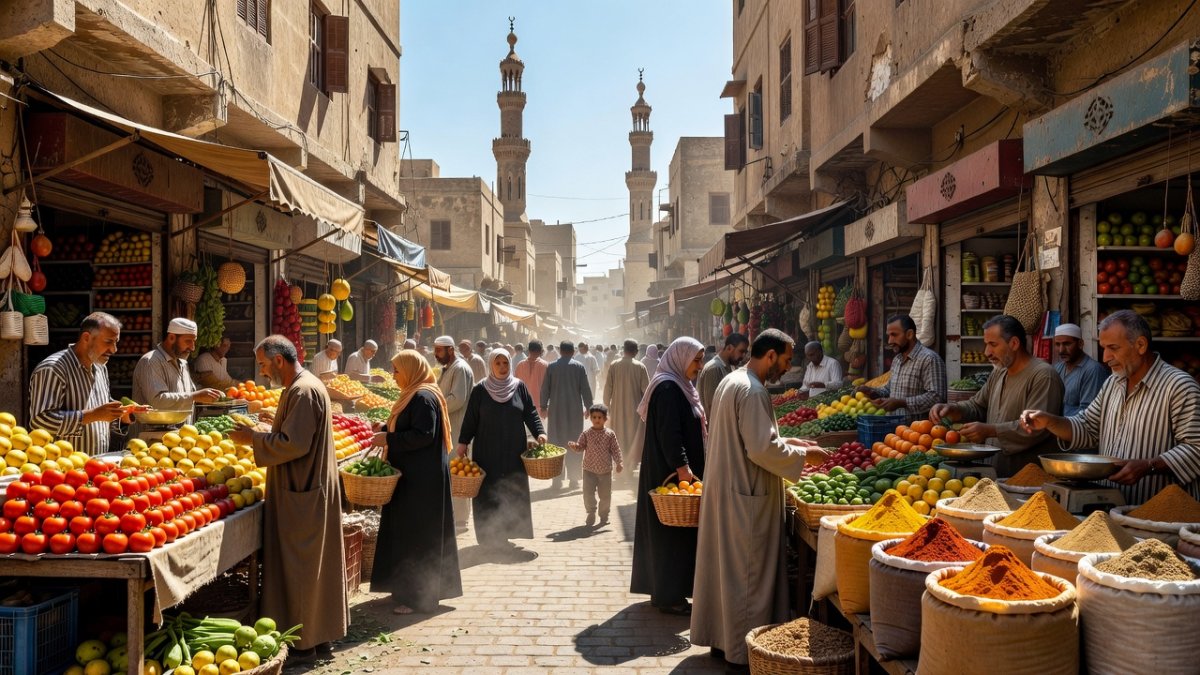
The satire resonates so deeply because it mirrors the arithmetic of daily survival in Egypt. A kilo of black-eyed beans, a humble staple that once anchored family meals, now costs several times what it did before the currency devaluations of recent years, and the same story repeats across the market: cooking oil, rice, chicken, and bread have all climbed in ways that outpace stagnant wages. Middle-class families that once planned for savings or a summer trip now describe themselves as living paycheck to paycheck, with rents in Cairo's working-class districts eating up half or more of a household's income. The group's jokes about overcrowded microbuses, crumbling sidewalks, and the endless wait for a metro train are not abstractions—they are the texture of a city where the state's economic reforms have yet to deliver visible relief.
Housing is perhaps the most visceral grievance. Young Egyptians, even those with university degrees and steady jobs, increasingly find themselves unable to afford independent apartments, doubling up with parents or moving to informal settlements on the city's edges. The group's posts capture this precisely: an angry crowd confronting two city officials at a desk beneath banners reading “rents are high” and “prices are on fire,” alongside running jokes about housing costs that young Egyptians can no longer carry alone. For the millions who joined, the humor is a coping mechanism, a way to name the pressure without risking a direct confrontation with authorities. The state's response—labeling the page a security threat—only confirms what many already believe: that the economic pain is too politically sensitive to be acknowledged openly, let alone addressed.
Regional Context: The Muslim Brotherhood Accusation
Pro-government talk show hosts and social media accounts were quick to assign blame. Veteran host Tamer Abdel Monaim declared on air: "The trend of al Hamour's Bottom belongs to the (Muslim) Brotherhood. Its objective is to sow confusion." Pro-government accounts described the group as a coordinated plot, with one writing: "When the genuine problems of the citizens are presented in a virtual and substitute state, then the whole affair—if it deviates from the boundaries of comedy and into doubts and incitement—becomes a threat to national security in the broadest sense."
The accusation is not new. Since the Muslim Brotherhood was removed from power in 2013 and designated a terrorist organization by an Egyptian court, Cairo has consistently blamed the group for using satellite TV channels, exiled media outlets, and social media networks to destabilize the state. The Brotherhood's regional network spans Qatar, where several of its media figures are based, and Turkey, which has hosted exiled Egyptian opposition figures. For Israeli observers, this is a familiar pattern: Egypt's internal stability is a cornerstone of regional security, and any perceived threat to the Sisi government reverberates far beyond Cairo's city limits.
Beyond the immediate accusation, the Brotherhood's regional footprint is a central pillar of Cairo's anxiety. Doha has long hosted a constellation of Brotherhood-linked media personalities, including former anchors of the now-shuttered Al Jazeera Mubasher Misr, who continue to broadcast criticism of the Sisi government to Egyptian audiences via satellite and YouTube. Turkey, meanwhile, has provided a base for exiled opposition politicians and activists, some of whom operate social media networks that amplify anti-government content in Arabic. These channels, combined with a decentralized ecosystem of Telegram groups and Facebook pages, form a decentralized media ecosystem that Cairo's security establishment has long cast as a "soft war" against the state—one that memes and AI-generated satire can now join with devastating speed. For Cairo, the threat is existential not because a cartoon can topple a government, but because it demonstrates that the Brotherhood's narrative machinery can still mobilize millions of Egyptians, even a decade after the group's political project was crushed.
Egypt's stability, in turn, is a load-bearing wall for the entire region. Cairo remains the indispensable mediator in Gaza ceasefire negotiations, maintaining working channels with Hamas, Israel, and the United States even as the war grinds on. Its security forces coordinate closely with Israel in Sinai, where joint efforts have largely contained jihadist insurgencies and kept the border quiet. And the Suez Canal, along with Egypt's Red Sea coastline, is a chokepoint for global trade and a theater where Iranian-backed Houthi attacks have already shown how quickly regional instability can spike shipping costs. A Cairo consumed by internal unrest, or a government that feels compelled to crack down hard on digital dissent, risks becoming less flexible, less willing to take political risks for the sake of regional diplomacy. Israeli officials watch these dynamics closely, knowing that the peace treaty's durability depends not just on formal agreements but on the Egyptian leadership's capacity to manage domestic pressures without lashing out externally.
Diplomatic and International Reactions
The episode comes at a delicate moment for Egypt's international standing. Earlier this month, President El Sisi publicly declared his government's commitment to freedom of expression and called for media reforms—a statement widely seen as an attempt to burnish Cairo's image ahead of renewed diplomatic engagements. The SpongeBob affair threatens to undermine that narrative, exposing the gap between official rhetoric and the reality of mass arrests of critics and the state's tight control of the media landscape.
For Israel, the stakes are concrete. Egypt is the anchor of the 1979 peace treaty, a key mediator in Gaza hostage and ceasefire diplomacy, and a vital security partner in Sinai. A government that feels besieged by online dissent tends to react defensively, prioritizing internal control over regional flexibility. Israeli defense officials have long monitored Egyptian domestic politics for signs of instability, knowing that a weakened Cairo would have direct implications for counterterrorism coordination and the management of the Gaza border.
Analysis and What This Means
The SpongeBob satire group is more than a viral meme; it is a stress test for Egypt's authoritarian model in the digital age. The fact that a cartoon-themed Facebook page could amass two million members in days—and force the state to respond with suspensions and accusations of Brotherhood infiltration—reveals the depth of public frustration and the limits of state control over online spaces. The regime's instinct to label all dissent as a foreign or terrorist plot may win the immediate battle, but it risks alienating a younger generation that sees the internet as its only arena for expression.
The suspension of the original group has not chilled the satire; it has fueled it. Spin-off pages continue to multiply, and the group's name remains a constant topic of conversation on Egyptian television and social media. The question now is whether the state escalates with arrests—which would likely trigger international condemnation—or allows the meme to run its course, betting that the public's attention will eventually shift. For now, the regime appears to be walking a tightrope, trying to contain the narrative without admitting that a SpongeBob character has exposed the fragility of its social contract.
Looking ahead, the episode signals that Egypt's approach to dissent is entering a new phase, one where AI-generated content and digital satire pose challenges that traditional censorship tools cannot easily address. For Israeli policymakers, the takeaway is clear: Cairo's internal pressures are not isolated from its regional behavior. A government distracted by domestic unrest is a less predictable partner, and the stability that Israel has long relied upon from its Egyptian neighbor may be more contingent than previously assumed. The SpongeBob affair is a reminder that in the Middle East, even a cartoon can carry geopolitical weight.
Looking forward, the SpongeBob episode is a preview of the next phase of Egyptian digital dissent. The state's traditional toolkit—arrests, website blocks, and media intimidation—is poorly suited to a landscape where AI tools allow anyone to generate viral content in minutes, and where the line between comedy and political commentary is deliberately blurred. The regime may win this round by suspending the original group, but the spin-offs and imitators will keep coming, each iteration harder to trace and attribute. For regional partners like Israel, the lesson is that Egypt's internal resilience is not a given; it is a product of economic performance and political space, both of which are under strain. A Cairo that feels cornered by its own citizens' humor is a Cairo that may become more brittle in its foreign policy, more reluctant to engage in the kind of creative diplomacy that the region's crises demand. The meme may fade, but the underlying pressures it exposed will not, and that is a reality that Jerusalem, Washington, and the Gulf capitals would be wise to factor into their calculations.
By Hannah Berg, Staff Writer
This article was produced with AI-assisted research and editorial support. Reporting is based on sources cited in the article.
What's Your Reaction?
 Like
0
Like
0
 Dislike
0
Dislike
0
 Love
0
Love
0
 Funny
0
Funny
0
 Wow
0
Wow
0
 Sad
0
Sad
0
 Angry
0
Angry
0

Israel Correspondent at Global1.News. Based in Tel Aviv, covering Israeli politics, security, technology, and society. Provides balanced, deeply-sourced reporting on one of the most closely-watched regions in the world.













Comments (0)