
West Bank 'Lawless Land,' Cardinal Warns as Settler Violence Surges
The Latin patriarch of Jerusalem has issued a stark warning that the occupied West Bank has descended into "a lawless land," where settler aggression continues without effective security or legal restraint.
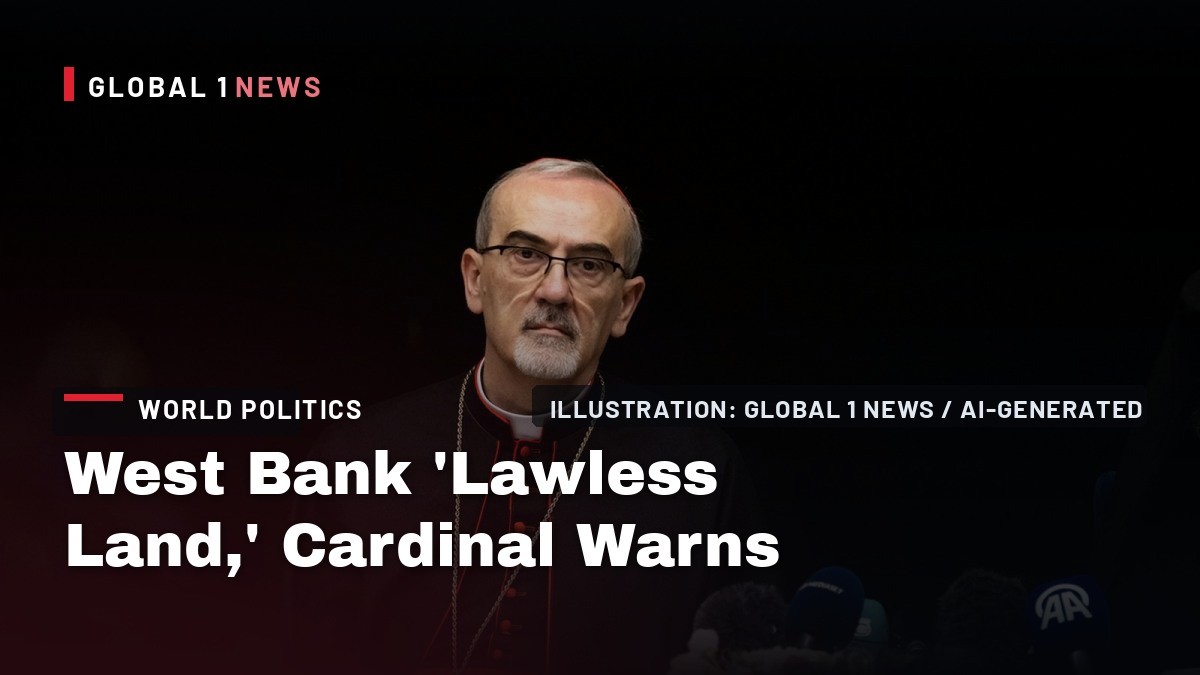
The Latin patriarch of Jerusalem has issued a stark warning that the occupied West Bank has descended into "a lawless land," where settler aggression continues without effective security or legal restraint. Speaking at a Catholic festival in northern Italy, Cardinal Pierbattista Pizzaballa called for renewed Western diplomatic engagement to halt what he described as a "continuing downward spiral" of violence. His remarks come amid escalating raids, settlement expansion, and attacks that have left Palestinian communities increasingly vulnerable.
West Bank 'Lawless Land,' Cardinal Warns as Settler Violence Surges
Jerusalem, Occupied Palestinian Territories – 27 August 2026 — Cardinal Pierbattista Pizzaballa, the top Catholic cleric in the Holy Land, told reporters Thursday that the West Bank has become "a lawless land" as Israeli settler aggression continues unabated, urging the international community to step up diplomatic efforts before the situation spirals further out of control. Speaking on the final day of the Meeting for Friendship Among Peoples in Rimini, Italy, the cardinal painted a grim picture of a territory where violence has become routine and where the absence of effective security and legal restraints has left Palestinians exposed.
A Warning From Rimini
Addressing journalists and later engaging with young people at the annual Catholic gathering in Rimini, Cardinal Pizzaballa said tensions between settlers and the Palestinian population are "continually rising." The West Bank, he stressed, "has now become a lawless land," with the situation continuing "without any effective security or legal restraints."
"The fact that there is a situation of continuous aggression by settlers is well established," Pizzaballa told reporters, according to Vatican News and Anadolu Agency. He called on Western nations to "help raise its gaze somewhat, create perspectives, and also help calm this continuing downward spiral through ever greater diplomatic efforts."
The cardinal's remarks come at a time when violence across the West Bank has shown no sign of abating. In recent weeks, Israeli raids and settler attacks have killed and displaced Palestinians, with a Palestinian body reporting that illegal Israeli settlements and outposts in the West Bank have reached 592. A 14-year-old was killed in a raid on Nablus in late August 2026, figures that underscore the human toll of the ongoing unrest.
Settler Violence and the Erosion of Security
The cardinal's characterization of the West Bank as lawless reflects a reality that Palestinian communities have long endured. Israeli Defense Minister Israel Katz recently said Israeli forces will maintain a permanent presence in northern West Bank refugee camps, a move that has raised fears of further displacement and entrenchment of military control.
Pizzaballa's own pastoral work has brought him face to face with these realities. In August 2026, he visited Taybeh, the last fully Christian village in the West Bank, standing in solidarity with a community facing what the Vatican described as grave persecution and a deliberate strategy of harassment. The visit underscored the pressures on Palestinian Christians, who are caught between the violence of occupation and the steady erosion of their presence in the land where their faith was born.
The cardinal's warning that the situation continues "without any effective security or legal restraints" points to a broader failure of accountability. Settler violence, often carried out with impunity, has become a defining feature of daily life for many Palestinians, who face threats to their homes, their land, and their livelihoods with little recourse to protection or justice.
Gaza's Humanitarian Devastation
Turning to Gaza, Cardinal Pizzaballa described the situation as "very devastated from a human point of view," adding that it "has deteriorated enormously." While he noted that the enclave is "more stable from a certain perspective; politically, there is a great deal of discussion," the human cost remains staggering.
The cardinal's words echo the experiences of the people of Gaza, who have endured repeated rounds of conflict, blockade, and displacement. In July 2025, Pizzaballa visited Gaza's Holy Family Church after it was hit by an Israeli attack, a visit that brought him into direct contact with the suffering of the small Christian community and the broader population.
Figures on the current humanitarian situation in Gaza were not immediately available, but the cardinal's assessment leaves little doubt about the scale of the crisis. "War steals from young people the most beautiful years of their lives, when it does not take their lives altogether," he said. "This is true for Ukraine, but also for the Middle East."
Diplomacy and the Two-State Solution
Amid the violence and despair, Cardinal Pizzaballa insisted that diplomacy remains "the only way" to resolve the conflict "while avoiding the use of weapons, violence and military force." He reaffirmed his support for the two-state solution, which he called "the only way to recognize the right of Israelis and Palestinians to have a home in their own land."
The two-state solution, long the cornerstone of international efforts to end the conflict, has faced mounting challenges in recent years. The expansion of settlements, the fragmentation of the West Bank, and the political divisions between and within Israeli and Palestinian leaderships have all undermined its viability. Yet Pizzaballa's insistence on this framework reflects a conviction that any just and lasting peace must acknowledge the national aspirations of both peoples.
The cardinal also lamented the loss of a sense of the common good in the Middle East, as institutions seemed guided by "what is good for themselves or for their own political side." In a region "so torn apart, burdened by hatred, resentment and hardship," he said, cultivating hope is not easy. "We must be realistic because the situation has deteriorated," he added.
A Papal Visit and the Search for Hope
Cardinal Pizzaballa also addressed the possibility of a papal visit to the Holy Land, saying, "Sooner or later the pope will come to the Holy Land — it is only a matter of time." He stressed the need to "prepare the conditions for this visit so that it can truly bear fruit," adding that "the visit must be part of a meaningful process."
The prospect of a papal visit offers a glimmer of hope for a region weary of conflict. But Pizzaballa was careful to distinguish hope from naive optimism. "We must not confuse hope with 'everything will be fine' or with a political solution," he warned. "Hope is something else." It arises "from within," through encounters and through people — "Israelis and Palestinians, Jews, Muslims and Christians" — people who choose "to refuse to dehumanize the other."
His remarks came during an event entitled "Gazing at the Sky of Jerusalem," where he answered questions from a student from Milan, a young man from the United States, and a high-school student of Ukrainian origin living in Rimini. The themes drew on his pastoral letter "They Returned to Jerusalem with Great Joy," published last April and addressed to his diocese, which encompasses Israel, Palestine, Jordan and Cyprus.
The Human Cost of Dehumanizing War
Throughout his address, Cardinal Pizzaballa returned to the theme of dehumanization, warning that the logic of war threatens to become our "way of thinking, of surviving." "War has its own dynamics, and they brutalize you," he said. "The other person is exorcized, because if the other is human and close to you, it becomes difficult to strike them."
This warning carries particular weight in a context where violence has become so normalized that the humanity of the other is often lost. Pizzaballa urged against "reducing peace to a slogan, as well as naive approaches to a complex reality." Peace, he suggested, requires a clear-eyed recognition of the challenges ahead, as well as a commitment to the hard work of encounter and dialogue.
For Palestinians in the West Bank and Gaza, the cardinal's words offer both a diagnosis and a challenge. The diagnosis is stark: a lawless land, a devastated population, and a conflict that continues to exact a terrible price. The challenge is to refuse to surrender to despair, to hold onto hope even as the situation deteriorates, and to insist on the possibility of a different future.
As the international community looks on, the question remains whether the diplomatic engagement Cardinal Pizzaballa called for will materialize. His appeal to the West to "raise its gaze" and "create perspectives" is a plea for leadership and vision in a region where both have been in short supply. Whether that plea will be heeded is uncertain, but the cardinal's voice adds to a growing chorus of religious and humanitarian leaders urging an end to the violence and a return to the path of negotiation and mutual recognition.
In the meantime, the people of the West Bank and Gaza continue to live with the daily realities of occupation, displacement, and insecurity. The cardinal's words remind us that behind the political analyses and diplomatic maneuvers are real human beings, whose lives and futures hang in the balance. "War steals from young people the most beautiful years of their lives," he said. It is a truth that resonates across the region, and one that demands a response.
Cover image: Mostafa Alkharouf/Anadolu Agency via Middle East Monitor.
By Fatima Al-Rashid, Staff Writer
This article was produced with AI-assisted research and editorial support. Sources: Middle East Monitor, Vatican News, Anadolu Agency.
What's Your Reaction?
 Like
0
Like
0
 Dislike
0
Dislike
0
 Love
0
Love
0
 Funny
0
Funny
0
 Wow
0
Wow
0
 Sad
0
Sad
0
 Angry
0
Angry
0

Gulf/MENA Correspondent at Global1.News. Based in Doha, covering Gulf politics, energy markets, diplomacy, and development across the Middle East and North Africa. Tracks the economic transformation of the Gulf states.












Comments (0)