
Ecuador's Drug War Escalates as Gangs Tighten Grip on Key Provinces
In a recent BBC News report, senior international correspondent Orla Guerin embedded with police in the Ecuadorian city of Durán — a frontline in the country's escalating war against drug gangs, corruption, and criminal infiltration of the state. The report reveals a crisis that has transformed what was once one of South America's most peaceful nations into a killing ground where gangs wield more power — and more money — than the authorities task
In a recent BBC News report, senior international correspondent Orla Guerin embedded with police in the Ecuadorian city of Durán — a frontline in the country's escalating war against drug gangs, corruption, and criminal infiltration of the state. The report reveals a crisis that has transformed what was once one of South America's most peaceful nations into a killing ground where gangs wield more power — and more money — than the authorities tasked with stopping them.
Ecuador's Drug War Escalates as Gangs Tighten Grip on Key Provinces
Durán, Ecuador — 28 July 2026
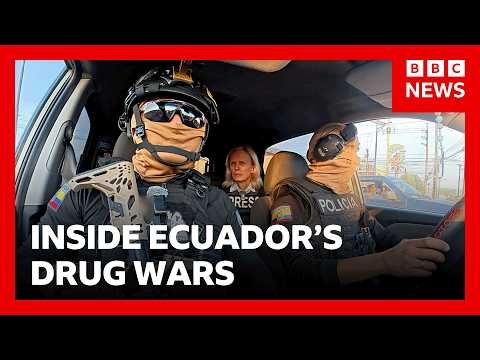
A Nation Transformed: Ecuador's Descent Into Drug Violence
Ecuador was once regarded as a peaceful tourist haven. In under a decade it has become a killing ground. Confirmed facts establish that approximately 9,200 people were killed in 2025, placing the country among those with the world's highest murder rates. This figure represented a 30 percent increase from 2024 to 2025. President Daniel Noboa, who took office in November 2023, launched an iron-fisted crackdown that has now lasted two years. Approximately 70 percent of cocaine destined for the United States and Europe transits through Ecuador, according to statements from President Noboa. Colombia and Peru remain the world's top two cocaine producers, and Ecuadorian gangs maintain documented links to Mexican cartels and Albanian mafia groups. Guayas province alone recorded 4,106 homicides in 2025, the highest total in the country. These verified developments have turned once-quiet streets into contested territory where bodies were routinely beheaded or dismembered.
Ecuador's geographic position between the world's two largest cocaine producers has turned its ports and highways into the principal corridor for northward shipments. With Colombia to the north and Peru to the south, traffickers exploit porous land borders and under-patrolled Pacific harbors to move product efficiently. President Noboa has repeatedly stated that roughly 70 percent of cocaine bound for the United States and Europe now passes through Ecuadorian territory, a dramatic shift from earlier decades when the country played a marginal role. Local gangs have forged operational ties with Mexican cartels that control wholesale distribution in North America and with Albanian mafia networks that manage onward distribution across Europe. In less than ten years this combination of location, alliances, and weak institutions converted a nation once marketed to tourists into one of Latin America's most violent theaters. The 30 percent rise in murders between 2024 and 2025 reflects the accelerating consolidation of these routes and the lethal competition among groups seeking to control them.
Corruption Within the Ranks
Police Captain Jean Carlos Bustamante has stated that many bad people operate inside the unit, inside the state, and inside politics. He has described how numerous individuals remain in the pay of the gangs. Colonel Santiago Gavilanez, deputy commander of the Durán police, has confirmed that gangs possess sufficient money to buy laws, judges, and politicians. Gang leader Jonathan, aged 37, has admitted maintaining four officers on his payroll at monthly salaries between 1,500 and 2,000 dollars. These payments illustrate the financial advantage gangs hold over state institutions. Analysts suggest that such embedded corruption undermines operational effectiveness and allows criminal networks to anticipate police movements. Interior Minister John Reimberg has described the situation as a war, underscoring the institutional challenge. All reporting draws from the verified accounts provided by BBC News correspondent Orla Guerin during her embedding in Durán.
During Orla Guerin's extended embed in Durán, officers described routine encounters with corruption that reach every level of the justice chain. One policeman recounted being offered a single bribe large enough to retire on, an amount that underscored the financial disparity between state salaries and gang resources. Colonel Gavilanez emphasized that gangs can purchase not only street-level cooperation but also favorable rulings from judges and legislative protections from politicians. Multiple officers expressed frustration that arrests frequently end in release, with one stating plainly that “we imprison them, they release them.” These patterns mirror documented problems in other Latin American security forces where cartel wealth has similarly penetrated courts and political structures, eroding operational gains and perpetuating cycles of violence.
Life on the Frontline: A Captain's Daily War
Police Captain Jean Carlos Bustamante, aged 34, leads a hand-picked team operating in Durán. He has lost three close friends to gang violence. Los Aguilas, known as The Eagles, control multiple neighbourhoods in the city. Captain Bustamante has noted that gangs possess many weapons and much more money than the state. Colonel Santiago Gavilanez has echoed concerns about the resources available to criminal groups. The captain's unit confronts daily threats in an environment where officers must remain vigilant against both external attacks and internal betrayal. Confirmed facts show that 75,000 police and soldiers have been deployed across the four provinces of El Oro, Guayas, Los Ríos, and Santo Domingo de los Tsáchilas. Night-time curfews remain in force in these areas. These measures reflect the scale of the security operation now underway.
Captain Bustamante's personal losses include three close colleagues killed in the line of duty, a toll that weighs heavily on his family; his parents have repeatedly urged him to leave the force. His unit conducts raids supported by drone surveillance, battering rams, and rapid room-clearing tactics that frequently uncover hidden weapons caches. Micro-traffickers continue to sell one-dollar packets of heroin on street corners even as larger operations are disrupted. In one case a prosecutor ordered the release of suspects despite clear evidence, an outcome the captain attributes to ongoing corruption. Despite these setbacks Bustamante has stated, “Maybe I am a little tired, but I believe we can win,” reflecting a cautious optimism grounded in incremental territorial gains.
Gangland: Children, Hitmen, and a Brutal Code
Children are recruited into gangs at age 12 and can become hitmen by age 15. The youngest gang member observed during reporting was 17 years old, wearing a bulletproof vest and flip-flops while carrying a weapon in daylight. Gang leader Jonathan has admitted responsibility for approximately eight killings and has stated that death is paid by death. He has also remarked that if authorities shut down one gang, another will simply take its place. Micro-traffickers sell packets of heroin labelled H for one dollar each. A witness has described criminals as ghosts who appear wherever they please. These patterns demonstrate how gangs sustain operations through early recruitment and a rigid code of retaliation. All details remain consistent with the verified facts reported by Orla Guerin and additional reporting by Wietske Burema, Lee Durant, and Chris Gibson.
Recruitment begins as early as age 12, with adolescents progressing to hitman roles by 15 under a system that rewards loyalty and ruthlessness. Jonathan's gang members have been observed walking openly with weapons in broad daylight, projecting control over contested neighborhoods. A local witness described the criminals as “ghosts who appear wherever they please,” highlighting their ability to operate with impunity. In one incident a victim was shot six times by two men on a motorcycle, a signature tactic that leaves little room for escape or identification. Forensic teams later worked under police floodlights beside the body, documenting the scene amid a community accustomed to such violence.
Glimmers of Progress Amid the Carnage
Durán's murder rate declined by 50 percent in the first half of 2026. Streets are no longer deserted after 19:00, and bodies are no longer routinely beheaded or dismembered. These improvements follow the deployment of 75,000 police and soldiers and the imposition of night-time curfews in the four affected provinces. Interior Minister John Reimberg has maintained that the country remains at war, yet the reduction in visible violence indicates partial success for the security measures. President Daniel Noboa's two-year crackdown has produced measurable drops in certain indicators even as critics argue the approach has fractured gangs into smaller, more numerous groups. The presence of the FBI's first office in Ecuador and the formation of the 17-country US-led alliance Shield of the Americas further signal international recognition of progress alongside ongoing challenges.
The 50 percent reduction in Durán's murder rate during the first half of 2026 has allowed residents to reclaim evening hours, with commercial activity resuming after 19:00. Bodies are no longer routinely subjected to beheading or dismemberment, a visible marker of declining gang dominance. The FBI's decision to open its first office in Ecuador and the launch of the 17-country Shield of the Americas alliance reflect growing international investment in the stabilization effort. President Trump has characterized the gangs as a cancer requiring aggressive treatment, aligning with Noboa's own rhetoric that the era of mafia control has ended.
Analysis — Geopolitical Dimensions and Regional Fallout
Analysts suggest that Ecuador's transformation carries implications beyond its borders. President Donald Trump has described gangs as a cancer and has urged the use of military force. President Daniel Noboa has stated that for too long mafias considered America their territory and that their time has run out. The Shield of the Americas alliance, launched at Mar-a-Lago, represents a coordinated regional response involving 17 countries. The opening of the FBI's first office in Ecuador underscores direct United States engagement. Critics maintain that the iron-fisted crackdown has multiplied rather than eliminated threats, yet the 50 percent drop in Durán's murder rate and the restoration of normal street activity after dark provide evidence that sustained pressure can alter local conditions. These developments illustrate how Ecuador has become a focal point in the broader contest over cocaine routes linking South American producers to North American and European markets. Additional reporting by Wietske Burema, Lee Durant, and Chris Gibson supports the assessment that external alliances will shape the next phase of the conflict.
Ecuador's crisis also intersects with wider geopolitical competition. Washington's deepening security presence through the FBI office and the Shield of the Americas framework stands in contrast to Moscow's longstanding diplomatic and military ties with several Andean governments. The documented involvement of Albanian mafia networks has simultaneously opened direct pipelines from Ecuadorian ports to European markets, prompting greater transatlantic law-enforcement coordination. These overlapping interests suggest that Ecuador will remain a test case for whether sustained regional pressure can disrupt both criminal economies and external influence operations.
By Irina Volkov, Staff Writer
This article was produced with AI-assisted research and editorial support. Reporting is based on sources cited in the article.
What's Your Reaction?
 Like
0
Like
0
 Dislike
0
Dislike
0
 Love
0
Love
0
 Funny
0
Funny
0
 Wow
0
Wow
0
 Sad
0
Sad
0
 Angry
0
Angry
0
Russia/Eastern Europe Correspondent at Global1.News. Covering Russian politics, energy, security, and the shifting dynamics of the post-Soviet space. Provides clear-eyed analysis on one of the world's most opaque regions.










Comments (0)