
Drone Attacks on Ecuador's Fishermen and the Covert CIA Program Behind Them
Fishermen say drone attacks sank their boats off the Galápagos, and a Washington Post report ties the strikes to a covert CIA program. Survivors describe a ghost ship, hoods, and a secret transfer to El Salvador.
What Happened: Explosions at Sea Off the Galápagos
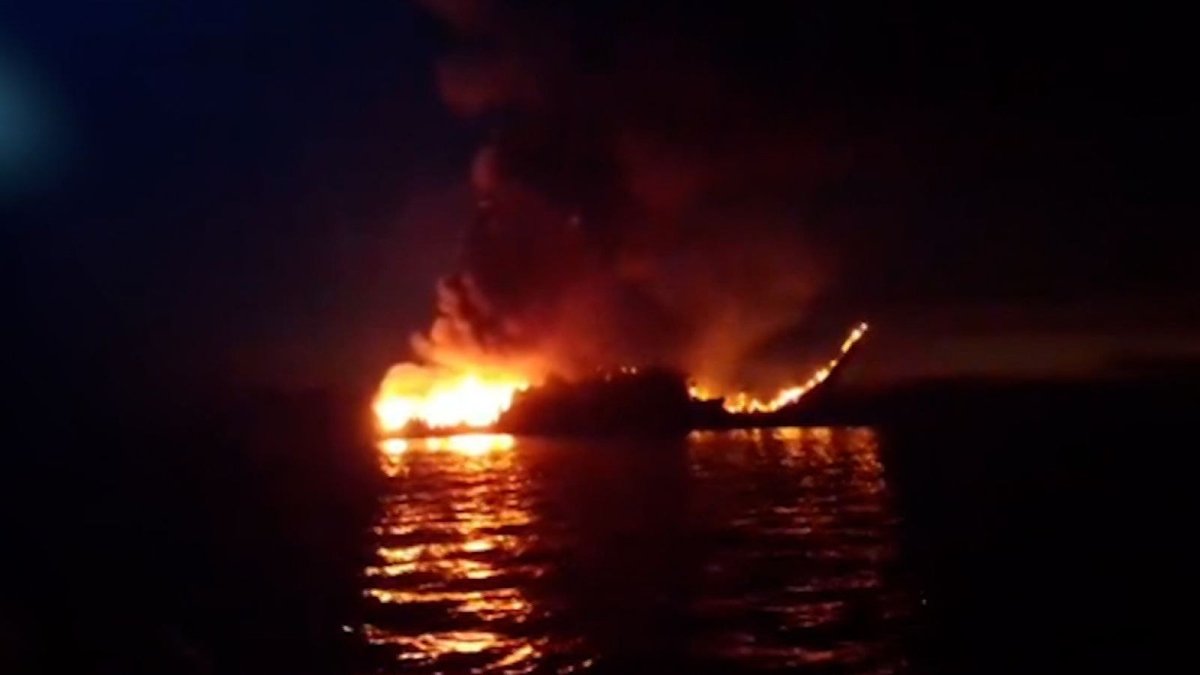
In mid-March 2026, Ecuadorian fishermen say their world erupted in flames. Captain Hernán Flores and his 16 crew members aboard the La Negra Francisca Duarte II were working roughly 170 miles off the Galápagos Islands, inside Ecuador's exclusive economic zone, when a drone the size of a pillow slammed into their gas tanks. The explosion severely injured the foot of his nephew, Jordyn Flores, and burned the upper back of another crewmate. The boat was left burning at coordinates NOAA satellites confirmed was on fire at 3:02 p.m. on March 17.
Nine days later, on March 26, the Don Maca suffered a similar fate. Its 20 crew members watched as explosive-laden quadcopters descended. Crewmate Jaime Rubén Cervantes Macías told CNN he "went flying and slammed into a diesel tank" as shouts of "Drone, drone, drone!" filled the air. Another crewmate, John Sebastián Palacios, suffered hearing damage; a third fisherman lost most of the vision in his left eye. The attackers kept striking the Don Maca until it sank, then left with the survivors.
These are not isolated incidents. The Fiorella, a vessel with eight crew members, disappeared on January 20, 2026, under circumstances survivors believe mirror the other attacks. Two crew members on a skiff survived and reported seeing "a large column of smoke in the distance in the direction of the Fiorella." Amnesty International last month raised suspicions of US involvement, noting the vessel was "allegedly subjected to sustained monitoring by aircraft, patrol boats, and drones bearing United States markings" in the days before it vanished.
The 'Ghost Ship' and the Hooded Men
Both crews described a mysterious blue vessel shadowing them for days before the attacks. Lawyer Jorge Chiriboga Dávalos, who represents the fishermen, called it a "ghost ship." Survivors say it resembled a tuna fishing boat but was larger, with a tall wheelhouse toward the front, a crane, three large containers, and a smaller motorboat. When the crews were boarded, armed men tied them up and placed hoods over their heads.
The men were White, tall, spoke English, and carried rifles. They wore brown camouflaged uniforms, some with a patch of the US flag over their arms. Jordyn Flores was taken into one of the containers for medical treatment and saw a board with images of the drones and his own boat.
A gray "mini plane" with long wings surveilled the area during the attacks. Flight data, first reported by the New York Times and later verified by CNN, suggested the area near the boats' last locations was patrolled by a plane registered to a company whose address is a private mailbox at a UPS store in Richmond, Virginia.
Shipped to El Salvador: A Covert Transfer
Hours after each attack, armed men transferred the crews to a Salvadoran Coast Guard ship, telling the guardsmen the fishermen had been shipwrecked. The crews were shipped to El Salvador, hundreds of miles from their homes in Manta, Ecuador. El Salvador acknowledged on March 24 that its forces picked up a group of Ecuadorian fishermen matching La Negra Francisca's crew, describing them as shipwreck survivors rescued at sea — with no mention of a blue ship or Americans.
The guardsmen treated the fishermen well — providing food, water, and medical care — but said their ship wasn't allowed to enter Ecuadorian waters. Both crews reached El Salvador after about a week, were interviewed, placed in migration centers and hospitals, then flown back to Manta. Foreign Minister Gabriela Sommerfeld gave no details in April, saying her only role was to coordinate the fishermen's return.
The transfer raises serious questions about coordination. If the Salvadoran Coast Guard genuinely believed these were shipwreck survivors, why did they not contact Ecuadorian authorities immediately? The fishermen were not charged with any crime — in El Salvador or Ecuador — and no evidence of wrongdoing has been presented.
The Washington Post Report: A Covert CIA Program
On August 13, 2026, The Washington Post reported that the strikes were part of a covert CIA program authorized by President Donald Trump. CNN cannot independently verify this claim. A CIA spokesperson told CNN: "We do not have any guidance to offer on this." The Pentagon has acknowledged conducting dozens of lethal attacks on alleged drug-trafficking vessels in the Pacific and Caribbean since September 2025 under Operation Southern Spear, which has destroyed 67 vessels and killed more than 220 people.
But here's the critical detail: the La Negra Francisca Duarte II and the Don Maca are NOT among the acknowledged incidents. The US Defense Department denied any involvement. Southern Command was directed to answer questions, and CNN reached out to the CIA and DEA for comment. Three security experts interviewed by Reuters said the United States was almost certainly responsible, given Southern Command's ongoing boat-strike campaign.
Former US officials with Latin America experience told the Post they were bewildered about the need for a covert CIA boat-strike campaign given the administration openly boasted about other attacks. "It begs the question about why you would need to do this. What would be the purpose of the secrecy?" one former official said. The New York Times reported on August 12 that the strikes originated in the US without naming a source.
No Evidence of Trafficking: The Fishermen's Case
The Post noted "no evidence has publicly emerged that the crew members were involved in drug trafficking." The fishermen insist they are not traffickers and have not been charged with drug-related offenses in Ecuador. Captain Flores said an Ecuadorian patrol ship, the LG-30, inspected La Negra Francisca before the alleged attacks and found no illicit activity.
Lawyer Chiriboga is blunt: "You cannot attack civilian vessels. That is an abuse and that is what we reject because it causes pain and economic harm, since it was their means of work." He plans to file a lawsuit in the US against those responsible — once they figure out who that is. If the CIA program is confirmed, the state secrets privilege could be invoked.
The context matters. The Galápagos Islands have increasingly become a hub for drug traffickers, where local fishermen are known to pick up jobs delivering gas to smugglers heading to the United States, per the Post. Onshore, drug cartels have turned the small ports of Ecuador's Manabi province into a cocaine-trafficking hub, extorting local fishermen prized for navigation skills. It's an impossible choice: earn more than a year's legal income smuggling drugs, or face extortion, threats, and violence.
The Human Toll: Trauma and Financial Ruin
The survivors are recovering physically, mentally, and financially, but they are traumatized. Jordyn Flores struggled with medical expenses after his foot injury. Hernán Flores has trouble sleeping and suffers migraines from a head injury. Palacios and other fishermen are hesitant to return to the ocean. "Psychologically, we're kind of traumatized," he told CNN.
Don Maca owner Cristhian Mendoza put it plainly: "The first point is to thank God for those human lives that we managed to rescue. The other point is to defend them and seek justice." The economic impact is severe — these boats were their means of work.
The fishermen's stories are consistent, detailed, and corroborated by satellite data and flight records. They describe being followed for days, attacked without warning, hooded, tied up, and shipped to another country — not arrested, not charged, not given a hearing. Collateral damage in a war they say they were never part of.
What Happens Next: Accountability and the Law
The Washington Post's report, if confirmed, would represent a significant expansion of covert US military operations. The administration has openly boasted about Operation Southern Spear's results — 67 vessels destroyed, more than 220 people killed — so the secrecy in these specific cases is puzzling. What would be the purpose of the secrecy?
For the fishermen, the path forward is legal. Chiriboga's planned lawsuit in the US will test whether civilian fishermen can seek redress for attacks they say were carried out by US forces. The lack of evidence of trafficking strengthens their case, though the cloak of national security could prove an insurmountable barrier.
The timeline matters. The attacks occurred in March 2026. The Washington Post report broke on August 13, and The New York Times followed a day earlier. As of August 16, the US government has offered no clear explanation. The CIA's non-answer — "We do not have any guidance to offer on this" — is not a denial. It is a dodge. The fishermen deserve better. The American public deserves better.
This article was produced with AI-assisted research and editorial support. Sources: CNN, The Washington Post, Reuters, Common Dreams.
By Jessica Ali, Staff WriterWhat's Your Reaction?
 Like
0
Like
0
 Dislike
0
Dislike
0
 Love
0
Love
0
 Funny
0
Funny
0
 Wow
0
Wow
0
 Sad
0
Sad
0
 Angry
0
Angry
0

Editor-in-Chief at Global1.News. Atlanta-based journalist who cuts through the BS and tells it like it is. Lead anchor, host, and the voice you hear when the spin stops and the truth starts.










Comments (0)