
Colombia's New President Lifts 10-Year Ban on Carrying Legal Firearms in Public
Colombia’s new president, Abelardo de la Espriella, has signed a decree that will allow nearly 700,000 legally registered gun owners to carry their firearms in public for the first time in a decade, fulfilling a hardline campaign promise and immediately igniting a fierce political and security...
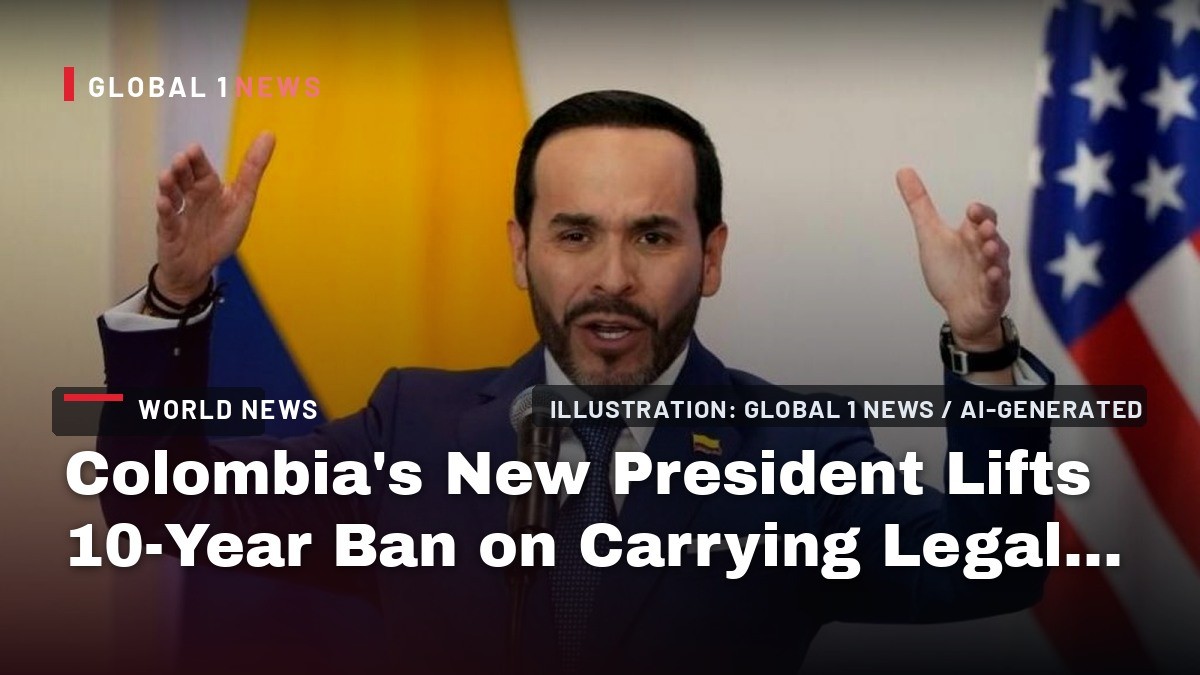
Colombia’s new president, Abelardo de la Espriella, has signed a decree that will allow nearly 700,000 legally registered gun owners to carry their firearms in public for the first time in a decade, fulfilling a hardline campaign promise and immediately igniting a fierce political and security debate. The measure, signed this week in Barranquilla, lifts a suspension first imposed in December 2015 by then-President Juan Manuel Santos as a temporary holiday-season measure, but which was extended year after year by three successive presidents from across the political spectrum. De la Espriella, who swept to power on an “iron fist” anti-crime platform, framed the decision as a matter of citizen self-defense, while critics warn it will flood the streets with weapons that will inevitably fall into criminal hands.
Colombia’s New President Lifts 10-Year Ban on Carrying Legal Firearms in Public, Sparking Security Debate
Bogota, Colombia - The decree, signed by President Abelardo de la Espriella on Tuesday, effectively ends a restriction that had been renewed annually since December 2015, meaning that even Colombians holding a valid permit to carry a gun were barred from taking it outside their homes without seeking additional, case-by-case authorization from authorities. The new rule removes that bureaucratic hurdle, allowing permit holders to carry their registered weapons in public as long as their permits remain up to date. The move reverses a restriction that had become a rare point of consensus across Colombia's political divide - and sets up a high-stakes test of whether more legal guns make Colombians safer or arm the criminals the president vows to crush.
A Campaign Promise Kept, an Iron Fist Extended
President de la Espriella made the announcement on Tuesday in the Caribbean port city of Barranquilla. In his remarks, the president framed the decision as a matter of basic justice, arguing that the state had for too long left law-abiding citizens defenseless against heavily armed criminal organizations. “It is not right that criminals are armed to the teeth while decent people can’t defend themselves,” de la Espriella said, according to remarks reported by the BBC. He insisted that the decree would not create a “free-for-all,” emphasizing that the existing, stringent controls over who can legally own a gun in Colombia would remain fully in place.
The signing was a direct fulfillment of a promise that defined his campaign. “A man’s word is his honour, and I have honour, that’s why I keep my word,” the president declared, casting the decree as a personal and political victory. For de la Espriella, who ran on a platform of restoring public order with an iron fist, the decree is the most visible expression of that promise to date.
The Decade-Long Suspension: A Temporary Measure That Became Permanent
The restriction that de la Espriella has now dismantled was born as a stopgap. In December 2015, President Juan Manuel Santos, then navigating the final, delicate stages of peace negotiations with the FARC rebel group, imposed a temporary suspension on the public carrying of legal firearms. The stated goal was narrow: to reduce violence during the Christmas and New Year festivities. The measure was never intended to be permanent, but it proved politically expedient to renew it year after year.
What followed was a remarkable political convergence. Santos, a center-right Nobel Peace Prize laureate, was succeeded by Iván Duque, a conservative who campaigned on a law-and-order platform and was deeply skeptical of the peace process. Duque, in turn, was followed by Gustavo Petro, a former guerrilla and the country’s first left-wing president, who promised sweeping social reforms. Despite their profound ideological differences, all three men chose to extend the suspension annually, effectively making it a permanent feature of Colombian gun policy. That cross-spectrum consensus suggests successive governments saw the suspension as a prudent curb on the number of guns on the streets, even if it inconvenienced legal owners.
Who Is Affected? The 700,000 Permit Holders
The practical impact of the decree is significant. According to a report from the Spanish newspaper El País, the change will affect almost 700,000 people in Colombia who currently hold a valid permit to carry a gun. For a decade, these individuals were effectively confined to keeping their weapons at home. To carry them in public, they were required to apply for and receive a separate, case-by-case authorization.
Under the new decree, that additional layer of bureaucracy is gone. Permit holders can now legally carry their registered firearms in public spaces, provided their permits remain valid and up to date. The decree does not alter the requirements for obtaining a permit in the first place, nor does it expand the categories of people eligible to own guns. It simply removes the extra hurdle that had been placed on top of the existing permit system. For the government, this is a matter of consistency: if the state has deemed someone fit to own a gun, it argues, why should it then bar them from carrying it for self-defense?
Critics Cry Foul: A ‘Grave Error’ and an Ethical Dilemma
Opposition to the decree was immediate and sharp, led by Senator Ariel Avila of the Green Alliance Party. Avila, a prominent voice on security issues, described the move as a “grave error,” arguing that the logic of the measure is fundamentally flawed. His central concern is the leakage of legal weapons into the criminal underworld. “Legally held guns will end up in the hands of criminals,” Avila warned.
Avila also framed the issue in ethical terms, arguing that the state has a monopoly on the legitimate use of force and that this monopoly should not be diluted. “It should only be state forces that carry guns and act as guarantors of people’s security,” he said. For Avila and his allies, the decree represents a dangerous shift toward a privatized model of security.
Government Defends the Measure: Targeting Illegal Guns, Not Legal Ones
The government has pushed back hard against these criticisms, insisting that the decree will not negatively affect security. President de la Espriella sought to reframe the debate, arguing that the real threat to public safety comes not from legal gun owners, but from the vast arsenal of illegal weapons in the hands of criminal organizations. To underscore this point, he cited the government’s security forces’ achievements this year, noting that they have seized more than 15,000 firearms so far in 2026. According to the president, the vast majority of these weapons belonged to members of breakaway factions of the FARC rebel group and the Gulf Clan (Clan del Golfo), the country’s most powerful drug-trafficking gang.
The government's argument is that aggressive enforcement against the illegal arms trade, combined with new rights for legal owners, will improve public security - an appeal to Colombians who feel abandoned by the state in high-crime areas.
A Regional Pendulum: Echoes from Brazil’s Gun Policy Debate
For those of us watching from Brazil, the Colombian debate has a deeply familiar ring. We have lived our own gun-policy pendulum over the past two decades. In 2003, Brazil enacted a comprehensive Disarmament Statute that imposed strict controls on gun ownership and carrying, and for years, gun-related deaths fell significantly. Then, under President Jair Bolsonaro, a series of decrees and regulatory changes loosened those restrictions, making it easier for citizens to acquire and carry firearms, on the theory that an armed citizenry would deter crime. More recently, under President Luiz Inácio Lula da Silva, the government has moved to re-tighten those rules, reimposing restrictions on calibers, magazine capacities, and the number of guns an individual can own.
The Colombian decree mirrors the Bolsonaro-era logic: that the state cannot protect everyone, and that law-abiding citizens should have the tools to defend themselves. But the Brazilian experience offers a cautionary tale: the promised benefits of widespread civilian armament did not clearly materialize, and the pendulum has swung back toward restriction under Lula. Whether Colombia follows a similar trajectory remains to be seen, but the parallels are impossible to ignore for those of us who have watched this debate play out at home.
What Happens Next: A High-Stakes Gamble
The decree is now in effect, but its long-term consequences are far from certain. The government will be watching crime statistics closely, particularly in urban centers like Bogotá, Medellín, and Cali. If the measure leads to a spike in homicides or in weapons stolen from legal owners, the political calculus could shift quickly; if crime remains stable or declines, de la Espriella will claim vindication.
For now, however, the president has the upper hand. He has delivered on a core campaign promise, and his supporters celebrate a victory for individual liberty and self-defense, while his detractors predict more weapons will end up in criminal hands. The coming months will provide the first real data points in this high-stakes experiment - and all of Latin America will be watching whether arming the "decent people" of Colombia makes the country safer or simply adds fuel to a fire that has burned for decades.
This article was produced with AI-assisted research and editorial support. Sources: BBC News (Colombia's new president loosens gun control rules, Sept 9 2026).
By Elena Vasquez, Staff Writer
What's Your Reaction?
 Like
0
Like
0
 Dislike
0
Dislike
0
 Love
0
Love
0
 Funny
0
Funny
0
 Wow
0
Wow
0
 Sad
0
Sad
0
 Angry
0
Angry
0

Latin America Correspondent at Global1.News. Based in Mexico City, covering politics, economics, energy, and culture across the region. Brings an on-the-ground perspective to stories spanning from the Rio Grande to Patagonia.














Comments (0)