
Chinese Executives May Join Xi's US Trip as Trade Truce Extension Nears
Chinese and US officials are discussing whether business leaders will join President Xi Jinping's delegation to Washington for his September 24 summit with Donald Trump, with sources telling the South China Morning Post that an extension of the Busan trade truce is almost certain. Beijing wants a...
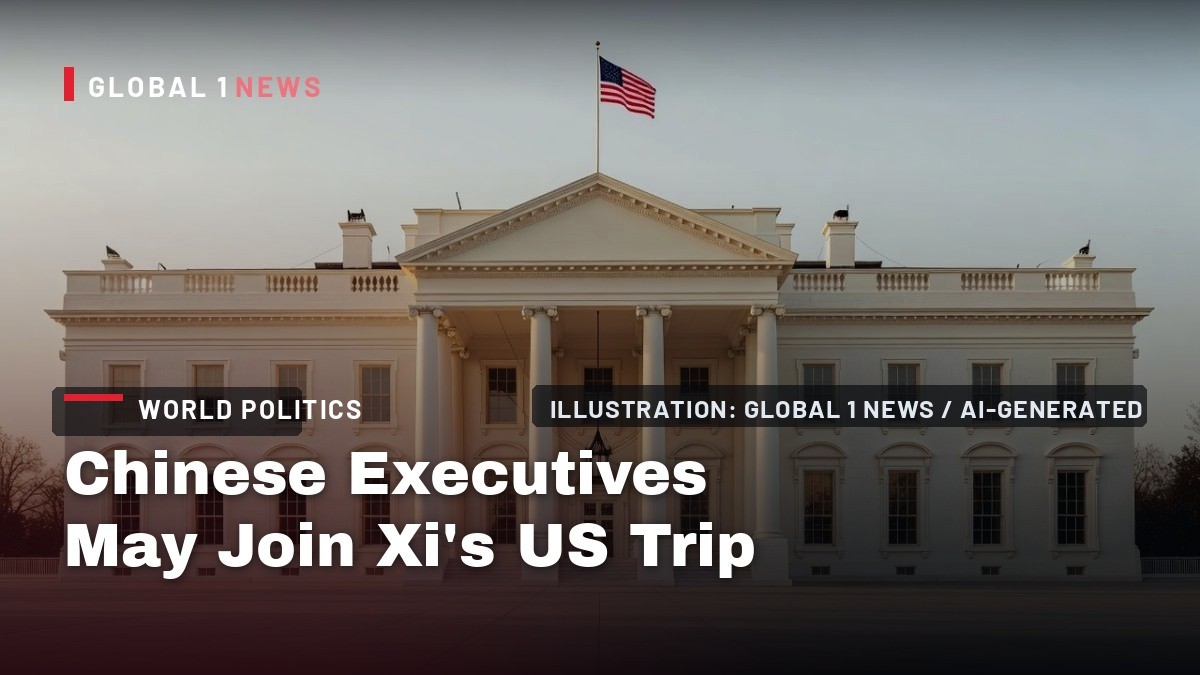
Beijing, Washington Weigh Business Delegation for September Summit
Tokyo - Chinese and US officials are discussing whether business leaders will join President Xi Jinping's delegation to Washington next month, as the two sides prepare to extend the one-year trade agreement reached in Busan last October, according to people familiar with the talks.
Xi is expected to meet President Donald Trump in Washington on September 24 for his first US state visit in more than a decade. The summit follows Trump's May journey to Beijing, which carried the heads of Tesla, Apple, Nvidia and Boeing, and both capitals are now weighing a reciprocal business presence, four people with knowledge of the discussions said.
The diplomatic groundwork is being laid. In a meeting with US ambassador David Perdue in Beijing on Wednesday, Foreign Minister Wang Yi called for both sides to implement the leaders' consensus, manage differences and remove obstacles to high-level exchanges so ties could become "stable, healthy and sustainable." Perdue said Trump and Xi had provided "important strategic guidance," described the May visit as "very successful," and later wrote on social media that the talks were part of preparations for Xi's visit.
Reciprocity After Trump's May Visit
The delegation talks are being framed around reciprocity, sources said, though accounts differed as to which side was driving the request. Two sources said Beijing was eager to bring executives, noting that many Chinese companies remained interested in investing in the United States. One described the discussion as pointing to China's interest in accelerating talks on the stalled Board of Investment, one of the key announcements from the May summit.
Another source said companies covered by the Board of Trade agreement could join the delegation, since the pact directly related to their business interests. The Board of Trade, a second major outcome from the Beijing summit, is in the final stages of being set up, focusing on identifying non-sensitive sectors and products eligible for tariff-reduced trade capped at US$30 billion for each side.
A person close to the talks said a delegation could help shift the relationship from confrontation toward managed economic competition, giving Chinese and American business leaders space to build ties alongside the political summit. A separate source, however, said the delegation had been requested by Washington. A final decision has yet to be reached.
The business delegation and the trade talks are unfolding in parallel, with both governments looking for concrete outcomes from the September summit as they manage trade and investment ties that have swung between detente and retaliation for more than a year.
The Busan Truce and the Extension Question
Both sides are also preparing to extend the trade truce agreed in Busan, South Korea, in October 2025. That deal reduced some US tariffs on Chinese goods, suspended additional US restrictions on Chinese-affiliated companies, paused certain Chinese rare earth export controls for a year, and secured Chinese commitments on American soybeans and fentanyl precursors. The agreement lowered US tariffs on Chinese imports from roughly 57 percent to 47 percent, according to trade data tracked through early 2026, even as bilateral trade continued to decline.
Sources said an extension was likely, or "almost certain," despite recent retaliatory measures and actions by the US Federal Communications Commission, but the two sides disagreed over its duration. Beijing preferred an extension running through the end of Trump's presidency, seeking to "lock in" what it viewed as a favourable agreement, while Washington was seeking another one-year deal. One source said the Trump administration was "playing coy" over the length of the extension to create an impression of leverage.
The agreement is set to be extended for one year, according to one source. Some officials expect it to be announced quietly or folded into a broader economic understanding, so the deal does not become the summit's centrepiece. One source said US concerns over rare earth supply flows could be addressed through dialogue and that the Busan deal was not expected to be given prominence during the summit itself.
Japan's Stake in the Rare Earth Pause
No country outside the two principals watches the truce extension more closely than Japan. China supplies about 80 percent of Japan's rare earth imports, and Beijing's one-year pause on export controls - part of the Busan deal - has been a rare period of relief for Japanese manufacturers of magnets, electric vehicles and precision machinery.
The fragility of that arrangement was on display earlier this year. Corporate Japan sounded alarms in March and April after Chinese export controls cut rare earth shipments by more than 80 percent year on year, choking off materials essential to EV motors and missile guidance systems. Japan received no dysprosium or terbium oxide shipments from China between November 2025 and May 2026, and remains more than 70 percent dependent on Chinese rare earth supplies despite years of diversification, according to industry analysis.
A longer truce would therefore be a quiet win for Tokyo, stabilising a supply chain that Japanese industry considers dangerously concentrated in Chinese hands. A return to export controls would immediately threaten Japan's EV battery and defence electronics sectors - stakes that give Japan a direct interest in how long the extension runs, and in whether Beijing treats the pause as a one-time concession or a standing policy.
Low-Level Friction Continues Despite the Truce
The search for stability does not mean an end to friction. The FCC last month banned the import and sale of new foreign-made robotic devices and power inverters, sectors in which China is a global leader, adding the categories to its Covered List on July 28. The rule applies regardless of the producer's nationality, which means Japanese robotics and inverter exporters face the same new authorisation bar as their Chinese rivals, even as China's humanoid makers hold more than 97 percent of global shipments in the first half of 2026.
Washington also added more than 40 Chinese companies to its Uyghur Forced Labour Prevention Act entity list the same month, and Beijing retaliated by tightening export controls on drones and sanctioning seven American firms. Tariff pressure continues as well. The Trump administration has signalled Section 301 tariffs on excess industrial capacity against 16 economies, including China, and last month imposed tariffs of 10 to 12.5 percent on goods from 60 economies under its forced-labour probe, with China facing the 12.5 percent rate. Beijing opposed the move but did not retaliate.
Washington has conveyed to Beijing that the additional tariffs are simply replacing import levies struck down by the US Supreme Court in February, and sources said the new measures were unlikely to adversely affect Xi's visit. Both sides are actively trying to insulate the September meeting from disputes across multiple sectors, seeking to prevent existing and new disagreements from derailing the broader effort to stabilise bilateral ties.
What a Longer Truce Means for Asia
For the region, an extended truce would validate what Asian officials have quietly argued since Busan: that managed US-China competition is preferable to open economic warfare. Japan, South Korea and Southeast Asian economies have all suffered supply-chain shock waves triggered by tariffs, export controls and rare earth restrictions, and a predictable extension would reduce the uncertainty that has weighed on regional investment decisions through 2026.
The stakes for Tokyo are strategic as well as commercial. A durable US-China detente reduces the pressure on Japan to choose between its security alliance with Washington and its deep economic ties with Beijing, even as the two giants continue to compete in semiconductors, robotics and critical minerals. For Japanese companies operating inside China, a longer truce also means fewer sudden rule changes and more calculable capacity planning.
There are limits to the calm: neither capital expects a strategic reconciliation, and sources said Washington was not seeking any major breakthrough. The extension is best understood as an acknowledgement that both economies benefit from a predictable floor under the relationship - not as a sign that the structural competition between the world's two largest economies has eased.
What to Watch For
The first signal will be the composition of the delegation, if one is confirmed. Whether Beijing or Washington is seen as the driving force will shape perceptions of who needs the summit more, and which companies are chosen will reveal which sectors the two governments want to protect from the broader rivalry.
The second signal is the length of the truce extension. A one-year renewal would simply roll the uncertainty forward, while a longer commitment - running through the end of Trump's presidency, as Beijing has proposed - would mark a genuine step toward managed economic competition. Chinese and American business leaders, and their counterparts across Asia, will be watching both developments closely in the run-up to September 24. For Japan, the clearest marker will be whether the rare earth pause survives the extension talks, and for how long.
By Kenji Tanaka, Staff Writer
This article was produced with AI-assisted research and editorial support. Sources: South China Morning Post, FCC, Al Jazeera, Global Times.
What's Your Reaction?
 Like
0
Like
0
 Dislike
0
Dislike
0
 Love
0
Love
0
 Funny
0
Funny
0
 Wow
0
Wow
0
 Sad
0
Sad
0
 Angry
0
Angry
0
Japan Correspondent at Global1.News. Tokyo-based voice covering Japanese politics, technology, economy, and culture. Tracks the intersection of tradition and innovation in one of the world's most dynamic societies.














Comments (0)